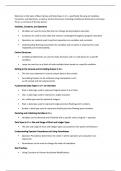
Welcome to the topic of Basic Syntax and Data Types in C++, specifically focusing on Variables,
Constants, and Operators, as well as Control Structures including Conditional Statements and Loops.
Here's a summary of the key points:
Variables, Constants, and Operators
Variables are used to store data that can change during program execution.
Constants are used to store data that remains unchanged throughout program execution.
Operators are symbols used to perform operations on variables and constants.
Understanding Naming Conventions for variables and constants is important for code
readability and maintainability.
Control Structures
Conditional Statements are used to make decisions and run code based on a specific
condition.
Loops are used to run a block of code multiple times based on a specific condition.
Writing to the Console and Formatting Output in C++
The std::cout statement is used to output data to the console.
Formatting Output can be achieved using manipulators such
as std::setw() and std::setprecision().
Fundamental Data Types in C++: An Overview
bool: a data type used to represent logical values true or false.
char: a data type used to represent a single character.
int: a data type used to represent integers.
float: a data type used to represent single-precision floating-point numbers.
double: a data type used to represent double-precision floating-point numbers.
Declaring and Initializing Variables in C++
Variables can be declared and initialized with a specific value using the = operator.
Data Types in C++: Size and Range of Short and Integer Types
The size and range of short and integer types vary based on the system architecture.
Understanding Operator Precedence and Using Parentheses
Operator Precedence determines the order in which operators are evaluated in an
expression.
Parentheses can be used to change the order of evaluation.
Best Practices
Using Constants to Prevent Accidental Modifications.
Constants, and Operators, as well as Control Structures including Conditional Statements and Loops.
Here's a summary of the key points:
Variables, Constants, and Operators
Variables are used to store data that can change during program execution.
Constants are used to store data that remains unchanged throughout program execution.
Operators are symbols used to perform operations on variables and constants.
Understanding Naming Conventions for variables and constants is important for code
readability and maintainability.
Control Structures
Conditional Statements are used to make decisions and run code based on a specific
condition.
Loops are used to run a block of code multiple times based on a specific condition.
Writing to the Console and Formatting Output in C++
The std::cout statement is used to output data to the console.
Formatting Output can be achieved using manipulators such
as std::setw() and std::setprecision().
Fundamental Data Types in C++: An Overview
bool: a data type used to represent logical values true or false.
char: a data type used to represent a single character.
int: a data type used to represent integers.
float: a data type used to represent single-precision floating-point numbers.
double: a data type used to represent double-precision floating-point numbers.
Declaring and Initializing Variables in C++
Variables can be declared and initialized with a specific value using the = operator.
Data Types in C++: Size and Range of Short and Integer Types
The size and range of short and integer types vary based on the system architecture.
Understanding Operator Precedence and Using Parentheses
Operator Precedence determines the order in which operators are evaluated in an
expression.
Parentheses can be used to change the order of evaluation.
Best Practices
Using Constants to Prevent Accidental Modifications.