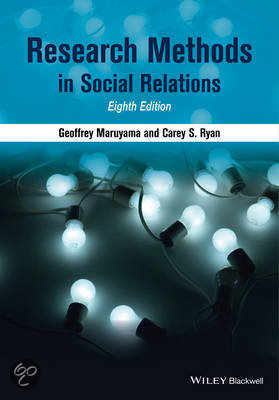
Research Methods in Social Relations ch. 8 Evaluating the
Construct Validity of Measures – G. Maruyama & C.S. Ryan
(2014)
Using multiple methods of measurement increases the reliability and validity by reducing errors tied
to specific measurement techniques (common method variance).
Indirect methods of measurement are measures that do not use direct questioning:
Collateral reports: Use third-party responses to a questionnaire or interview by informants,
people close to the participants, to reduce bias in self-reporting. Challenges include
discrepancies between sources and higher costs.
Observation: Uses trained judges to assess behaviours objectively, avoiding participant bias.
It’s useful for cases where self-report is unreliable but lacks strong causal inference and may
not capture internal constructs like emotions.
Physiological measures: Assess internal states (e.g., emotions) through bodily systems. They
provide objective data but require managing large data volumes and expensive equipment.
Implicit Association Test (IAT): Measures unconscious attitudes via response times to
attribute-concept pairings.
Card Sort: Participants categorize descriptive cards to reveal complex self-perceptions or
social group views.
Autophotography/photovoice: Participants take photos of their experiences, which are
analysed to gain insights into their identity and social connections.
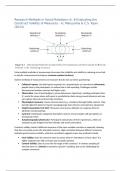
Construct validity checks if different measures of the same variable correlate as expected, showing
that they accurately assess the intended construct. High correlation between different measures
indicates good construct validity, while low correlation suggests issues. Key methods include:
Face Validity: Does the measure seem to assess what it's intended to at face value? It is
highly subjective but still necessary due to public opinions.
Content Validity: Does it cover the full range of the construct? It involves sampling all
relevant items in a domain to examine a person’s standing, but can be challenging for
complex constructs.
Construct Validity of Measures – G. Maruyama & C.S. Ryan
(2014)
Using multiple methods of measurement increases the reliability and validity by reducing errors tied
to specific measurement techniques (common method variance).
Indirect methods of measurement are measures that do not use direct questioning:
Collateral reports: Use third-party responses to a questionnaire or interview by informants,
people close to the participants, to reduce bias in self-reporting. Challenges include
discrepancies between sources and higher costs.
Observation: Uses trained judges to assess behaviours objectively, avoiding participant bias.
It’s useful for cases where self-report is unreliable but lacks strong causal inference and may
not capture internal constructs like emotions.
Physiological measures: Assess internal states (e.g., emotions) through bodily systems. They
provide objective data but require managing large data volumes and expensive equipment.
Implicit Association Test (IAT): Measures unconscious attitudes via response times to
attribute-concept pairings.
Card Sort: Participants categorize descriptive cards to reveal complex self-perceptions or
social group views.
Autophotography/photovoice: Participants take photos of their experiences, which are
analysed to gain insights into their identity and social connections.
Construct validity checks if different measures of the same variable correlate as expected, showing
that they accurately assess the intended construct. High correlation between different measures
indicates good construct validity, while low correlation suggests issues. Key methods include:
Face Validity: Does the measure seem to assess what it's intended to at face value? It is
highly subjective but still necessary due to public opinions.
Content Validity: Does it cover the full range of the construct? It involves sampling all
relevant items in a domain to examine a person’s standing, but can be challenging for
complex constructs.