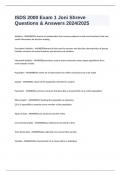
ISDS 2000 Exam 1 Joni Shreve
Questions & Answers 2024/2025
Statistics - ANSWERSThe branch of mathematics that uncovers patterns in data and transforms that into
useful information for decision making
Descriptive Statistics - ANSWERSNumerical data used to measure and describe characteristics of groups.
Includes measures of central tendency and measures of variation.
Inferential Statistics - ANSWERSprocedures used to draw conclusions about larger populations from
small samples of data
Population - ANSWERSthe entire set of observations for which conclusions are to be made
Sample - ANSWERSa subset of the population selected for analysis
Parameter - ANSWERSa summary measure that describes a characteristic of an entire population
Why sample? - ANSWERS(1) Studying the population is expensive
(2) It is impossible to examine every member of the population
Types of Data - ANSWERScross sectional and time series
Cross-Sectional Data - ANSWERSdata collected at one point in time
Time Series Data - ANSWERSdata collected over several time periods
Variable - ANSWERSThe characteristic of an observation or individual
, Data - ANSWERSthe values associated with a variable
Types of variables - ANSWERScategorical and quantitative
Categorical Variables - ANSWERSAlso known as qualitative
Values that can be placed into categories
Quantitative Variables - ANSWERSValues that represent quantities
Can be discrete or continuous
Quantitative discrete variables - ANSWERSresult of counting (whole numbers)
Quantitative continuous variables - ANSWERSmeasurements can take on infinitely many values within an
interval (decimal values)
Scales of Measure - ANSWERSNominal
Ordinal
Interval
Ratio
nominal measurement scale - ANSWERSmost basic: classify responses into categories
ex: gender, race, religion, marital status
ordinal measurement scale - ANSWERScompares categories
ex: movie ratings, surveys (question with scales like "highly satisfied" or "1-good, 2-fair...")
Questions & Answers 2024/2025
Statistics - ANSWERSThe branch of mathematics that uncovers patterns in data and transforms that into
useful information for decision making
Descriptive Statistics - ANSWERSNumerical data used to measure and describe characteristics of groups.
Includes measures of central tendency and measures of variation.
Inferential Statistics - ANSWERSprocedures used to draw conclusions about larger populations from
small samples of data
Population - ANSWERSthe entire set of observations for which conclusions are to be made
Sample - ANSWERSa subset of the population selected for analysis
Parameter - ANSWERSa summary measure that describes a characteristic of an entire population
Why sample? - ANSWERS(1) Studying the population is expensive
(2) It is impossible to examine every member of the population
Types of Data - ANSWERScross sectional and time series
Cross-Sectional Data - ANSWERSdata collected at one point in time
Time Series Data - ANSWERSdata collected over several time periods
Variable - ANSWERSThe characteristic of an observation or individual
, Data - ANSWERSthe values associated with a variable
Types of variables - ANSWERScategorical and quantitative
Categorical Variables - ANSWERSAlso known as qualitative
Values that can be placed into categories
Quantitative Variables - ANSWERSValues that represent quantities
Can be discrete or continuous
Quantitative discrete variables - ANSWERSresult of counting (whole numbers)
Quantitative continuous variables - ANSWERSmeasurements can take on infinitely many values within an
interval (decimal values)
Scales of Measure - ANSWERSNominal
Ordinal
Interval
Ratio
nominal measurement scale - ANSWERSmost basic: classify responses into categories
ex: gender, race, religion, marital status
ordinal measurement scale - ANSWERScompares categories
ex: movie ratings, surveys (question with scales like "highly satisfied" or "1-good, 2-fair...")