🖊️
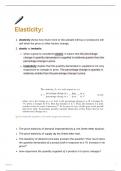
Elasticity:
1. elasticity shows how much more or less people will buy or producers will
sell when the price or other factors change.
2. elastic vs inelastic:
when a good is considered elastic, it means that the percentage
change in quantity demanded or supplied is relatively greater than the
percentage change in price.
inelasticity implies that the quantity demanded or supplied is not very
responsive to changes in price. The percentage change in quantity is
relatively smaller than the percentage change in price.
😊 this elasticity equation is for both supply and demand.
The price elasticity of demand (represented by ε, the Greek letter epsilon).
The price elasticity of supply (η, the Greek letter eta).
The elasticity of demand concisely answers the question “How much does
the quantity demanded of a product fall in response to a 1% increase in its
price?”
how responsive the quantity supplied of a product is to price changes?
Elasticity: 1
, as the value gets closer to 0, the elasticity becomes lower.
the elasticity changes along the demand/supply curve.
how to calculate the percent change:
percentage change= (new value-initial value/initial value)
×100 If the result is
positive, it indicates an increase, and if it's negative, it
indicates a decrease.
example:
if the initial value of a quantity is $50, and it increases to $60,
the percentage change would be calculated as follows:
percentagechange =(60 − 50/50) × 100 = 20%
so the quantity has increased by 20%
🔒 the elasticity of demand coefficient is the % change in Q divided by
the % change in P. % change in Q/% change in P
calculate the price elasticity of demand/supply (PED&PES):
1. the PED (ε) and PES (η) are:
the percentage change that will occur in the quantity demanded or supplied
in response to a 1% change in price.
Elasticity: 2
Elasticity:
1. elasticity shows how much more or less people will buy or producers will
sell when the price or other factors change.
2. elastic vs inelastic:
when a good is considered elastic, it means that the percentage
change in quantity demanded or supplied is relatively greater than the
percentage change in price.
inelasticity implies that the quantity demanded or supplied is not very
responsive to changes in price. The percentage change in quantity is
relatively smaller than the percentage change in price.
😊 this elasticity equation is for both supply and demand.
The price elasticity of demand (represented by ε, the Greek letter epsilon).
The price elasticity of supply (η, the Greek letter eta).
The elasticity of demand concisely answers the question “How much does
the quantity demanded of a product fall in response to a 1% increase in its
price?”
how responsive the quantity supplied of a product is to price changes?
Elasticity: 1
, as the value gets closer to 0, the elasticity becomes lower.
the elasticity changes along the demand/supply curve.
how to calculate the percent change:
percentage change= (new value-initial value/initial value)
×100 If the result is
positive, it indicates an increase, and if it's negative, it
indicates a decrease.
example:
if the initial value of a quantity is $50, and it increases to $60,
the percentage change would be calculated as follows:
percentagechange =(60 − 50/50) × 100 = 20%
so the quantity has increased by 20%
🔒 the elasticity of demand coefficient is the % change in Q divided by
the % change in P. % change in Q/% change in P
calculate the price elasticity of demand/supply (PED&PES):
1. the PED (ε) and PES (η) are:
the percentage change that will occur in the quantity demanded or supplied
in response to a 1% change in price.
Elasticity: 2