

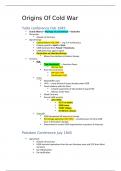
Origins Of Cold War
Yalta conference Feb 1945
Grand Alliance = Marriage of convenience— Deutscher
Discussion
Division of Germany
Agreementgv
United Nations Feb 1945 — org. For world peace
Poland expand to North + West
USSR took land from Poland + Manchuria
USSR joined war against Japan
Declaration on Liberated Europe
Allows free elections in Eastern Europe
Tensions
FDR
“Pax Americana” — American Peace
UN Feb 1945
Econ. Reconstruction
IMF July 1944
World bank 1944
Stalin
Want Buffer zone
1945 — many Eastern Europe already under USSR
Good relations with the West
A-bomb superiority of USA (ended in Aug 1949)
Alliance of the West
Weak Germany
Ensure USSR security
After WW2
25-27 m deaths
2000 towns
70000 villages
65 000 km railways
Churchill
USSR threatened UK interest in Europe
Percentage agreement Oct 1944 — predominance of UK & USSR
have in the Eastern Europe
Determined to control USSR expansionism to protect uk interests
Potsdam Conference July 1945
Agreement
Division of Germany
USSR received reparations from its own Germany zone and 25% from West
Germany
De-militarisation
De-nazification
, Re-establishment of democracy in Germany
Tensions
Stalin
broke the Declaration on Liberated Europe
Provisional Govt. of National unity in Poland June 1945
Weaken Germany
Convinced that Truman = anti-USSR
A-bomb superiority of USA threatened the security of USSR
Truman
Convinced that Stalin did not accept the Diplomatic solution , may
use force to make USSR corporate
Do not want another TOV
Eastern Europe 1945 -1948
Poland
June 1945 — Provisional Govt. of Liberated unity (Lublin Govt.)
Bulgaria
April 1947 — Banned all parties
Romania
Dec 1947 — King Michael = forced to abolish
Feb 1948 — Romanian Workers Party
Czechoslovakia
March 1948 — Jan Masaryk ( foreign minister — promote democracy)
found death under a closed window
Yugoslavia
June 1948 — Tito = expelled from Cominform (Sept 1947)
Long Telegram Feb 1946
Kenan — US embassy in Moscow
Lengthy dispatch to US department in Washington
Main:
USSR view West = hostile
USSR policy = Aggressive
US needs to prepare the use of force to contain communism
Required Containment
Peaceful relations = unlikely
Prosperity in Europe = undermine USSR influence
Significance:
Shifted US roles to global power
Containment
Econ. Assistance in Europe — June 1947 Marshall Plan
Confirmed Truman’s view — USSR threatened USA interests
Abandoned negotiations with USSR
Sept 1947 — Zhandov Doctrine — emphasise the division of the world into 2
opposing camp
Shaped USSR foreign policy 4e
Yalta conference Feb 1945
Grand Alliance = Marriage of convenience— Deutscher
Discussion
Division of Germany
Agreementgv
United Nations Feb 1945 — org. For world peace
Poland expand to North + West
USSR took land from Poland + Manchuria
USSR joined war against Japan
Declaration on Liberated Europe
Allows free elections in Eastern Europe
Tensions
FDR
“Pax Americana” — American Peace
UN Feb 1945
Econ. Reconstruction
IMF July 1944
World bank 1944
Stalin
Want Buffer zone
1945 — many Eastern Europe already under USSR
Good relations with the West
A-bomb superiority of USA (ended in Aug 1949)
Alliance of the West
Weak Germany
Ensure USSR security
After WW2
25-27 m deaths
2000 towns
70000 villages
65 000 km railways
Churchill
USSR threatened UK interest in Europe
Percentage agreement Oct 1944 — predominance of UK & USSR
have in the Eastern Europe
Determined to control USSR expansionism to protect uk interests
Potsdam Conference July 1945
Agreement
Division of Germany
USSR received reparations from its own Germany zone and 25% from West
Germany
De-militarisation
De-nazification
, Re-establishment of democracy in Germany
Tensions
Stalin
broke the Declaration on Liberated Europe
Provisional Govt. of National unity in Poland June 1945
Weaken Germany
Convinced that Truman = anti-USSR
A-bomb superiority of USA threatened the security of USSR
Truman
Convinced that Stalin did not accept the Diplomatic solution , may
use force to make USSR corporate
Do not want another TOV
Eastern Europe 1945 -1948
Poland
June 1945 — Provisional Govt. of Liberated unity (Lublin Govt.)
Bulgaria
April 1947 — Banned all parties
Romania
Dec 1947 — King Michael = forced to abolish
Feb 1948 — Romanian Workers Party
Czechoslovakia
March 1948 — Jan Masaryk ( foreign minister — promote democracy)
found death under a closed window
Yugoslavia
June 1948 — Tito = expelled from Cominform (Sept 1947)
Long Telegram Feb 1946
Kenan — US embassy in Moscow
Lengthy dispatch to US department in Washington
Main:
USSR view West = hostile
USSR policy = Aggressive
US needs to prepare the use of force to contain communism
Required Containment
Peaceful relations = unlikely
Prosperity in Europe = undermine USSR influence
Significance:
Shifted US roles to global power
Containment
Econ. Assistance in Europe — June 1947 Marshall Plan
Confirmed Truman’s view — USSR threatened USA interests
Abandoned negotiations with USSR
Sept 1947 — Zhandov Doctrine — emphasise the division of the world into 2
opposing camp
Shaped USSR foreign policy 4e



