Human Physiology Transport Systems
Muscular System Basics Overview
Primary Function: Chemical Energy Mechanical Energy
Done by:
1.) Equilibrium: Posture/no movement
2.) Force: Change in velocity of muscle shortening (F=ma)
3.) Work: Displacement in direction of force (w=Fs)
4.) Transport: Circulation, digestion (contraction, relaxation)
5.) Heat production: body temp. regulation (shivering reflex)
General Properties
1.) Nucleated cells
2.) Contractability (voluntary/involuntary)
3.) Pacemaker Capacity: capable of generating action potentials that initiate muscle
contraction
- Modulated (NOT initiated) by ANS
Special Properties
1.) Excitability – producing action potentials in response to stimuli
2.) Contractability – action potentials forceful contractions
- Muscle contraction = change in velocity of muscle shortening = force =
movement
- The greater the change in velocity of muscle fiber shortening = greater
contraction force (F=ma)
3.) Extensibility – stretch with no damage
- Connective tissues keep contractile range with no damage
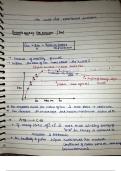
- Too much or too little overlap of thick and think filaments in resting muscle =
decreased tension
4.) Elasticity – return to original length/shape after contraction/extension
- Titin: accessory protein, from Z disk to M line, stabilizes myosin
5.) Adaptability – adults = post mitotic muscle fibres have little turnover
- Hypertrophy: muscle growth through exercise (muscle plasticity)
- Atrophy : muscle degradation
Skeletal Muscle Plasticity Properties
1.) Force of contraction
2.) Contraction speed
3.) Endurance
4.) Oxidative/glycolytic capacity
a. Amount of energy reserved in muscles
b. Rate of energy consumption
c. Rate of energy production
d. Size of muscle
e. Velocity of muscle shortening
Muscular System Basics Overview
Primary Function: Chemical Energy Mechanical Energy
Done by:
1.) Equilibrium: Posture/no movement
2.) Force: Change in velocity of muscle shortening (F=ma)
3.) Work: Displacement in direction of force (w=Fs)
4.) Transport: Circulation, digestion (contraction, relaxation)
5.) Heat production: body temp. regulation (shivering reflex)
General Properties
1.) Nucleated cells
2.) Contractability (voluntary/involuntary)
3.) Pacemaker Capacity: capable of generating action potentials that initiate muscle
contraction
- Modulated (NOT initiated) by ANS
Special Properties
1.) Excitability – producing action potentials in response to stimuli
2.) Contractability – action potentials forceful contractions
- Muscle contraction = change in velocity of muscle shortening = force =
movement
- The greater the change in velocity of muscle fiber shortening = greater
contraction force (F=ma)
3.) Extensibility – stretch with no damage
- Connective tissues keep contractile range with no damage
- Too much or too little overlap of thick and think filaments in resting muscle =
decreased tension
4.) Elasticity – return to original length/shape after contraction/extension
- Titin: accessory protein, from Z disk to M line, stabilizes myosin
5.) Adaptability – adults = post mitotic muscle fibres have little turnover
- Hypertrophy: muscle growth through exercise (muscle plasticity)
- Atrophy : muscle degradation
Skeletal Muscle Plasticity Properties
1.) Force of contraction
2.) Contraction speed
3.) Endurance
4.) Oxidative/glycolytic capacity
a. Amount of energy reserved in muscles
b. Rate of energy consumption
c. Rate of energy production
d. Size of muscle
e. Velocity of muscle shortening