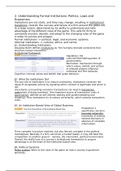
2. Understanding Formal Institutions: Politics, Laws and
Economics.
Institutions are not static, and they may change, resulting in institutional
transitions. Overall, the success and failure of a firm around the globe are,
to a large extent, determined by its ability to understand and take
advantage of the different rules of the game. This calls for firms to
constantly monitor, decode, and adapt to the changing rules of the game
in order to survive and prosper.
Formal institutions -> political, legal, and economic systems.
Informal institutions -> cultures, ethics, and norms.
§1. Understanding Institutions
Douglass North defines institutions as “the humanly devised constraints that
structure human interaction.”
Institutional framework:
regulatory: the
coercive/intimidating power of
governments.
Normative: mechanism through
which values, beliefs, and actions
of relevant players influence
individual and firm behavior.
Cognitive: internal values and beliefs that guide behavior.
§2. What Do Institutions Do?
The key role of institutions is to reduce uncertainty. Institutions constrain the
range of acceptable actions by signaling which conduct is legitimate and which is
not.
Uncertainty surrounding economic transactions can lead to transaction
costs(costs of doing business). One important source of transaction costs is
opportunism, defined as self-interest seeking with guile(misleading and
cheating). Thus institutions try to reduce uncertainty, which reduces transaction
costs.
§3. An Institution-Based View of Global Business
Proposition 1
specifically concerns
bounded rationality
(necessity of making
rational decisions in
absence of complete
information).
Firms compete in product markets, but also fiercely compete in the political
marketplace. Basically if a firm cannot be a market leader, it may still beat the
competition on another ground – namely, the nonmarket, political environment.
Overall, the skillful use of a country’s institutional frameworks to acquire
advantage is at the heart of the institution-based view.
§4. Political Systems
Politic system refers to the rules of the game on how a country is governed
politically.
Economics.
Institutions are not static, and they may change, resulting in institutional
transitions. Overall, the success and failure of a firm around the globe are,
to a large extent, determined by its ability to understand and take
advantage of the different rules of the game. This calls for firms to
constantly monitor, decode, and adapt to the changing rules of the game
in order to survive and prosper.
Formal institutions -> political, legal, and economic systems.
Informal institutions -> cultures, ethics, and norms.
§1. Understanding Institutions
Douglass North defines institutions as “the humanly devised constraints that
structure human interaction.”
Institutional framework:
regulatory: the
coercive/intimidating power of
governments.
Normative: mechanism through
which values, beliefs, and actions
of relevant players influence
individual and firm behavior.
Cognitive: internal values and beliefs that guide behavior.
§2. What Do Institutions Do?
The key role of institutions is to reduce uncertainty. Institutions constrain the
range of acceptable actions by signaling which conduct is legitimate and which is
not.
Uncertainty surrounding economic transactions can lead to transaction
costs(costs of doing business). One important source of transaction costs is
opportunism, defined as self-interest seeking with guile(misleading and
cheating). Thus institutions try to reduce uncertainty, which reduces transaction
costs.
§3. An Institution-Based View of Global Business
Proposition 1
specifically concerns
bounded rationality
(necessity of making
rational decisions in
absence of complete
information).
Firms compete in product markets, but also fiercely compete in the political
marketplace. Basically if a firm cannot be a market leader, it may still beat the
competition on another ground – namely, the nonmarket, political environment.
Overall, the skillful use of a country’s institutional frameworks to acquire
advantage is at the heart of the institution-based view.
§4. Political Systems
Politic system refers to the rules of the game on how a country is governed
politically.