3. Emphasizing Informal Institutions: Cultures, Ethics, and
Norms
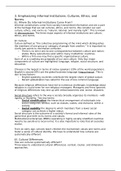
§1. Where Do Informal Institutions Come From?
Informal constitutions come from socially transmitted information and are a part
of the heritage that we call cultures, ethics, and norms. We consider our own
culture, ethics, and norms as “natural, rational, and morally right”. This is known
as ethnocentrism. The three major aspects of informal institutions are culture,
ethics, and norms.
§2. Culture
Culture defined as “the collective programming of the mind which distinguishes
the members of one group or category of people from another.” It is important to
clarify two points to minimalize confusion.
- There is no strict one-to-one correspondence between culture and nation-
states. Many subcultures exist within many multiethnic countries.
- Within a firm one may find a specific organizational culture.
Each of us is a walking encyclopedia of our own culture. Only four major
components of culture are highlighted: language, religion, social structure, and
education.
Chinese is the largest in terms of native speakers (20% of the world population).
English is second (8%) yet the global business language (lingua franca). This is
due to two factors:
- English-speaking countries contribute the largest share of global output.
- Recent globalization has called for the use of one common language.
Because religious differences have led to numerous challenges, knowledge about
religions is crucial even for non-religious managers. Managers and firms ignorant
of religious differences may end up with embarrassments and, worse, disasters.
Social structure refers to the way a society broadly organizes its members – with
rigidity or flexibility. Two key terms:
- Social stratification the hierarchical arrangement of individuals into
social categories (strata), such as classes, castes, and divisions, within a
society.
- Social mobility the degree to which members from a lower social
category can achieve a higher status.
Social structure is the outcome of a society’s formal and informal rules of the
game that give birth to its norms and values.
Multinational enterprises (MNEs) operating in highly socially stratified countries
need to be sensitive to local norms. It is also important to note that all societies
evolve.
From an early age, schools teach children the mainstream values and norms and
foster a sense of cultural identity. We have to understand how cultures are
systematically different.
§3. Cultural Differences
How are cultures systematically different?
Three ways to understand cultural differences: context, cluster, and dimension
approaches.
Norms
§1. Where Do Informal Institutions Come From?
Informal constitutions come from socially transmitted information and are a part
of the heritage that we call cultures, ethics, and norms. We consider our own
culture, ethics, and norms as “natural, rational, and morally right”. This is known
as ethnocentrism. The three major aspects of informal institutions are culture,
ethics, and norms.
§2. Culture
Culture defined as “the collective programming of the mind which distinguishes
the members of one group or category of people from another.” It is important to
clarify two points to minimalize confusion.
- There is no strict one-to-one correspondence between culture and nation-
states. Many subcultures exist within many multiethnic countries.
- Within a firm one may find a specific organizational culture.
Each of us is a walking encyclopedia of our own culture. Only four major
components of culture are highlighted: language, religion, social structure, and
education.
Chinese is the largest in terms of native speakers (20% of the world population).
English is second (8%) yet the global business language (lingua franca). This is
due to two factors:
- English-speaking countries contribute the largest share of global output.
- Recent globalization has called for the use of one common language.
Because religious differences have led to numerous challenges, knowledge about
religions is crucial even for non-religious managers. Managers and firms ignorant
of religious differences may end up with embarrassments and, worse, disasters.
Social structure refers to the way a society broadly organizes its members – with
rigidity or flexibility. Two key terms:
- Social stratification the hierarchical arrangement of individuals into
social categories (strata), such as classes, castes, and divisions, within a
society.
- Social mobility the degree to which members from a lower social
category can achieve a higher status.
Social structure is the outcome of a society’s formal and informal rules of the
game that give birth to its norms and values.
Multinational enterprises (MNEs) operating in highly socially stratified countries
need to be sensitive to local norms. It is also important to note that all societies
evolve.
From an early age, schools teach children the mainstream values and norms and
foster a sense of cultural identity. We have to understand how cultures are
systematically different.
§3. Cultural Differences
How are cultures systematically different?
Three ways to understand cultural differences: context, cluster, and dimension
approaches.