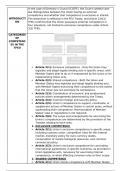
In the case of Germany v Council (COTIF), the Court's settled case-
law distinguishes between the Union having an external
competence and whether that competence is exclusive or shared.
INTRODUCTI The distinction is reflected in the FEU Treaty, and Article 216(1)
ON TFEU confirms that the Union possesses external competence in
four situations, not limited to exclusive competence under Article
3(2) TFEU.
CATEGORIES
OF categories
COMPETENC
ES IN THE
TFEU non-exclusive exlusive
competence cometence
shared parallel
competence competence
Article 2(1): Exclusive competence - Only the Union may
legislate and adopt legally binding acts in specific areas, with
Member States able to do so if empowered by the Union or for
implementing Union acts.
Article 2(2): Shared competence - Both the Union and
Member States may legislate and adopt legally binding acts,
with Member States exercising their competence to the extent
that the Union has not exercised its competence.
Article 2(3): Coordination of economic and employment
policies within arrangements determined by the Treaty.
Article 2(4): Common foreign and security policy.
Article 2(5): Union's competence to support, coordinate, or
supplement actions of Member States in certain areas, without
superseding their competence. Harmonization of Member
States' laws or regulations is not required.
Article 2(6): The scope and arrangements for exercising the
Union's competences are determined by the provisions of the
Treaties relating to each area.
1. EXCLUSIVE COMPETENCE
Article 3(1): Union's exclusive competence in specific areas,
including customs union, competition rules for the internal
market, monetary policy for euro currency states,
conservation of marine biological resources, and common
commercial policy.
Article 3(2): Union's exclusive competence for concluding
international agreements in specific scenarios, as provided in
Union legislative acts, necessary for exercising internal
competence, or when affecting common rules or their scope.
2. SHARED COMPETENCE
Article 4(1): Union shares competence with Member States
, in areas other than those mentioned in Articles 3 and 6.
Article 4(2): Shared competence applies in various principal
areas, including the internal market, social policy, economic
and social cohesion, agriculture and fisheries (excluding
marine conservation), environment, consumer protection,
transport, trans-European networks, energy, area of freedom,
security and justice, and common safety concerns in public
health matters.
Article 4(3): Union's competence in research, technological
development, space, development cooperation, and
humanitarian aid does not prevent Member States from
exercising their competence.
EXCLUSIVIT 1. A PRIORI EXCLUSIVITY
Y Article 3(1) TFEU lists the exclusive competences of the Union
in areas such as customs union, competition rules, monetary
policy for eurozone countries, conservation of marine
resources under the common fisheries policy, and common
commercial policy.
The exclusivity of these competences does not depend on
their exercise.
Opinion 1/75 (OECD Understanding on a Local Cost
Standard):
- The common commercial policy aims to defend the
common interests of the Community and prevent
disparities in export credits between Member States.
- Member States cannot adopt positions in external
relations that differ from those of the Community, as it
would compromise the effective defense of common
interests.
- The Court uses the concept of "the common interests of
the Community" to emphasize the need for Member
States to adapt their particular interests to the overall
common interests of the EU.
- The Court's reasoning in the final paragraph highlights
the risk of distorting the institutional framework, mutual
trust within the Community, and the Community's ability
to defend the common interest if Member States can
adopt positions that differ from those of the EU.
- The Court could have relied on ERTA (European Union -
EEC Treaty of Accession) to support its reasoning.
Judgment of 14 July 1976, Kramer and Others: At the
time of the case, Member States had transitional power to
assume commitments within the framework of the North-east
Atlantic Fisheries Convention, but this authority was of a
transitional nature.
Judgment of 5 May 1981, Commission v United
Kingdom: Since the expiration of the transitional period, the
law distinguishes between the Union having an external
competence and whether that competence is exclusive or shared.
INTRODUCTI The distinction is reflected in the FEU Treaty, and Article 216(1)
ON TFEU confirms that the Union possesses external competence in
four situations, not limited to exclusive competence under Article
3(2) TFEU.
CATEGORIES
OF categories
COMPETENC
ES IN THE
TFEU non-exclusive exlusive
competence cometence
shared parallel
competence competence
Article 2(1): Exclusive competence - Only the Union may
legislate and adopt legally binding acts in specific areas, with
Member States able to do so if empowered by the Union or for
implementing Union acts.
Article 2(2): Shared competence - Both the Union and
Member States may legislate and adopt legally binding acts,
with Member States exercising their competence to the extent
that the Union has not exercised its competence.
Article 2(3): Coordination of economic and employment
policies within arrangements determined by the Treaty.
Article 2(4): Common foreign and security policy.
Article 2(5): Union's competence to support, coordinate, or
supplement actions of Member States in certain areas, without
superseding their competence. Harmonization of Member
States' laws or regulations is not required.
Article 2(6): The scope and arrangements for exercising the
Union's competences are determined by the provisions of the
Treaties relating to each area.
1. EXCLUSIVE COMPETENCE
Article 3(1): Union's exclusive competence in specific areas,
including customs union, competition rules for the internal
market, monetary policy for euro currency states,
conservation of marine biological resources, and common
commercial policy.
Article 3(2): Union's exclusive competence for concluding
international agreements in specific scenarios, as provided in
Union legislative acts, necessary for exercising internal
competence, or when affecting common rules or their scope.
2. SHARED COMPETENCE
Article 4(1): Union shares competence with Member States
, in areas other than those mentioned in Articles 3 and 6.
Article 4(2): Shared competence applies in various principal
areas, including the internal market, social policy, economic
and social cohesion, agriculture and fisheries (excluding
marine conservation), environment, consumer protection,
transport, trans-European networks, energy, area of freedom,
security and justice, and common safety concerns in public
health matters.
Article 4(3): Union's competence in research, technological
development, space, development cooperation, and
humanitarian aid does not prevent Member States from
exercising their competence.
EXCLUSIVIT 1. A PRIORI EXCLUSIVITY
Y Article 3(1) TFEU lists the exclusive competences of the Union
in areas such as customs union, competition rules, monetary
policy for eurozone countries, conservation of marine
resources under the common fisheries policy, and common
commercial policy.
The exclusivity of these competences does not depend on
their exercise.
Opinion 1/75 (OECD Understanding on a Local Cost
Standard):
- The common commercial policy aims to defend the
common interests of the Community and prevent
disparities in export credits between Member States.
- Member States cannot adopt positions in external
relations that differ from those of the Community, as it
would compromise the effective defense of common
interests.
- The Court uses the concept of "the common interests of
the Community" to emphasize the need for Member
States to adapt their particular interests to the overall
common interests of the EU.
- The Court's reasoning in the final paragraph highlights
the risk of distorting the institutional framework, mutual
trust within the Community, and the Community's ability
to defend the common interest if Member States can
adopt positions that differ from those of the EU.
- The Court could have relied on ERTA (European Union -
EEC Treaty of Accession) to support its reasoning.
Judgment of 14 July 1976, Kramer and Others: At the
time of the case, Member States had transitional power to
assume commitments within the framework of the North-east
Atlantic Fisheries Convention, but this authority was of a
transitional nature.
Judgment of 5 May 1981, Commission v United
Kingdom: Since the expiration of the transitional period, the