

PCR
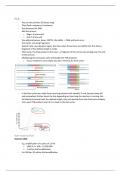
- You use two primers (20 bases long)
- They flank a sequence in between
- You denature the DNA
- Add the primers
o Begin: 3 prime end
o End: 5 prime end
- You add polymerase, bases, DNTPs, the buffer -> DNA synthesis occur
- First cycle: very long fragments
- Second cycle: you denature again, but then when the primers are add for the first Pme a
fragment of the defined length is made
- Third cycle: the final product is first seen , a fragment of the correct size ending near the end
of the primers
- MulPplying this and every cycle will double the PCR products
o If your material is very simple you don’t need to do 30 th cycles
- In the first cycles you make these very long strands with variable 3’ end, because they will
end somewhere further down the line depending on how long the reacPon is running. But
the fixed end strands with the defined length, they will starPng from the third cycle mulPply.
- From your PCR product most of it is made in the last cycles.
Start material PCR
Genomic DNA
- E.g. amplificaPon of a piece of 1.6 kb
o 1600:3.3 x 109= 1:2.000.000
o 2 million fold amplificaPon
- For 160 bp: 20 million fold amplificaPon
, cDNA: RT PCR (reverse transcriptase PCR)
- mRNA is extracted from Pssue
- Converted to cDNA via reverse transcriptase
- AmplificaPon depends on the expression level of the gene
- Genes with high expression: moderate amplificaPon level
- Genes with low expression: amplificaPon level can be extremely high
Primer design
- About 18-25 bp long
- Longer primers give a higher annealing temperature and a higher specificity
o somePmes longer at the 5 prime end because you add tags
- Annealing temperature is also determined by GC content
- primers with a lot GC have a higher annealing temperature
o Every GC base pair is 4°C and every AT base pair is 2°C
- To avoid in primer design:
o Tandem repeats
o Complementarity with known sequences can be checked using DNA databases
o Large differences in length and GC content between both primers
o Annealing temperature of the primers should be similar
o Possible hairpin structure in primer
§ Can change primer, leading to aspecific fragments
§ If there is internal complementarity the primer will fall back
o Complementarity at 2 last 3’ bases leads to primer-dimer
§ Also complementarity between the two primers should be avoided
Temperature cycles
- DenaturaPon: usually 93-95°C for human DNA
- Annealing: usually 5°C below melPng temperature primers
o MelPng temperature = temperature where 50% of the molecules is hybridised and 50%
not
o To be opPmized experimentally
- Extension: DNA synthesis
o Heat stable polymerases work most efficiently at 70-75°C
o Usually Taq DNA polymerase
§ No proofreading
• 3’ -> 5’ exonuclease acPvity
• Proofreading: A polymerase incorporates a base -> takes a step back and looks
if it is the right base -> proceed
§ Results in many incorrect bases in PCR product (mistakes)
o For some applicaPons
§ DNA polymerase with proofreading acPvity
• The proofreading that is absence in Taq can result in wrong bases in the PCR
product. If you clone some with a wrong base it can occur in a problem
• Most used is Pfu polymerase (Pyrococcus furiosus)
• Proofreading is by 3’ -> 5’ exonuclease acPvity
• Can degrade primers
§ Ohen a mix of polymerases with and without proofreading used
- You use two primers (20 bases long)
- They flank a sequence in between
- You denature the DNA
- Add the primers
o Begin: 3 prime end
o End: 5 prime end
- You add polymerase, bases, DNTPs, the buffer -> DNA synthesis occur
- First cycle: very long fragments
- Second cycle: you denature again, but then when the primers are add for the first Pme a
fragment of the defined length is made
- Third cycle: the final product is first seen , a fragment of the correct size ending near the end
of the primers
- MulPplying this and every cycle will double the PCR products
o If your material is very simple you don’t need to do 30 th cycles
- In the first cycles you make these very long strands with variable 3’ end, because they will
end somewhere further down the line depending on how long the reacPon is running. But
the fixed end strands with the defined length, they will starPng from the third cycle mulPply.
- From your PCR product most of it is made in the last cycles.
Start material PCR
Genomic DNA
- E.g. amplificaPon of a piece of 1.6 kb
o 1600:3.3 x 109= 1:2.000.000
o 2 million fold amplificaPon
- For 160 bp: 20 million fold amplificaPon
, cDNA: RT PCR (reverse transcriptase PCR)
- mRNA is extracted from Pssue
- Converted to cDNA via reverse transcriptase
- AmplificaPon depends on the expression level of the gene
- Genes with high expression: moderate amplificaPon level
- Genes with low expression: amplificaPon level can be extremely high
Primer design
- About 18-25 bp long
- Longer primers give a higher annealing temperature and a higher specificity
o somePmes longer at the 5 prime end because you add tags
- Annealing temperature is also determined by GC content
- primers with a lot GC have a higher annealing temperature
o Every GC base pair is 4°C and every AT base pair is 2°C
- To avoid in primer design:
o Tandem repeats
o Complementarity with known sequences can be checked using DNA databases
o Large differences in length and GC content between both primers
o Annealing temperature of the primers should be similar
o Possible hairpin structure in primer
§ Can change primer, leading to aspecific fragments
§ If there is internal complementarity the primer will fall back
o Complementarity at 2 last 3’ bases leads to primer-dimer
§ Also complementarity between the two primers should be avoided
Temperature cycles
- DenaturaPon: usually 93-95°C for human DNA
- Annealing: usually 5°C below melPng temperature primers
o MelPng temperature = temperature where 50% of the molecules is hybridised and 50%
not
o To be opPmized experimentally
- Extension: DNA synthesis
o Heat stable polymerases work most efficiently at 70-75°C
o Usually Taq DNA polymerase
§ No proofreading
• 3’ -> 5’ exonuclease acPvity
• Proofreading: A polymerase incorporates a base -> takes a step back and looks
if it is the right base -> proceed
§ Results in many incorrect bases in PCR product (mistakes)
o For some applicaPons
§ DNA polymerase with proofreading acPvity
• The proofreading that is absence in Taq can result in wrong bases in the PCR
product. If you clone some with a wrong base it can occur in a problem
• Most used is Pfu polymerase (Pyrococcus furiosus)
• Proofreading is by 3’ -> 5’ exonuclease acPvity
• Can degrade primers
§ Ohen a mix of polymerases with and without proofreading used


