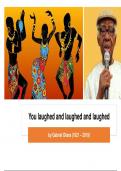
You laughed and laughed and laughed
by Gabriel Okara (1921 – 2019)
, ABOUT THE POET:
• Gabriel Okara was born on 21 April 1921 and died on 25 March
(aged 97).
• He was a Nigerian poet and novelist who is considered one of th
founders of modern African literature and he received numerous
for his writing.
• He is a brilliant literary craftsman, extremely successful in captur
moods, sights and sounds of Africa. His modern approach chan
African poetry.
• In his writing Okara focused on the African religion, folklore and
• A recurrent theme in his poetry is the confrontation between the
culture of Africa and that of the modern western culture, colonial
racism.
, Colonialism, Civilization, Christianity
• Colonialism is the practice of one country taking full or partial political control of a
country and occupying it with settlers for purposes of profiting from its resources
economy.
• As the imperial powers of Europe set their sights on new geographic regions to e
their spheres of influence, Africa emerged as a prime location for colonisation due
wealth of natural resources and supposedly undeveloped economies ripe for exp
• 1884 marked the official beginning of colonialism in Africa. The British colonised N
1901. In 1960 British rule stopped when Nigeria was finally granted their indepen
• Being unfamiliar with the diverse cultures on the continent of Africa, European ex
viewed these unfamiliar practices as savage and of no value.
• The general belief was that these Africans had to be pulled toward the ‘light’ in or
the error of their ‘savage’ nature.
• Another ‘justifying’ principle behind colonialism was the need to civilise and conve
supposedly backward, savage people of Africa to Christianity.
, ABOUT THE POEM:
• The poem reflects the pain, emotions and irritation of an Afri
being discredited and laughed at by a European colonialist b
of his mannerisms and beliefs.
• The blacks were laughed at, made fun of, by white settlers f
songs, their physical movement and their spiritual beliefs.
• The African man is proud of his culture, his ancestry and him
brings his culture into sharp contrast with that of the colonial
presented as ignorant, uninformed and arrogant.
• The white man considers himself to be superior to the black
no understanding or appreciation of the beauty of the natura
the speaker’s world, the world that shaped him into a well-ad
human being.
• When the black man dances to the beat of drums, the white
laughs at him, gets into his car and drives away - separating
from nature and its healing influence too.
by Gabriel Okara (1921 – 2019)
, ABOUT THE POET:
• Gabriel Okara was born on 21 April 1921 and died on 25 March
(aged 97).
• He was a Nigerian poet and novelist who is considered one of th
founders of modern African literature and he received numerous
for his writing.
• He is a brilliant literary craftsman, extremely successful in captur
moods, sights and sounds of Africa. His modern approach chan
African poetry.
• In his writing Okara focused on the African religion, folklore and
• A recurrent theme in his poetry is the confrontation between the
culture of Africa and that of the modern western culture, colonial
racism.
, Colonialism, Civilization, Christianity
• Colonialism is the practice of one country taking full or partial political control of a
country and occupying it with settlers for purposes of profiting from its resources
economy.
• As the imperial powers of Europe set their sights on new geographic regions to e
their spheres of influence, Africa emerged as a prime location for colonisation due
wealth of natural resources and supposedly undeveloped economies ripe for exp
• 1884 marked the official beginning of colonialism in Africa. The British colonised N
1901. In 1960 British rule stopped when Nigeria was finally granted their indepen
• Being unfamiliar with the diverse cultures on the continent of Africa, European ex
viewed these unfamiliar practices as savage and of no value.
• The general belief was that these Africans had to be pulled toward the ‘light’ in or
the error of their ‘savage’ nature.
• Another ‘justifying’ principle behind colonialism was the need to civilise and conve
supposedly backward, savage people of Africa to Christianity.
, ABOUT THE POEM:
• The poem reflects the pain, emotions and irritation of an Afri
being discredited and laughed at by a European colonialist b
of his mannerisms and beliefs.
• The blacks were laughed at, made fun of, by white settlers f
songs, their physical movement and their spiritual beliefs.
• The African man is proud of his culture, his ancestry and him
brings his culture into sharp contrast with that of the colonial
presented as ignorant, uninformed and arrogant.
• The white man considers himself to be superior to the black
no understanding or appreciation of the beauty of the natura
the speaker’s world, the world that shaped him into a well-ad
human being.
• When the black man dances to the beat of drums, the white
laughs at him, gets into his car and drives away - separating
from nature and its healing influence too.