

P8 – Create a table in which you explain the different rules used to interpret statute.
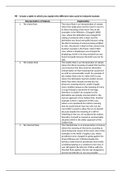
Interpretation of Statute Explanation
1. The Literal Rule The Literal Rule is an interpretation of statute
where the Judge gives out the word in court in
its literal meaning of the word. One of the
examples is the Whiteley v Chappell (1868)
case, where the defendant was charged for
voting as someone who is dead, but the
defendant was found not guilty because using
the literal meaning of someone being entitled
to vote, the person is dead so they cannot vote.
Another example is the Fisher v Bell (1960)
case, where a shopkeeper was charged for
displaying a knife in his shop window but was
found not guilty because the knife was not for
sale.
2. The Golden Rule The Golden Rule is an interpretation of statute
where the literal meaning is looked that but the
court ensures that they avoid an alternative
interpretation of that meaning that would end
up with an unreasonable result. An example of
the Golden Rule is the R v Allen (1872) case,
where the defendant married another person
when they were already married but not
divorced, meaning that he couldn’t legally
marry another spouse as the meaning of marry
is to go through a ceremony of marriage,
therefore it couldn’t be accepted as the
defendant was already married which is the
narrow approach of the Golden Rule. Another
example is the R v Sigsworth (1935) case,
where a son murdered his mother meaning
that he would inherit from her will, but the
court didn’t accept to allow the son to benefit
because despite the meaning of a will for
inheriting to the son, he murdered his mother,
therefore it would’ve caused an unreasonable
situation which is the wider approach of the
Golden Rule.
3. The Mischief Rule The Mischief Rule is an interpretation of statute
where the meaning of the terms according to
what Parliament meant of the word. One of the
examples is the Smith v Hughes case, where
prostitutes were charged for going against the
Street Offences Act 1958 but despite the
defence made that the prostitutes were inside
a building tapping on a window to lure men, it
was still against the SOA Act 1958 as with the
Mischief Rule applied, the law was designed to
prevent prostitution in any way possible.
Interpretation of Statute Explanation
1. The Literal Rule The Literal Rule is an interpretation of statute
where the Judge gives out the word in court in
its literal meaning of the word. One of the
examples is the Whiteley v Chappell (1868)
case, where the defendant was charged for
voting as someone who is dead, but the
defendant was found not guilty because using
the literal meaning of someone being entitled
to vote, the person is dead so they cannot vote.
Another example is the Fisher v Bell (1960)
case, where a shopkeeper was charged for
displaying a knife in his shop window but was
found not guilty because the knife was not for
sale.
2. The Golden Rule The Golden Rule is an interpretation of statute
where the literal meaning is looked that but the
court ensures that they avoid an alternative
interpretation of that meaning that would end
up with an unreasonable result. An example of
the Golden Rule is the R v Allen (1872) case,
where the defendant married another person
when they were already married but not
divorced, meaning that he couldn’t legally
marry another spouse as the meaning of marry
is to go through a ceremony of marriage,
therefore it couldn’t be accepted as the
defendant was already married which is the
narrow approach of the Golden Rule. Another
example is the R v Sigsworth (1935) case,
where a son murdered his mother meaning
that he would inherit from her will, but the
court didn’t accept to allow the son to benefit
because despite the meaning of a will for
inheriting to the son, he murdered his mother,
therefore it would’ve caused an unreasonable
situation which is the wider approach of the
Golden Rule.
3. The Mischief Rule The Mischief Rule is an interpretation of statute
where the meaning of the terms according to
what Parliament meant of the word. One of the
examples is the Smith v Hughes case, where
prostitutes were charged for going against the
Street Offences Act 1958 but despite the
defence made that the prostitutes were inside
a building tapping on a window to lure men, it
was still against the SOA Act 1958 as with the
Mischief Rule applied, the law was designed to
prevent prostitution in any way possible.


