Chapter 5: Business Level Strategy
Introduction 5-1
- How attractive is the industry?
- How will the firm compete in the industry?
- To develop a business-level strategy
- Who do we serve? (a broad or narrow market segment)
- What do we provide? (a small or large range of products or services)
- How do we provide it? (out unique production approach or delivery processes)
- Determine which strategic approach
- Low-cost strategy
- Differentiation strategy
- Focused strategy
How the External Environment Impacts Industry Attractiveness 5-2
- Technological forces, economic forces, political and legal forces, sociocultural forces,
global forces
- Aligns a company’s resources and strengths with the opportunities presented in the
external environment
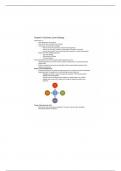
Porter’s 5-Forces Model 5-2a
- Includes the threat of new entrants, bargaining power of customers, threat of substitutes,
bargaining power of suppliers, and rivalry among existing companies
- Manager can obtain a sense of long-term prospects of the industry and the
strategic forces that guide it
- Starting point for identifying the strengths and weaknesses of an industry
- Assess which forces a firm might try to modify to make the industry more
attractive
-
Threat of New Entrants 5-2b
- More of the same products are supplied to the same customer base, ultimately
decreasing profits for all players
, - Depends on the barriers to entry and on the reaction from existing competitors that
entrants can expect
- Barriers to entry: Obstacles a firm may face while trying to enter a market or
industry
- Ex. High capital investments needed to enter the industry, high costs
associated with customers switching from one company to another
- When an industry or a market is new and emerging, barriers are generally low and many
firms scramble to enter and build a dominant position
- When an industry becomes more established and mature, it is often difficult for a new
entrant to enter on a similar scale or level as an incumbent
- Major sources of barriers to entry
- Supply-Side Economies of Scale: arise when a firm manufactures products or
services in high volumes.
- Ability to produce and sell large volumes results in much lower production
costs
- Lower costs can deter entry by new firms since they cannot generate the
same production scale at the time of entry
- Present in: microprocessors, steel, automobiles
- Demand-Side Benefits of Scale: arise in situations where any buyer’s
willingness to pay for that product increases as the number of other buyers for
that product increases.
- Buyers benefit by buying something that others are also buying
- Discourage entry by reducing consumers’ preference to purchase from a
newcomer to the industry.
- Ex. Telephone, fax machines, Microsoft operating system Windows
- Customer Switching Costs: fixed costs that buyers encounter if they change
the supplier of a particular product or service. Arises because the buyer has to
make changes to their product or operating procedure when using a new supply
source.
- Ex. Customers had to incur significant costs to switch to Apple because it
was not compatible with other PC providers
- Ex. Investment brokerage industry
- Ex. Online banking
- Capital Requirements: Large amounts of capital are required by any new
entrant just to begin operating.
- Fixed facilities, customer credit, inventories, possible start-up losses
- Ex. Copper mining, pharmaceuticals, steel production
- Incumbency Advantages Independent of Size: Incumbent companies maintain
cost or quality advantages that are not easily available to a potential rival.
- Superior technology, preferential access to raw materials, government
subsidies, strong brand
- Ex. IBM
- Unequal Access to Distribution Channels: Many industries are marked by
limited distribution channels.
Introduction 5-1
- How attractive is the industry?
- How will the firm compete in the industry?
- To develop a business-level strategy
- Who do we serve? (a broad or narrow market segment)
- What do we provide? (a small or large range of products or services)
- How do we provide it? (out unique production approach or delivery processes)
- Determine which strategic approach
- Low-cost strategy
- Differentiation strategy
- Focused strategy
How the External Environment Impacts Industry Attractiveness 5-2
- Technological forces, economic forces, political and legal forces, sociocultural forces,
global forces
- Aligns a company’s resources and strengths with the opportunities presented in the
external environment
Porter’s 5-Forces Model 5-2a
- Includes the threat of new entrants, bargaining power of customers, threat of substitutes,
bargaining power of suppliers, and rivalry among existing companies
- Manager can obtain a sense of long-term prospects of the industry and the
strategic forces that guide it
- Starting point for identifying the strengths and weaknesses of an industry
- Assess which forces a firm might try to modify to make the industry more
attractive
-
Threat of New Entrants 5-2b
- More of the same products are supplied to the same customer base, ultimately
decreasing profits for all players
, - Depends on the barriers to entry and on the reaction from existing competitors that
entrants can expect
- Barriers to entry: Obstacles a firm may face while trying to enter a market or
industry
- Ex. High capital investments needed to enter the industry, high costs
associated with customers switching from one company to another
- When an industry or a market is new and emerging, barriers are generally low and many
firms scramble to enter and build a dominant position
- When an industry becomes more established and mature, it is often difficult for a new
entrant to enter on a similar scale or level as an incumbent
- Major sources of barriers to entry
- Supply-Side Economies of Scale: arise when a firm manufactures products or
services in high volumes.
- Ability to produce and sell large volumes results in much lower production
costs
- Lower costs can deter entry by new firms since they cannot generate the
same production scale at the time of entry
- Present in: microprocessors, steel, automobiles
- Demand-Side Benefits of Scale: arise in situations where any buyer’s
willingness to pay for that product increases as the number of other buyers for
that product increases.
- Buyers benefit by buying something that others are also buying
- Discourage entry by reducing consumers’ preference to purchase from a
newcomer to the industry.
- Ex. Telephone, fax machines, Microsoft operating system Windows
- Customer Switching Costs: fixed costs that buyers encounter if they change
the supplier of a particular product or service. Arises because the buyer has to
make changes to their product or operating procedure when using a new supply
source.
- Ex. Customers had to incur significant costs to switch to Apple because it
was not compatible with other PC providers
- Ex. Investment brokerage industry
- Ex. Online banking
- Capital Requirements: Large amounts of capital are required by any new
entrant just to begin operating.
- Fixed facilities, customer credit, inventories, possible start-up losses
- Ex. Copper mining, pharmaceuticals, steel production
- Incumbency Advantages Independent of Size: Incumbent companies maintain
cost or quality advantages that are not easily available to a potential rival.
- Superior technology, preferential access to raw materials, government
subsidies, strong brand
- Ex. IBM
- Unequal Access to Distribution Channels: Many industries are marked by
limited distribution channels.