Types of data
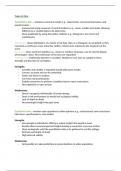
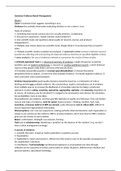
Quantitative data – produces numerical results e.g., experiments, structured interviews, and
questionnaires.
- Summarised using measures of central tendency e.g., mean, median and mode. Allowing
differences or relationships to be determine.
- Done graphically by using descriptive statistics e.g., histograms, bar charts and
scattergrams.
Histograms: shows distribution of a whole set of data. Bars on a histogram are all joined as they
represent a continuous scale. Equal bar widths. Column area represents the frequency of the
score.
Bar charts: show summary statistics e.g., means or medians of groups. Can be sued to display
percentages/ ratios. Not continuous so the bars are separated.
Scattergrams: relationship between 2 variables. Marked on two axes on a graph to show
strength and direction of correlation.
Strengths:
- Scientific and reliable, if repeated should yield same results.
- Concise, accurate and can be controlled.
- Faster and easier to analyse.
- Can have many participants.
- Enables researcher to perform a statistical test to reach conclusions
- Not subjective or open to bias
Weaknesses:
- Doesn’t recognise individuality of human beings.
- Done in lab environment so would lack ecological validity.
- Lack of depth in detail
- No meaningful insight into ppts views
Qualitative data – involves open questions to allow opinions e.g., unstructured/ semi structured
interviews, questionnaires, case studies.
Strengths
- Sees people as individuals, offering a unique insight into people’s views.
- Results often reveal unexpected insights leading a researcher to pursue further.
- More ecologically valid the quantitative data as its gathered in real life settings.
- Richness and depth of detail
- High external validity
Weaknesses
- Not possible to make predictions or generalisations to wider population.
Quantitative data – produces numerical results e.g., experiments, structured interviews, and
questionnaires.
- Summarised using measures of central tendency e.g., mean, median and mode. Allowing
differences or relationships to be determine.
- Done graphically by using descriptive statistics e.g., histograms, bar charts and
scattergrams.
Histograms: shows distribution of a whole set of data. Bars on a histogram are all joined as they
represent a continuous scale. Equal bar widths. Column area represents the frequency of the
score.
Bar charts: show summary statistics e.g., means or medians of groups. Can be sued to display
percentages/ ratios. Not continuous so the bars are separated.
Scattergrams: relationship between 2 variables. Marked on two axes on a graph to show
strength and direction of correlation.
Strengths:
- Scientific and reliable, if repeated should yield same results.
- Concise, accurate and can be controlled.
- Faster and easier to analyse.
- Can have many participants.
- Enables researcher to perform a statistical test to reach conclusions
- Not subjective or open to bias
Weaknesses:
- Doesn’t recognise individuality of human beings.
- Done in lab environment so would lack ecological validity.
- Lack of depth in detail
- No meaningful insight into ppts views
Qualitative data – involves open questions to allow opinions e.g., unstructured/ semi structured
interviews, questionnaires, case studies.
Strengths
- Sees people as individuals, offering a unique insight into people’s views.
- Results often reveal unexpected insights leading a researcher to pursue further.
- More ecologically valid the quantitative data as its gathered in real life settings.
- Richness and depth of detail
- High external validity
Weaknesses
- Not possible to make predictions or generalisations to wider population.