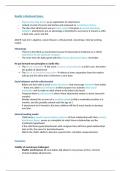
Bowlby’s attachment theory
- Rejected learning theory as an explanation for attachment
- Looked at work of Lorenz and Harlow and proposed an evolutionary theory
- The idea that attachment was an innate system that gives a survival advantage
- Adaptive: attachments are an advantage or beneficial to survival as it ensures a child
is kept safe, warm and fed.
ASCMI (‘ask me’): adaptive, social releasers, critical period, monotropy, internal working
model.
Monotropy
- Theory is described as monotropic because he placed great emphasis on a child’s
attachment to one particular caregiver.
- The more time the baby spent with the primary attachment figure, the better
He put forward two principles to clarify this:
The law of continuity the more constant and predictable a child’s care, the better
the quality of attachment
The law of accumulated separation effects of every separation from the mother
add up and the safest does is therefore a zero dose
Social releasers and the critical period
- Babies are born with a set of innate behaviours that encourage attention from adults
– these are called social releasers as their purpose is to activate adult social
interaction and to make an adult attach to the baby (cute faces)
- Proposed there’s critical period where infant attachment system is active (around 6
months)
- Bowlby viewed this as more of a sensitive period a child is maximally sensitive at 6
months, and this possibly extends until the age of 2
- if attachment isn’t formed in this time children will find it much harder to develop
one later.
Internal working model
- Child forms a mental representation (schema) of their relationship with their primary
attachment figure, serves as a template for what future relationships are like
(continuity hypothesis)
- If the child forms good attachments with caregiver they will form good relationships
later in life, the same for bad attachments.
- Effects the child’s ability to become a parent later. (sensitive responsiveness)
Evaluation
Validity of monotropy challenged.
- Shaffer and Emerson most babies did attach to one person at first, minority
formed multiple attachments.
- Rejected learning theory as an explanation for attachment
- Looked at work of Lorenz and Harlow and proposed an evolutionary theory
- The idea that attachment was an innate system that gives a survival advantage
- Adaptive: attachments are an advantage or beneficial to survival as it ensures a child
is kept safe, warm and fed.
ASCMI (‘ask me’): adaptive, social releasers, critical period, monotropy, internal working
model.
Monotropy
- Theory is described as monotropic because he placed great emphasis on a child’s
attachment to one particular caregiver.
- The more time the baby spent with the primary attachment figure, the better
He put forward two principles to clarify this:
The law of continuity the more constant and predictable a child’s care, the better
the quality of attachment
The law of accumulated separation effects of every separation from the mother
add up and the safest does is therefore a zero dose
Social releasers and the critical period
- Babies are born with a set of innate behaviours that encourage attention from adults
– these are called social releasers as their purpose is to activate adult social
interaction and to make an adult attach to the baby (cute faces)
- Proposed there’s critical period where infant attachment system is active (around 6
months)
- Bowlby viewed this as more of a sensitive period a child is maximally sensitive at 6
months, and this possibly extends until the age of 2
- if attachment isn’t formed in this time children will find it much harder to develop
one later.
Internal working model
- Child forms a mental representation (schema) of their relationship with their primary
attachment figure, serves as a template for what future relationships are like
(continuity hypothesis)
- If the child forms good attachments with caregiver they will form good relationships
later in life, the same for bad attachments.
- Effects the child’s ability to become a parent later. (sensitive responsiveness)
Evaluation
Validity of monotropy challenged.
- Shaffer and Emerson most babies did attach to one person at first, minority
formed multiple attachments.