Cognitive approach
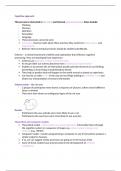
This process is interested in the mind and internal mental processes these include:
- Thinking
- Memory
- Attention
- Perception
- Language
These processes cannot be seen
Inferences must be made about them and how they work from observations and
experiments.
Believes internal mental processes should be studied scientifically.
Schema – a mental framework of beliefs and expectation that influence cognitive
processing. They are developed from experience
Schemas are packages of ideas and information
As we get older our schema becomes more detailed and sophisticated
Enables us to process lots of information quickly and take shortcuts in our thinking,
preventing us from being overwhelmed by stimuli
They help us predict what will happen in the world around us based on experience
Can lead to us make errors in the way we see things leading to unreliable recall and
distort our interpretation of sensory information
Schema study – the rat man
- 2 groups of participants were shown a sequence of pictures, either several different
faces or animals
- They were then shown an ambiguous figure of the rat man
Results
- Participant who saw animals were more likely to see a rat
- Participants who saw faces were more likely to see a person
Theoretical and computer models
Theoretical model – (information processing approach) information flows through
the cognitive system in a sequence of stages e.g., input, output, storage, and
retrieval (e.g., WMM)
Computer model - involves programming a computer to see if instructions produce a
similar output to humans.
If so, we can suggest similar processes are going on in the human mind.
Some of these models have proved useful in the development of artificial
intelligence.
This process is interested in the mind and internal mental processes these include:
- Thinking
- Memory
- Attention
- Perception
- Language
These processes cannot be seen
Inferences must be made about them and how they work from observations and
experiments.
Believes internal mental processes should be studied scientifically.
Schema – a mental framework of beliefs and expectation that influence cognitive
processing. They are developed from experience
Schemas are packages of ideas and information
As we get older our schema becomes more detailed and sophisticated
Enables us to process lots of information quickly and take shortcuts in our thinking,
preventing us from being overwhelmed by stimuli
They help us predict what will happen in the world around us based on experience
Can lead to us make errors in the way we see things leading to unreliable recall and
distort our interpretation of sensory information
Schema study – the rat man
- 2 groups of participants were shown a sequence of pictures, either several different
faces or animals
- They were then shown an ambiguous figure of the rat man
Results
- Participant who saw animals were more likely to see a rat
- Participants who saw faces were more likely to see a person
Theoretical and computer models
Theoretical model – (information processing approach) information flows through
the cognitive system in a sequence of stages e.g., input, output, storage, and
retrieval (e.g., WMM)
Computer model - involves programming a computer to see if instructions produce a
similar output to humans.
If so, we can suggest similar processes are going on in the human mind.
Some of these models have proved useful in the development of artificial
intelligence.