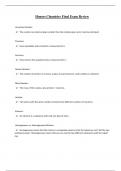
Honors Chemistry Final Exam Review
Uncertain Number:
✔️ The number one decimal place smaller than the smallest given unit; must be estimated.
Precision:
✔️ How repeatable and consistent a measurement is.
Accuracy:
✔️ How close to the accepted value a measurement is.
Atomic Number:
✔️ The number of protons in an atom, unique to each element, used to define an element.
Mass Number:
✔️ The mass of the nucleus; also protons + neutrons.
Isotope:
✔️ Two atoms with the same number of protons but different numbers of neutrons.
Element:
✔️ An element is a substance with only one type of atom.
Homogeneous vs. Heterogeneous Mixture:
✔️ Homogeneous means that the mixture is completely mixed so that the naked eye can't tell the two
substances apart. Heterogeneous means that you can see the two different substances with the naked
eye.
, Radioactivity:
✔️ A natural process that certain elements undergo that alters their nuclei and gives off rays in the
form of either charged particles or energy.
Alpha Particles:
✔️ 2 protons and 2 neutrons (⁴₂α); least harmful radiation.
Beta Particles:
✔️ An electron (⁰₋₁β); moderately harmful radiation.
Gamma Particles:
✔️ Most harmful radiation.
Positron:
✔️ The opposite of an electron (⁰₁β).
Transmutation:
✔️ When an atom is bombarded by particles in order to change it into a different atom.
HalfLife:
✔️ The time it takes for half of a radioactive sample to decay.
Deci:
✔️ 10⁻¹.
Centi:
✔️ 10⁻².
Uncertain Number:
✔️ The number one decimal place smaller than the smallest given unit; must be estimated.
Precision:
✔️ How repeatable and consistent a measurement is.
Accuracy:
✔️ How close to the accepted value a measurement is.
Atomic Number:
✔️ The number of protons in an atom, unique to each element, used to define an element.
Mass Number:
✔️ The mass of the nucleus; also protons + neutrons.
Isotope:
✔️ Two atoms with the same number of protons but different numbers of neutrons.
Element:
✔️ An element is a substance with only one type of atom.
Homogeneous vs. Heterogeneous Mixture:
✔️ Homogeneous means that the mixture is completely mixed so that the naked eye can't tell the two
substances apart. Heterogeneous means that you can see the two different substances with the naked
eye.
, Radioactivity:
✔️ A natural process that certain elements undergo that alters their nuclei and gives off rays in the
form of either charged particles or energy.
Alpha Particles:
✔️ 2 protons and 2 neutrons (⁴₂α); least harmful radiation.
Beta Particles:
✔️ An electron (⁰₋₁β); moderately harmful radiation.
Gamma Particles:
✔️ Most harmful radiation.
Positron:
✔️ The opposite of an electron (⁰₁β).
Transmutation:
✔️ When an atom is bombarded by particles in order to change it into a different atom.
HalfLife:
✔️ The time it takes for half of a radioactive sample to decay.
Deci:
✔️ 10⁻¹.
Centi:
✔️ 10⁻².