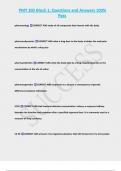
PMY 302 Block 1; Questions and Answers 100%
Pass
pharmacology CORRECT ANS-study of all compounds that interact with the body
pharmacodynamics CORRECT ANS-what a drug does to the body. Includes the molecular
mechanisms by which a drug acts
pharmacokinetics CORRECT ANS-what the body does to a drug. Usually depends on the
concentration at the site of action
pharmacogenetics CORRECT ANS-responses to a drug as a consequence of genetic
differences between individuals
EC50 CORRECT ANS-Half maximal effective concentration. induces a response halfway
between the baseline and maximum after a specified exposure time. It is commonly used as a
measure of drug's potency.
LD 50 CORRECT ANS-amount of an ingested substance that kills 50 percent of a test sample
, PMY 302 Block 1; Questions and Answers 100%
Pass
phase 1 of biotransformation CORRECT ANS-makes drug slightly less hydrophobic
phase 2 of biotransformation CORRECT ANS-makes drug very hydrophillic
drug CORRECT ANS-any agent that affects the living process, including chemicals that
mimic or antagonize endogenous
dose CORRECT ANS-amount of medication administered at single time (effects toxicity)
response CORRECT ANS-effect of a drug on the body, including both intended and
unintended effects
therapeutic response CORRECT ANS-the desired effect
adverse effect CORRECT ANS-side effects
, PMY 302 Block 1; Questions and Answers 100%
Pass
toxic response CORRECT ANS-any harmful repsonse
idiosyncratic response CORRECT ANS-individual hypersensitivity; happens on first dose
atropa belladona CORRECT ANS-dilates pupils
important that drug came from plant
Law of Mass Action CORRECT ANS-D + R <-- --> DR;
increasing the amount drug will cause greater amounts of drug receptor complexes to formed
the DR complex exerts the therapeutic response
saturability CORRECT ANS-a limited amount of receptors mediate the actions of a drug
reversbility CORRECT ANS-drugs bind to but then dissociate from their specific receptor
Pass
pharmacology CORRECT ANS-study of all compounds that interact with the body
pharmacodynamics CORRECT ANS-what a drug does to the body. Includes the molecular
mechanisms by which a drug acts
pharmacokinetics CORRECT ANS-what the body does to a drug. Usually depends on the
concentration at the site of action
pharmacogenetics CORRECT ANS-responses to a drug as a consequence of genetic
differences between individuals
EC50 CORRECT ANS-Half maximal effective concentration. induces a response halfway
between the baseline and maximum after a specified exposure time. It is commonly used as a
measure of drug's potency.
LD 50 CORRECT ANS-amount of an ingested substance that kills 50 percent of a test sample
, PMY 302 Block 1; Questions and Answers 100%
Pass
phase 1 of biotransformation CORRECT ANS-makes drug slightly less hydrophobic
phase 2 of biotransformation CORRECT ANS-makes drug very hydrophillic
drug CORRECT ANS-any agent that affects the living process, including chemicals that
mimic or antagonize endogenous
dose CORRECT ANS-amount of medication administered at single time (effects toxicity)
response CORRECT ANS-effect of a drug on the body, including both intended and
unintended effects
therapeutic response CORRECT ANS-the desired effect
adverse effect CORRECT ANS-side effects
, PMY 302 Block 1; Questions and Answers 100%
Pass
toxic response CORRECT ANS-any harmful repsonse
idiosyncratic response CORRECT ANS-individual hypersensitivity; happens on first dose
atropa belladona CORRECT ANS-dilates pupils
important that drug came from plant
Law of Mass Action CORRECT ANS-D + R <-- --> DR;
increasing the amount drug will cause greater amounts of drug receptor complexes to formed
the DR complex exerts the therapeutic response
saturability CORRECT ANS-a limited amount of receptors mediate the actions of a drug
reversbility CORRECT ANS-drugs bind to but then dissociate from their specific receptor