SOME BASIC CONCEPTS
CHEMISTRY
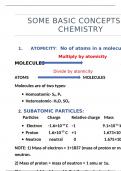
1. ATOMICITY: No of atoms in a molecu
Multiply by atomicity
MOLECULES A
Divide by atomicity
ATOMS MOLECULES
Molecules are of two types-
Homoatomic- S8, P4
Heteroatomic- H2O, SO2
2. SUBATOMIC PARTICLES:
Particles Charge Relative charge Mass
Electron -1.6×10⁻¹⁹ C -1 9.1×10⁻³¹ k
Proton 1.6×10⁻¹⁹ C +1 1.673×10-
Neutron neutral 0 1.675×10
NOTE: 1) Mass of electron = 1÷1837 (mass of proton or ma
neutron.
2) Mass of proton ≈ mass of neutron = 1 amu or 1u.
, A = Atomic mass or mass number, Z = Atomic number, X =
Atomic number (Z): Number of protons present in a
Mass number (A): Number of nucleons i.e. protons +
present in an atom.
In an atom, number of protons = Z, number of neutr
Atomic number, mass number, number of electrons
and neutrons are always whole number.
Number of electrons in an atom-
ATOM
NEUTRAL/UNCHARGED/ISOLATED ATOM CHARGED AT
Number of electrons = number of protons = Z
CATIONS
Cation Anion
Positively charged. Negatively c
Formed by loss of e. Formed by g
Number of e < p. Number of e
Number of e = number of proton - |charge| e = p + |char
4.ISOTOPES:
1) Same atomic number but different atomic mass.
2) Same number of protons but different number of neutr
CHEMISTRY
1. ATOMICITY: No of atoms in a molecu
Multiply by atomicity
MOLECULES A
Divide by atomicity
ATOMS MOLECULES
Molecules are of two types-
Homoatomic- S8, P4
Heteroatomic- H2O, SO2
2. SUBATOMIC PARTICLES:
Particles Charge Relative charge Mass
Electron -1.6×10⁻¹⁹ C -1 9.1×10⁻³¹ k
Proton 1.6×10⁻¹⁹ C +1 1.673×10-
Neutron neutral 0 1.675×10
NOTE: 1) Mass of electron = 1÷1837 (mass of proton or ma
neutron.
2) Mass of proton ≈ mass of neutron = 1 amu or 1u.
, A = Atomic mass or mass number, Z = Atomic number, X =
Atomic number (Z): Number of protons present in a
Mass number (A): Number of nucleons i.e. protons +
present in an atom.
In an atom, number of protons = Z, number of neutr
Atomic number, mass number, number of electrons
and neutrons are always whole number.
Number of electrons in an atom-
ATOM
NEUTRAL/UNCHARGED/ISOLATED ATOM CHARGED AT
Number of electrons = number of protons = Z
CATIONS
Cation Anion
Positively charged. Negatively c
Formed by loss of e. Formed by g
Number of e < p. Number of e
Number of e = number of proton - |charge| e = p + |char
4.ISOTOPES:
1) Same atomic number but different atomic mass.
2) Same number of protons but different number of neutr