dinsdag 22 oktober 2019
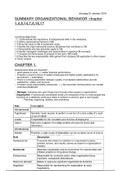
SUMMARY ORGANIZATIONAL BEHAVIOR chapter
1,4,5,14,7,8,16,17
Learning objectives:
- 1.1 Demonstrate the importance of interpersonal skills in the workplace.
1.2 Define organizational behavior (OB).
1.3 Show the value to OB of systematic study.
1.4 Identify the major behavioral science disciplines that contribute to OB.
1.5 Demonstrate why few absolutes apply to OB.
1.6 Identify managers’ challenges and opportunities in applying OB concepts.
1.7 Compare the three levels of analysis in this text’s OB model.
1.8 Describe the key employability skills gained from studying OB applicable to other majors
or future careers.
CHAPTER 1.
Interpersonal skills are important:
- good places to work —> better financial performance.
- It results in lower turnover of quality employees and higher quality applications for
recruitment. = sollicitaties.
- There is a strong association between quality of workplace relationships and job
satisfaction, stress, and turnover.
- It fosters social responsibility awareness. —> Het bevordert het bewustzijn van sociale
verantwoordelijkheid.
- Manager: Someone who gets things done through other people in organizations.
• Organization: A consciously coordinated social unit composed of two or more people that
functions on a relatively continuous basis to achieve a common goal or set of goals.
– Planning, organizing, leading, and controlling
1
SUMMARY ORGANIZATIONAL BEHAVIOR chapter
1,4,5,14,7,8,16,17
Learning objectives:
- 1.1 Demonstrate the importance of interpersonal skills in the workplace.
1.2 Define organizational behavior (OB).
1.3 Show the value to OB of systematic study.
1.4 Identify the major behavioral science disciplines that contribute to OB.
1.5 Demonstrate why few absolutes apply to OB.
1.6 Identify managers’ challenges and opportunities in applying OB concepts.
1.7 Compare the three levels of analysis in this text’s OB model.
1.8 Describe the key employability skills gained from studying OB applicable to other majors
or future careers.
CHAPTER 1.
Interpersonal skills are important:
- good places to work —> better financial performance.
- It results in lower turnover of quality employees and higher quality applications for
recruitment. = sollicitaties.
- There is a strong association between quality of workplace relationships and job
satisfaction, stress, and turnover.
- It fosters social responsibility awareness. —> Het bevordert het bewustzijn van sociale
verantwoordelijkheid.
- Manager: Someone who gets things done through other people in organizations.
• Organization: A consciously coordinated social unit composed of two or more people that
functions on a relatively continuous basis to achieve a common goal or set of goals.
– Planning, organizing, leading, and controlling
1