©SOPHIABENNETT@2024-2025 Sunday, August 25, 2024 2:42 PM
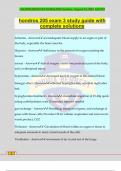
hondros 205 exam 3 study guide with
complete solutions
Ischemia - Answer✔️✔️-an inadequate blood supply to an organ or part of
the body, especially the heart muscles.
Hypoxia - Answer✔️✔️-deficiency in the amount of oxygen reaching the
tissues
anoxia - Answer✔️✔️-lack of oxygen. can be one particular part of the body,
and a widespread injury.
hypoxemia - Answer✔️✔️-decreased level of oxygen in the arterial blood
Simogyi effect - Answer✔️✔️-rebound hyperglycemia. occurs at night after
bed.
hypoglycemia treatment - Answer✔️✔️-immediate ingestion of 15-20g quick
acting carbohydrates; wait 15 minutes, repeat if needed
gas exchange - Answer✔️✔️-Breathing, transport of gases, and exchange of
gases with tissue cells; Provides O2 for cellular respiration and removes its
waste product, CO2
Perfusion - Answer✔️✔️-Circulation of blood within an organ or tissue in
adequate amounts to meet current needs of the cells.
Ventilation - Answer✔️✔️-movement of air in and out of the lungs
1
, ©SOPHIABENNETT@2024-2025 Sunday, August 25, 2024 2:42 PM
Room air is what % oxygen? - Answer✔️✔️-21%
Transport in gas exchange - Answer✔️✔️-occurs during respiration normally
by diffusion
difusion - Answer✔️✔️-process by which molecules tend to move from an
area where they are more concentrated to an area where they are more
concentrated to an area where they are less concentrated
gas exchange impairment - Answer✔️✔️-occurs when the diffusion of gases
become impaired.
gas exchange impairment causes - Answer✔️✔️-ineffective ventilation
reduced capacity for gas transportation
inadequate perfusion
consequences of gas exchange impairment - Answer✔️✔️-mild: fatigue,
increased heart rate
more Severe: respiratory acidosis
Prolonged/severe: Cellular ischemia and necrosis, death
newborn at greater risk for gas exchange impairment - Answer✔️✔️-
newborns: higher metabolic rate, decreased functional residual capacity,
decreased lung compliance. increased resistance and potential for right to
left shunts through ductus, foramen ovule, or both
2
hondros 205 exam 3 study guide with
complete solutions
Ischemia - Answer✔️✔️-an inadequate blood supply to an organ or part of
the body, especially the heart muscles.
Hypoxia - Answer✔️✔️-deficiency in the amount of oxygen reaching the
tissues
anoxia - Answer✔️✔️-lack of oxygen. can be one particular part of the body,
and a widespread injury.
hypoxemia - Answer✔️✔️-decreased level of oxygen in the arterial blood
Simogyi effect - Answer✔️✔️-rebound hyperglycemia. occurs at night after
bed.
hypoglycemia treatment - Answer✔️✔️-immediate ingestion of 15-20g quick
acting carbohydrates; wait 15 minutes, repeat if needed
gas exchange - Answer✔️✔️-Breathing, transport of gases, and exchange of
gases with tissue cells; Provides O2 for cellular respiration and removes its
waste product, CO2
Perfusion - Answer✔️✔️-Circulation of blood within an organ or tissue in
adequate amounts to meet current needs of the cells.
Ventilation - Answer✔️✔️-movement of air in and out of the lungs
1
, ©SOPHIABENNETT@2024-2025 Sunday, August 25, 2024 2:42 PM
Room air is what % oxygen? - Answer✔️✔️-21%
Transport in gas exchange - Answer✔️✔️-occurs during respiration normally
by diffusion
difusion - Answer✔️✔️-process by which molecules tend to move from an
area where they are more concentrated to an area where they are more
concentrated to an area where they are less concentrated
gas exchange impairment - Answer✔️✔️-occurs when the diffusion of gases
become impaired.
gas exchange impairment causes - Answer✔️✔️-ineffective ventilation
reduced capacity for gas transportation
inadequate perfusion
consequences of gas exchange impairment - Answer✔️✔️-mild: fatigue,
increased heart rate
more Severe: respiratory acidosis
Prolonged/severe: Cellular ischemia and necrosis, death
newborn at greater risk for gas exchange impairment - Answer✔️✔️-
newborns: higher metabolic rate, decreased functional residual capacity,
decreased lung compliance. increased resistance and potential for right to
left shunts through ductus, foramen ovule, or both
2