100% satisfaction guarantee Immediately available after payment Both online and in PDF No strings attached 4.2 TrustPilot
logo-home
Exam (elaborations)

UHDDS Inpatient Coding Guidelines Questions with 100% Correct Answers | Latest Update | Verified

Rating
-
Sold
-
Pages
3
Grade
A+
Uploaded on
27-08-2024
Written in
2024/2025

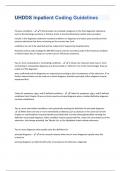
Previous conditions - If the provider has included a diagnosis in the final diagnostic statement, such as the discharge summary or the face sheet, it should ordinarily be coded. Some providers include in the diagnostic statement resolved conditions or diagnoses and status-post procedures from previous admission that have no bearing on the current stay. Such conditions are not to be reported and are coded only if required by hospital policy. However, history codes (categories Z80-Z87) may be used as secondary codes if the historical condition or family history has an impact on current care or influences treatment. Two or more comparative or contrasting conditions - In those rare instances when two or more contrasting or comparative diagnoses are documented as "either/or" (or similar terminology), they are coded as if the diagnoses were confirmed and the diagnoses are sequenced according to the circumstances of the admission. If no further determination can be made as to which diagnosis should be principal, either diagnosis may be sequenced first. Codes for symptoms, signs, and ill-defined conditions - Codes for symptoms, signs, and ill-defined conditions from Chapter 18 are not to be used as principal diagnosis when a related definitive diagnosis has been established. Two or more interrelated conditions, each potentially meeting the definition for principal diagnosis - When there are two or more interrelated conditions (such as diseases in the same ICD-10-CM chapter or manifestations characteristically associated with a certain disease)potentially meeting the definition of principal diagnosis, either condition may be sequenced first, unless the circumstances of the admission, the therapy provided, the Tabular List, or the Alphabetic Index indicate otherwise. Two or more diagnoses that equally meet the definition for principal diagnosis - In the unusual instance when two or more diagnoses equally meet the criteria for principal diagnosis as determined by the circumstances of admission, diagnosticworkup and/or therapy provided, and the Alphabetic Index, Tabular List, or another coding guidelines does not provide sequencing direction, any one of the diagnoses may be sequenced first. Original treatment plan not carried out - Sequence as the principal diagnosis the condition, which after study occasioned the admission to the hospital, even though treatment may not have been carried out due to unforeseen circumstances. Uncertain Diagnosis - If the diagnosis documented at the time of discharge is qualified as "probable", "suspected", "likely", "questionable", "possible", or "still to be ruled out", or other similar terms indicating uncertainty, code the condition as if it existed or was established. The basis for these guidelines are the diagnostic workup, arrangements for further workup or observation, and initial therapeutic approach that correspond most closely with the established diagnosis. Note: This guideline is applicable only to inpatient admissions to short-term, acute, long-term care and psychiatric hospitals. Admission from Observation Unit - Admission Following Medical Observation 1. When a patient is admitted to an observation unit for a medical condition, which either worsens or does not improve, and is subsequently admitted as an inpatient of the same hospital for this same medical condition, the principal diagnosis would be the medical condition which led to the hospital admission. 2. Admission Following Post-Operative Observation When a patient is admitted to an observation unit to monitor a condition (or complication) that develops following outpatient surgery, and then is subsequently admitted as an inpatient of the same hospital, hospitals should apply the Uniform Hospital Discharge Data Set (UHDDS) definition of principal diagnosis as "that condition established after study to be chiefly responsible for occasioning the admission of the patient to the hospital for care." J. Admission from Outpatient Surgery When a patient receives surgery in the hospital's outpatient surgery department and is subsequently admitted for continuing inpatient care at the same hospital, the following guidelines should be followed in selecting the principal diagnosis for the inpatient admission:• If the reason for the inpatient admission is a complication, assign the complication as the principal diagnosis. • If no complication, or other condition, is documented as the reason for the inpatient admission, assign the reason for the outpatient surgery as the principal diagnosis. • If the reason for the inpatient admission is another condition unrelated to the surgery, assign the unrelated condition as the principal diagnosis. K. Admissions/Encounters for Rehabilitation When the purpose for the admission/encounter is rehabilitation, sequence first the code for the condition for which the service is being performed. For example, for an admission/encounter for rehabilitation Abnormal findings - Abnormal findings (laboratory, x-ray, pathologic, and other diagnostic results) are not coded and reported unless the provider indicates their clinical significance. If the findings are outside the normal range and the attending provider has ordered other tests to evaluate the condition or prescribed treatment, it is appropriate to ask the provider whether the abnormal finding should be added. Please note: This differs from the coding practices in the outpatient setting for coding encounters for diagnostic tests that have been interpreted by a provider

Show more Read less
Institution
UHDDS Inpatient Coding
Course
UHDDS Inpatient Coding


Whoops! We can’t load your doc right now. Try again or contact support.

Written for

Institution
UHDDS Inpatient Coding
Course
UHDDS Inpatient Coding

Document information

Uploaded on
August 27, 2024
Number of pages
3
Written in
2024/2025
Type
Exam (elaborations)
Contains
Questions & answers

Subjects

Content preview

UHDDS Inpatient Coding Guidelines

Previous conditions - If the provider has included a diagnosis in the final diagnostic statement,
such as the discharge summary or the face sheet, it should ordinarily be coded. Some providers

include in the diagnostic statement resolved conditions or diagnoses and status-post procedures from
previous admission that have no bearing on the current stay. Such

conditions are not to be reported and are coded only if required by hospital policy.

However, history codes (categories Z80-Z87) may be used as secondary codes if the historical condition
or family history has an impact on current care or influences treatment.


Two or more comparative or contrasting conditions - In those rare instances when two or more
contrasting or comparative diagnoses are documented as "either/or" (or similar terminology), they are
coded as if the diagnoses

were confirmed and the diagnoses are sequenced according to the circumstances of the admission. If no
further determination can be made as to which diagnosis should be principal, either diagnosis may be
sequenced first.


Codes for symptoms, signs, and ill-defined conditions - Codes for symptoms, signs, and ill-defined
conditions from Chapter 18 are not to be used as principal diagnosis when a related definitive diagnosis
has been established.


Two or more interrelated conditions, each potentially meeting the definition for principal diagnosis -
When there are two or more interrelated conditions (such as diseases in the same ICD-10-CM
chapter or manifestations characteristically associated with a certain disease)potentially meeting the
definition of principal diagnosis, either condition may be sequenced first, unless the circumstances of the
admission, the therapy provided, the Tabular List, or the Alphabetic Index indicate otherwise.


Two or more diagnoses that equally meet the definition for

principal diagnosis - In the unusual instance when two or more diagnoses equally meet the
criteria for

principal diagnosis as determined by the circumstances of admission, diagnostic

Get to know the seller

Seller avatar
Reputation scores are based on the amount of documents a seller has sold for a fee and the reviews they have received for those documents. There are three levels: Bronze, Silver and Gold. The better the reputation, the more your can rely on the quality of the sellers work.
PatrickKaylian Delaware State University
View profile
Follow You need to be logged in order to follow users or courses
Sold
1818
Member since
2 year
Number of followers
1043
Documents
22126
Last sold
2 days ago

3.8

316 reviews

5
147
4
60
3
54
2
15
1
40

Recently viewed by you

Why students choose Stuvia

Created by fellow students, verified by reviews

Quality you can trust: written by students who passed their tests and reviewed by others who've used these notes.

Didn't get what you expected? Choose another document

No worries! You can instantly pick a different document that better fits what you're looking for.

Pay as you like, start learning right away

No subscription, no commitments. Pay the way you're used to via credit card and download your PDF document instantly.

Student with book image

“Bought, downloaded, and aced it. It really can be that simple.”

Alisha Student

Frequently asked questions