

100% satisfaction guarantee Immediately available after payment Both online and in PDF No strings attached 4.2 TrustPilot
logo-home
Exam (elaborations)

AVIXA CTS-D: PAG-NAG QUESTIONS & ANSWERS SCORED A+

Rating
-
Sold
-
Pages
3
Grade
A+
Uploaded on
25-08-2024
Written in
2024/2025

EAD, Equivalent Acoustic Distance - Is the farthest distance one can go from the source without the need for sound amplification or reinforcement to maintain good speech intelligibility. It is a design parameter dependent on the level of the presenter and the noise level in the room PAG - Potential Acoustic Gain is the potential gain that can be delivered by the sound system without ringing and before feedback occurs. It is based upon the number of open microphones, and the distances between source(s) (like a presenter) and microphone(s), microphones to loudspeakers, and listeners to loudspeakers. NAG - Needed Acoustic Gain is to determine how much gain is needed to deliver the same level of sound to all the listeners in the space Is the gain the sound system requires to achieve an equivalent acoustic level at the farthest listener equal to what the nearest listener would hear without sound reinforcement Excessive background noise level will cause this to decrease. Rule of Thumb for EAD for Voice - 4 ft (1.2 meters) is often a safe bet for voice. This assumes a 25 dB acoustic signal-to-noise ratio Gain - Refers to the electronic amplification of a signal. NAG Formula - 20 log (D0 / EAD) in dB, and it indicates the amount of acoustical loss from the EAD position to the farthest listener.Where: D0 = Distance from source to listener EAD = Equivalent Acoustic Distance Calculated before equipment is employed, no equipment is represented in the formula. PAG Formula - 20 log [(D0 * D1 ) / (D2 * DS )] Where: D0 = Distance from source to listener D1 = Distance from loudspeaker to mic D2 = Distance from loudspeaker to listener DS = Distance from source to microphone Assumes that you are using an omnidirectional microphone and loudspeaker. NOM - Number of Open Microphones The more open microphones that are present, the more system gain increases. Open microphones will add together, which increases acoustic power. Each time the number of open microphones is doubled (1 to 2, 2 to 4, etc), acoustic power is doubled. However, each time the number of open microphones is doubled, there is a 3 dB loss before feedback.

Show more Read less
Institution
AVIXA CTS-D: PAG-NAG
Course
AVIXA CTS-D: PAG-NAG


Whoops! We can’t load your doc right now. Try again or contact support.

Written for

Institution
AVIXA CTS-D: PAG-NAG
Course
AVIXA CTS-D: PAG-NAG

Document information

Uploaded on
August 25, 2024
Number of pages
3
Written in
2024/2025
Type
Exam (elaborations)
Contains
Questions & answers

Content preview

AVIXA CTS-D: PAG-NAG
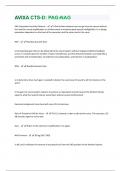
EAD, Equivalent Acoustic Distance - Is the farthest distance one can go from the source without
the need for sound amplification or reinforcement to maintain good speech intelligibility. It is a design
parameter dependent on the level of the presenter and the noise level in the room


PAG - Potential Acoustic Gain


is the potential gain that can be delivered by the sound system without ringing and before feedback
occurs. It is based upon the number of open microphones, and the distances between source(s) (like a
presenter) and microphone(s), microphones to loudspeakers, and listeners to loudspeakers.


NAG - Needed Acoustic Gain


is to determine how much gain is needed to deliver the same level of sound to all the listeners in the
space


Is the gain the sound system requires to achieve an equivalent acoustic level at the farthest listener
equal to what the nearest listener would hear without sound reinforcement


Excessive background noise level will cause this to decrease.


Rule of Thumb for EAD for Voice - 4 ft (1.2 meters) is often a safe bet for voice. This assumes a 25
dB acoustic signal-to-noise ratio


Gain - Refers to the electronic amplification of a signal.


NAG Formula - 20 log (D0 / EAD)


in dB, and it indicates the amount of acoustical loss from the EAD position to the farthest listener.

Get to know the seller

Seller avatar
Reputation scores are based on the amount of documents a seller has sold for a fee and the reviews they have received for those documents. There are three levels: Bronze, Silver and Gold. The better the reputation, the more your can rely on the quality of the sellers work.
PatrickKaylian Delaware State University
View profile
Follow You need to be logged in order to follow users or courses
Sold
1820
Member since
2 year
Number of followers
1044
Documents
22126
Last sold
4 days ago

3.8

317 reviews

5
147
4
60
3
54
2
16
1
40

Why students choose Stuvia

Created by fellow students, verified by reviews

Quality you can trust: written by students who passed their tests and reviewed by others who've used these notes.

Didn't get what you expected? Choose another document

No worries! You can instantly pick a different document that better fits what you're looking for.

Pay as you like, start learning right away

No subscription, no commitments. Pay the way you're used to via credit card and download your PDF document instantly.

Student with book image

“Bought, downloaded, and aced it. It really can be that simple.”

Alisha Student

Frequently asked questions
