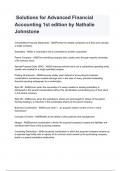
Solutions for Advanced Financial
Accounting 1st edition by Nathalie
Johnstone
Consolidated Financial Statements - ANSPortray the related companies as if they were actually
a single company.
Subsidiary - ANSIs a corporation that is controlled by another corporation
Parent Company - ANSThe controlling company who usually owns through majority ownership
of its common stock
Special-Purpose Entity (SPE) - ANSA financing vehicle that is not a substantive operating entity,
usually one created for a single specified purpose.
Pooling-Of-Interests - ANSPreviously widely used method of accounting for business
combinations, sometimes created earnings and, in the view of many, provided misleading
financial reporting subsequent to a combination.
Spin-Off - ANSOccurs when the ownership of a newly created or existing subsidiary is
distributed to the parent's stockholders without the stockholders surrendering any of their stock
in the parent company.
Split-Off - ANSOccurs when the subsidiary's shares are exchanged for shares of the parent,
thereby leading to a reduction in the outstanding shares of the parent company
Business Combination - ANSOccurs when "...an acquirer obtains control of one or more
businesses."
Concept of Control - ANSRelates to the ability to direct policies and management
Merger - ANSBusiness combination in which the acquired company's assets and liabilities are
combined with those of the acquiring company.
Controlling Ownership - ANSA business combination in which the acquired company remains as
a seperate legal entity with a majority of its common stock owned by the purchasing company
leads to a parent-subsidiary relationship.
, Noncontrolling Ownership - ANSThe purchase of a less-than-majority interest in another
corporation does not usually result in a business combination or controlling situation.
Other Beneficial Interest - ANSOne company may have a beneficial interest in another entity
even without a direct ownership interest.
Primary Beneficiary - ANSA company that has the ability to make decisions significantly
affecting the results of another entity's activities or is expected to receive a majority of the other
entity's profits and losses
Statutory Merger - ANSIs a type of business combination in which only one of the combining
companies survives and the other loses its seperate identitiy.
Liquidated - ANSWhen the acquired company's assets and liabilities are transferred to the
acquiring company, and the acquired company is disolved
Statutory Consolidation - ANSIs a business combination in which both combining companies
are dissolved and the assets and liabilities of both companies are transferred to a newly created
corporation.
Stock Acquisition - ANSOccurs when one company acquires the voting shares of another
company and the two companies continue to operate as seperat, but related, legal entities
Parent-Subsidiary Relationship - ANSThe relationship that is created in a stock acquisition
Hostile Takeover - ANSIn an unfriendly combination, where the managements of the companies
involved are unable to agree on the terms of a combination, and the management of one of the
companies makes a tender offer directly to the shareholders of the other company.
Tender Offer - ANSInvities the shareholders of the other company to exchange their shares for
securities or assets of the acquiring company.
Noncontrolling Interest - ANSThe total of the shares of an acquired company not held by the
controlling shareholder
Acquisition Method - ANSThe acquirer recongnizes all assets acquired and liabilities assumed
in a business combination and measures them at their acquisition-date fair values.
Goodwill - ANSIs an asset representing the future economic benefits arising from other assets
acquired in a business combination that are not individually identified and separately recognized
Differential - ANSThe total difference at the acquisition date between the fair value of the
consideration exchanged and the book value of the net identifiable assets acquired
Accounting 1st edition by Nathalie
Johnstone
Consolidated Financial Statements - ANSPortray the related companies as if they were actually
a single company.
Subsidiary - ANSIs a corporation that is controlled by another corporation
Parent Company - ANSThe controlling company who usually owns through majority ownership
of its common stock
Special-Purpose Entity (SPE) - ANSA financing vehicle that is not a substantive operating entity,
usually one created for a single specified purpose.
Pooling-Of-Interests - ANSPreviously widely used method of accounting for business
combinations, sometimes created earnings and, in the view of many, provided misleading
financial reporting subsequent to a combination.
Spin-Off - ANSOccurs when the ownership of a newly created or existing subsidiary is
distributed to the parent's stockholders without the stockholders surrendering any of their stock
in the parent company.
Split-Off - ANSOccurs when the subsidiary's shares are exchanged for shares of the parent,
thereby leading to a reduction in the outstanding shares of the parent company
Business Combination - ANSOccurs when "...an acquirer obtains control of one or more
businesses."
Concept of Control - ANSRelates to the ability to direct policies and management
Merger - ANSBusiness combination in which the acquired company's assets and liabilities are
combined with those of the acquiring company.
Controlling Ownership - ANSA business combination in which the acquired company remains as
a seperate legal entity with a majority of its common stock owned by the purchasing company
leads to a parent-subsidiary relationship.
, Noncontrolling Ownership - ANSThe purchase of a less-than-majority interest in another
corporation does not usually result in a business combination or controlling situation.
Other Beneficial Interest - ANSOne company may have a beneficial interest in another entity
even without a direct ownership interest.
Primary Beneficiary - ANSA company that has the ability to make decisions significantly
affecting the results of another entity's activities or is expected to receive a majority of the other
entity's profits and losses
Statutory Merger - ANSIs a type of business combination in which only one of the combining
companies survives and the other loses its seperate identitiy.
Liquidated - ANSWhen the acquired company's assets and liabilities are transferred to the
acquiring company, and the acquired company is disolved
Statutory Consolidation - ANSIs a business combination in which both combining companies
are dissolved and the assets and liabilities of both companies are transferred to a newly created
corporation.
Stock Acquisition - ANSOccurs when one company acquires the voting shares of another
company and the two companies continue to operate as seperat, but related, legal entities
Parent-Subsidiary Relationship - ANSThe relationship that is created in a stock acquisition
Hostile Takeover - ANSIn an unfriendly combination, where the managements of the companies
involved are unable to agree on the terms of a combination, and the management of one of the
companies makes a tender offer directly to the shareholders of the other company.
Tender Offer - ANSInvities the shareholders of the other company to exchange their shares for
securities or assets of the acquiring company.
Noncontrolling Interest - ANSThe total of the shares of an acquired company not held by the
controlling shareholder
Acquisition Method - ANSThe acquirer recongnizes all assets acquired and liabilities assumed
in a business combination and measures them at their acquisition-date fair values.
Goodwill - ANSIs an asset representing the future economic benefits arising from other assets
acquired in a business combination that are not individually identified and separately recognized
Differential - ANSThe total difference at the acquisition date between the fair value of the
consideration exchanged and the book value of the net identifiable assets acquired