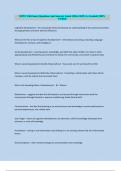
MTTC 106 Exam | Questions And Answers Latest {2024- 2025} A+ Graded | 100%
Verified
Cognitive Development - the way people think and develop an understanding of the world around them
through genetics and other learned influences
What are the five areas of cognitive development? - Information processing, reasoning, language
development, memory, and intelligence
Social development - learning values, knowledge, and skills that allow children to relate to other
appropriately and effectively and contribute to family, the community, and school in positive ways
What is social development directly influenced by? - those who care for and teach the child
What is social development INdirectly influenced by? - friendships, relationships with other family
members, and the culture that surrounds them
Who is the founding father of behaviorism? - B.F. Skinner
Behaviorism - suggests the idea that all behaviors are learned through interactions with the
environment through classical or operant conditioning; blank slate at birth
Constructivism - the idea that learning is an active process and knowledge is constructed based on
personal experiences; not a blank slate
Jean Piaget - theory of cognitive development; the idea that a child's knowledge developed from
schemas, or units of knowledge
Assimilation - taking in new information and relating it to an existing schema that the child already
knows
Accommodation - when schema changes to accommodate new knowledge
, Sensorimotor stage - infancy; infants demonstrate intelligence through motor activities and without
using sumbols
Pre-operational stage - toddlerhood to early childhood; demonstration of intelligence through symbols.
language abilities mature at this stage and memory and imagination are developing rapidly
Concrete operational stage - elementary years to early adolescence; children begin to use actions that
are logical and rational when thinking and solving problems
Formal operational Stage - adolescence through adulthood; children become able to independently
navigate through problems and situations
Lev Vygotsky - social development theory and zone of proximal development
social development theory - the idea that social development plays a critical role in which cognitive
development depends upon
ZPD - the distance between a child's actual developmental level and the potential developmental level
as demonstrated under adult or peer guidance
When is ZPD achieved? - When children are engaged in social behavior with adults or peers
Erik Erikson - theory of psychosocial development; suggests that a healthy personality is developed by
the successful completion of each stage
Albert Bandura - Social learning theory; the idea that people learn best by observing, imitating, and
modeling behaviors, attitudes, and emotional reactions
Jerome Bruner - Three modes of representation; enactive, iconic, symbolic
Howard gardner - Multiple intelligences
Verified
Cognitive Development - the way people think and develop an understanding of the world around them
through genetics and other learned influences
What are the five areas of cognitive development? - Information processing, reasoning, language
development, memory, and intelligence
Social development - learning values, knowledge, and skills that allow children to relate to other
appropriately and effectively and contribute to family, the community, and school in positive ways
What is social development directly influenced by? - those who care for and teach the child
What is social development INdirectly influenced by? - friendships, relationships with other family
members, and the culture that surrounds them
Who is the founding father of behaviorism? - B.F. Skinner
Behaviorism - suggests the idea that all behaviors are learned through interactions with the
environment through classical or operant conditioning; blank slate at birth
Constructivism - the idea that learning is an active process and knowledge is constructed based on
personal experiences; not a blank slate
Jean Piaget - theory of cognitive development; the idea that a child's knowledge developed from
schemas, or units of knowledge
Assimilation - taking in new information and relating it to an existing schema that the child already
knows
Accommodation - when schema changes to accommodate new knowledge
, Sensorimotor stage - infancy; infants demonstrate intelligence through motor activities and without
using sumbols
Pre-operational stage - toddlerhood to early childhood; demonstration of intelligence through symbols.
language abilities mature at this stage and memory and imagination are developing rapidly
Concrete operational stage - elementary years to early adolescence; children begin to use actions that
are logical and rational when thinking and solving problems
Formal operational Stage - adolescence through adulthood; children become able to independently
navigate through problems and situations
Lev Vygotsky - social development theory and zone of proximal development
social development theory - the idea that social development plays a critical role in which cognitive
development depends upon
ZPD - the distance between a child's actual developmental level and the potential developmental level
as demonstrated under adult or peer guidance
When is ZPD achieved? - When children are engaged in social behavior with adults or peers
Erik Erikson - theory of psychosocial development; suggests that a healthy personality is developed by
the successful completion of each stage
Albert Bandura - Social learning theory; the idea that people learn best by observing, imitating, and
modeling behaviors, attitudes, and emotional reactions
Jerome Bruner - Three modes of representation; enactive, iconic, symbolic
Howard gardner - Multiple intelligences