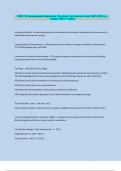
CEH V10 Scanning and Enumeration | Questions And Answers Latest {2024- 2025} A+
Graded | 100% Verified
Scanning Defintion - discovering systems on the network and looking at what ports are open as well as
applications that may be running
Connectionless Communication - UDP packets are sent without creating a connection. Examples are
TFTP, DNS (lookups only) and DHCP
Connection-Oriented Communication - TCP packets require a connection due to the size of the data
being transmitted and to ensure deliverability
TCP Flags - -total of 8 bits for 8 flags
SYN (Synchronize) Set during initial communication. Negotiating of parameters and sequence numbers
ACK (Acknowledgment) Set as an acknowledgement to the SYN flag. Always set after initial SYN
RST (Reset) Forces the termination of a connection (in both directions)
FIN (Finish) Ordered close to communications
PSH (Push) Forces the delivery of data without concern for buffering
URG (Urgent) Data inside is being sent out of band. Example is cancelling a message
TCP Handshake - SYN -> SYN-ACK - ACK
The protocol by which a client and server machine establish communication for the transfer of data.
Internet Assigned Numbers Authority (IANA) - maintains Service Name and Transport Protocol Port
Number Registry which lists all port number reservations
Port Number Ranges - Well-known ports - 0 - 1023
Registered ports - 1024 - 49,151
Dynamic ports - 49,152 - 65,535
, Port 20/21 - FTP File Transfer Protocol (TCP/UDP) 21(SCTP)
Port 22 - SSH TCP
Port 23 - TCP Telnet
Port 25 - SMTP (Simple Mail Transfer Protocol)- TCP
Port 53 - DNS TCP/UDP
Port 67 - DHCP UDP
Port 69 - TFTP UDP
Port 80 - HTTP TCP
Port 110 - POP3 TCP
Port 135 - Remote Procedure Call (RPC) TCP
Port 137-139 - NetBIOS
(TCP / UDP)
Port 143 - IMAP TCP
Port 161/162 - SNMP (Simple Network Management Protocol) UDP
Port 389 - LDAP (Lightweight Directory Access Protocol) TCP/UDP
Graded | 100% Verified
Scanning Defintion - discovering systems on the network and looking at what ports are open as well as
applications that may be running
Connectionless Communication - UDP packets are sent without creating a connection. Examples are
TFTP, DNS (lookups only) and DHCP
Connection-Oriented Communication - TCP packets require a connection due to the size of the data
being transmitted and to ensure deliverability
TCP Flags - -total of 8 bits for 8 flags
SYN (Synchronize) Set during initial communication. Negotiating of parameters and sequence numbers
ACK (Acknowledgment) Set as an acknowledgement to the SYN flag. Always set after initial SYN
RST (Reset) Forces the termination of a connection (in both directions)
FIN (Finish) Ordered close to communications
PSH (Push) Forces the delivery of data without concern for buffering
URG (Urgent) Data inside is being sent out of band. Example is cancelling a message
TCP Handshake - SYN -> SYN-ACK - ACK
The protocol by which a client and server machine establish communication for the transfer of data.
Internet Assigned Numbers Authority (IANA) - maintains Service Name and Transport Protocol Port
Number Registry which lists all port number reservations
Port Number Ranges - Well-known ports - 0 - 1023
Registered ports - 1024 - 49,151
Dynamic ports - 49,152 - 65,535
, Port 20/21 - FTP File Transfer Protocol (TCP/UDP) 21(SCTP)
Port 22 - SSH TCP
Port 23 - TCP Telnet
Port 25 - SMTP (Simple Mail Transfer Protocol)- TCP
Port 53 - DNS TCP/UDP
Port 67 - DHCP UDP
Port 69 - TFTP UDP
Port 80 - HTTP TCP
Port 110 - POP3 TCP
Port 135 - Remote Procedure Call (RPC) TCP
Port 137-139 - NetBIOS
(TCP / UDP)
Port 143 - IMAP TCP
Port 161/162 - SNMP (Simple Network Management Protocol) UDP
Port 389 - LDAP (Lightweight Directory Access Protocol) TCP/UDP