8/17/24, 5:25 AM
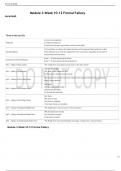
Module 3-Week 10-12 Formal Fallacy
Jeremiah
Terms in this set (25)
An error in an argument.
Fallacies Lt. Fallere (to deceive)
It looks true but upon examination, will be proven false
A formal fallacy is a flaw in the logical structure of an argument that renders it invalid.
Formal Fallacies These fallacies occur when the argument's form is incorrect, regardless of the truth of
the premises and conclusion.
Rules 1 - 4 Rules governing the terms
2 Divisions of Formal Fallacies
Rules 5 - 8 Rules governing the propositions
R#1 = Fallacy of Equivocation "The middle term must always be be taken in the same sense."
(1P) A feather is light.
R#1 = Fallacy of Equivocation (2P) What is light cannot be dark.
(C) Therefore, a feather cannot be dark.
"The major term and the minor term cannot have a greater tension in the conclusion
R#2 = Fallacy of Illicit Major/Minor
than in the premise."
Ilicit Major
(MP) All Dogs are Mammals.
R#2 = Fallacy of Illicit Major/Minor
(mP) No cats are dogs.
(C) No cats are Mammals.
Ilicit Minor
(MP) Pizza is tasty.
R#2 = Fallacy of Illicit Major/Minor
(mP) Pizza is unhealthy.
(C) All tasty things are unhealthy.
R#3 = Fallacy of Misplaced Middle Term "The Middle term must not occur in the conclusion."
(MP) All humans are mortal.
R#3 = Fallacy of Misplaced Middle Term (mP) All cats are animals.
(C) all cats are mortal.
R#4 = Fallacy of Undistributed Middle Term "The Middle term must be distributed universally, at least once, in the premises."
Module 3-Week 10-12 Formal Fallacy
1/2
Module 3-Week 10-12 Formal Fallacy
Jeremiah
Terms in this set (25)
An error in an argument.
Fallacies Lt. Fallere (to deceive)
It looks true but upon examination, will be proven false
A formal fallacy is a flaw in the logical structure of an argument that renders it invalid.
Formal Fallacies These fallacies occur when the argument's form is incorrect, regardless of the truth of
the premises and conclusion.
Rules 1 - 4 Rules governing the terms
2 Divisions of Formal Fallacies
Rules 5 - 8 Rules governing the propositions
R#1 = Fallacy of Equivocation "The middle term must always be be taken in the same sense."
(1P) A feather is light.
R#1 = Fallacy of Equivocation (2P) What is light cannot be dark.
(C) Therefore, a feather cannot be dark.
"The major term and the minor term cannot have a greater tension in the conclusion
R#2 = Fallacy of Illicit Major/Minor
than in the premise."
Ilicit Major
(MP) All Dogs are Mammals.
R#2 = Fallacy of Illicit Major/Minor
(mP) No cats are dogs.
(C) No cats are Mammals.
Ilicit Minor
(MP) Pizza is tasty.
R#2 = Fallacy of Illicit Major/Minor
(mP) Pizza is unhealthy.
(C) All tasty things are unhealthy.
R#3 = Fallacy of Misplaced Middle Term "The Middle term must not occur in the conclusion."
(MP) All humans are mortal.
R#3 = Fallacy of Misplaced Middle Term (mP) All cats are animals.
(C) all cats are mortal.
R#4 = Fallacy of Undistributed Middle Term "The Middle term must be distributed universally, at least once, in the premises."
Module 3-Week 10-12 Formal Fallacy
1/2