Financial and Management Accounting
Lecture 1 – Financial accounting
Chapter 1: Introduction to Financial and Management Accounting
Accounting: collecting, analyzing and communicating financial information
Financial accounting: information for external users.
Management accounting: information for internal users.
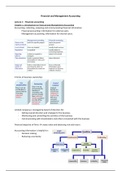
3 forms of business ownership:
Limited company is managed by board of directors for:
- Setting overall direction and strategy for the business
- Monitoring and controlling the activities of the business
- Communicating with shareholders and others connected with the business
Financial objective of firms → create value and balancing risk and return.
Accounting information is helpful for:
- Decision making
- Reducing uncertainty
,Chapter 2: Measuring and reporting financial position
Current assets:
- Held for sale or consumption during the business’s operating cycle
- Expected to be sold within the next year
- Held principally for trading
- Cash or equivalents to cash
Non-current assets:
- All other assets
Current liabilities:
- Expected to settle within the business’s normal operating cycle.
- Held principally for trading purposes
- Due to settle within a year after the statement of financial position date
- No right to defer payment beyond a year
Non-current liabilities:
- All other liabilities
Equity:
- Shares, reserves, etc.
Business equity convention: distinguish legal position between business and owners.
Historic cost convention: value of assets should be based on historic cost.
Prudence convention: caution should be exercised when making accounting judgments.
Going concern convention: financial statements should be prepared on the assumption that a
business will continue.
Dual aspect convention: each transaction has two aspects and both will affect balance sheet.
Money measurement: key problems:
- Goodwill, brands: lack clear separate identity and reflect many attributes, difficult to value.
- Human resources: human capital, often impossible to value rights/services, difficult to
measure.
- Monetary stability: assumption that money will keep its value (inflation/exchange rates)
, Usefulness of statement of financial position:
- Shows how the business is financed and how funds are deployed
- Assess relationship between assets and claims
- Provide basis for assessing the value of the business
- Assess the performance of the business
Lecture 2 – Financial accounting
Chapter 3 – Measuring and reporting financial performance
Income statement
Profit(loss) = total revenue – total expenses
→ green = operating expenses
Revenue recognition:
- Amount of revenue measured reliably
- Likely the economics benefits will be received
Long term contracts: could lead to misleading impression of performance over time
→ so define stages in contract and recognize revenues when stages are completed
Continuous services: impossible to define stages → so assume evenly periods
Matching convention: expenses should be matched to the revenue that it generated.
Accruals convention: profit = revenue – expenses (not cash receipts – cash payments)
Depreciation/amortization: measure the cost of non-current assets that are depleted in generating
revenue of particular period.
Depreciation: tangible assets, in case of physical deterioration
Amortization: intangible assets, in case of outdated software
Consistency convention: once a particular method of accounting is selected it should be applied
consistently over time.
Lecture 1 – Financial accounting
Chapter 1: Introduction to Financial and Management Accounting
Accounting: collecting, analyzing and communicating financial information
Financial accounting: information for external users.
Management accounting: information for internal users.
3 forms of business ownership:
Limited company is managed by board of directors for:
- Setting overall direction and strategy for the business
- Monitoring and controlling the activities of the business
- Communicating with shareholders and others connected with the business
Financial objective of firms → create value and balancing risk and return.
Accounting information is helpful for:
- Decision making
- Reducing uncertainty
,Chapter 2: Measuring and reporting financial position
Current assets:
- Held for sale or consumption during the business’s operating cycle
- Expected to be sold within the next year
- Held principally for trading
- Cash or equivalents to cash
Non-current assets:
- All other assets
Current liabilities:
- Expected to settle within the business’s normal operating cycle.
- Held principally for trading purposes
- Due to settle within a year after the statement of financial position date
- No right to defer payment beyond a year
Non-current liabilities:
- All other liabilities
Equity:
- Shares, reserves, etc.
Business equity convention: distinguish legal position between business and owners.
Historic cost convention: value of assets should be based on historic cost.
Prudence convention: caution should be exercised when making accounting judgments.
Going concern convention: financial statements should be prepared on the assumption that a
business will continue.
Dual aspect convention: each transaction has two aspects and both will affect balance sheet.
Money measurement: key problems:
- Goodwill, brands: lack clear separate identity and reflect many attributes, difficult to value.
- Human resources: human capital, often impossible to value rights/services, difficult to
measure.
- Monetary stability: assumption that money will keep its value (inflation/exchange rates)
, Usefulness of statement of financial position:
- Shows how the business is financed and how funds are deployed
- Assess relationship between assets and claims
- Provide basis for assessing the value of the business
- Assess the performance of the business
Lecture 2 – Financial accounting
Chapter 3 – Measuring and reporting financial performance
Income statement
Profit(loss) = total revenue – total expenses
→ green = operating expenses
Revenue recognition:
- Amount of revenue measured reliably
- Likely the economics benefits will be received
Long term contracts: could lead to misleading impression of performance over time
→ so define stages in contract and recognize revenues when stages are completed
Continuous services: impossible to define stages → so assume evenly periods
Matching convention: expenses should be matched to the revenue that it generated.
Accruals convention: profit = revenue – expenses (not cash receipts – cash payments)
Depreciation/amortization: measure the cost of non-current assets that are depleted in generating
revenue of particular period.
Depreciation: tangible assets, in case of physical deterioration
Amortization: intangible assets, in case of outdated software
Consistency convention: once a particular method of accounting is selected it should be applied
consistently over time.