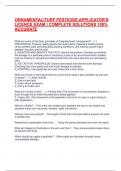
ORNAMENTAL/TURF PESTICIDE APPLICATOR'S
LICENCE EXAM | COMPLETE SOLUTIONS 100%
ACCURATE
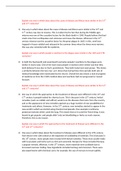
What are some of the basic principles of Integrated pest management? - 1.)
PREVENTION: Produce healthy plants that resist plants: (Selecting healthy plants,
using certified seed, providing good growing conditions, and making a good match
between the plant and the site)
2.) MONITOR AND IDENTIFY THE PEST: Identify the problem: (Finding out whether
the damage to a particular plant is caused by a pest or by an environmental condition
such as freezing or drought and always determine the exact pest that you are dealing
with)
3.) SET ACTION THRESHOLDS: Expect some pests and tolerate some damage:
(Deciding how many pests and how much damage to tolerate)
4.) CONTROL: Use pesticides as a last choice-Not a first choice
What are 4 tools or techniques that you could use to study a plant problem as you look
for pests? - 1.) Keep records
2.) Use a hand lens
3.) Learn about symptoms
4.) Carry an index card
What are 2 kinds of drift? - 1.) Particle drift: (The movement of fine particles (droplets or
dust) through the air while the pesticide is being applied)
2.) Vapor drift: (The movement of the pesticide in the form of a gas or vapor during or
after application)
What is a Buffer? - This is the non treated zone between the area to be treated and
sensitive areas such as ponds, streams, wells, and drains
What is a Re-entry period? - The length of time that must pass before anyone can enter
a treated area
Resistance to pesticides come from... - Using the same pesticides over and over again
What will happen to Pesticides in the soil over time? - They are eventually broken down
by bacteria and fungi
When should you apply a pesticide? - When pests are abundant enough cause
unacceptable damage
, What hand lens magnification is recommended for insect identification? - 5 power to 10
power
What should you do in an IPM program? - Produce healthy plants that can resist pests
Why should pesticide application be the last choice in pest management? - Because
they are labeled for use only on specific pests and types of plants and because it is
safer to use other controls
What is Integrated pest management (IPM) ? - It is an effective and environmentally
sensitive approach to pest management that relies on a combination of common-sense
practices. IPM programs use current, comprehensive information on the life cycles of
pests and their interaction with the environment
What is Phytotoxicity? - A toxic effect by a compound on plant growth
What is Pesticide breakdown? - The breakdown of pesticides into non-toxic substances
from bacteria and fungi in the soil
What is a Threshold? - A point at which pest populations or environmental conditions
indicate that pest control action must be taken
What are the strategies that delay the development of pesticide resistance? - Using a
pesticide only when needed and choosing alternative pesticides from different chemical
classes
What is an Indicator plant? - Plants that can indicate the onset of a pest infestation
What does proper mowing mean? - Using sharp mower blades to make a clean cut
What do you need to do to promote healthy turf and reduce disease? - Water
thoroughly when you first see wilting
What should you do when fertilizing? - Determine fertilizer need through results of a soil
test
Cool-season cultivars... - Can be mixed to minimize disease
What does good soil drainage do? - Promotes healthy turfgrass
What are the 3 major geographical regions in the southeastern U.S.? - 1.) Mountains:
(Cool-season grasses)
2.) Piedmont: (The transitional zone where both warm and cool-season grasses are
used)
*Cool-season gasses do better in the upper-piedmont region
*Warm-season grasses do better in the lower-piedmont region
LICENCE EXAM | COMPLETE SOLUTIONS 100%
ACCURATE
What are some of the basic principles of Integrated pest management? - 1.)
PREVENTION: Produce healthy plants that resist plants: (Selecting healthy plants,
using certified seed, providing good growing conditions, and making a good match
between the plant and the site)
2.) MONITOR AND IDENTIFY THE PEST: Identify the problem: (Finding out whether
the damage to a particular plant is caused by a pest or by an environmental condition
such as freezing or drought and always determine the exact pest that you are dealing
with)
3.) SET ACTION THRESHOLDS: Expect some pests and tolerate some damage:
(Deciding how many pests and how much damage to tolerate)
4.) CONTROL: Use pesticides as a last choice-Not a first choice
What are 4 tools or techniques that you could use to study a plant problem as you look
for pests? - 1.) Keep records
2.) Use a hand lens
3.) Learn about symptoms
4.) Carry an index card
What are 2 kinds of drift? - 1.) Particle drift: (The movement of fine particles (droplets or
dust) through the air while the pesticide is being applied)
2.) Vapor drift: (The movement of the pesticide in the form of a gas or vapor during or
after application)
What is a Buffer? - This is the non treated zone between the area to be treated and
sensitive areas such as ponds, streams, wells, and drains
What is a Re-entry period? - The length of time that must pass before anyone can enter
a treated area
Resistance to pesticides come from... - Using the same pesticides over and over again
What will happen to Pesticides in the soil over time? - They are eventually broken down
by bacteria and fungi
When should you apply a pesticide? - When pests are abundant enough cause
unacceptable damage
, What hand lens magnification is recommended for insect identification? - 5 power to 10
power
What should you do in an IPM program? - Produce healthy plants that can resist pests
Why should pesticide application be the last choice in pest management? - Because
they are labeled for use only on specific pests and types of plants and because it is
safer to use other controls
What is Integrated pest management (IPM) ? - It is an effective and environmentally
sensitive approach to pest management that relies on a combination of common-sense
practices. IPM programs use current, comprehensive information on the life cycles of
pests and their interaction with the environment
What is Phytotoxicity? - A toxic effect by a compound on plant growth
What is Pesticide breakdown? - The breakdown of pesticides into non-toxic substances
from bacteria and fungi in the soil
What is a Threshold? - A point at which pest populations or environmental conditions
indicate that pest control action must be taken
What are the strategies that delay the development of pesticide resistance? - Using a
pesticide only when needed and choosing alternative pesticides from different chemical
classes
What is an Indicator plant? - Plants that can indicate the onset of a pest infestation
What does proper mowing mean? - Using sharp mower blades to make a clean cut
What do you need to do to promote healthy turf and reduce disease? - Water
thoroughly when you first see wilting
What should you do when fertilizing? - Determine fertilizer need through results of a soil
test
Cool-season cultivars... - Can be mixed to minimize disease
What does good soil drainage do? - Promotes healthy turfgrass
What are the 3 major geographical regions in the southeastern U.S.? - 1.) Mountains:
(Cool-season grasses)
2.) Piedmont: (The transitional zone where both warm and cool-season grasses are
used)
*Cool-season gasses do better in the upper-piedmont region
*Warm-season grasses do better in the lower-piedmont region