, 10th Edition
Materials Science
and Engineering
AN INTRODUCTION
WILLIAM D. CALLISTER, JR.
Department of Metallurgical Engineering
The University of Utah
DAVID G. RETHWISCH
Department of Chemical and Biochemical Engineering
The University of Iowa
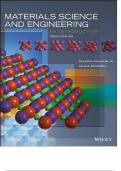
,Front Cover: Representation of a (110) plane for barium titanate (BaTiO3), which has the perovskite crystal structure. Red, purple, and
green spheres represent, respectively, oxygen, barium, and titanium ions.
Back Cover: Depiction of a (123) plane for sodium chloride (NaCl), which has the rock salt crystal structure. Green and brown spheres
denote chlorine and sodium ions, respectively.
VICE PRESIDENT AND DIRECTOR Laurie Rosatone
ACQUISITIONS EDITOR Linda Ratts
DEVELOPMENT EDITOR Adria Giattino
EDITORIAL ASSISTANT Adriana Alecci
MARKETING MANAGER John LaVacca
SENIOR PRODUCT DESIGNER Tom Kulesa
PRODUCTION EDITOR Ashley Patterson
SENIOR CONTENT MANAGER Valerie Zaborski
SENIOR PHOTO EDITOR MaryAnn Price
COVER DESIGNER Tom Nery
COVER ART Roy Wiemann and William D. Callister, Jr.
This book was set in 9.5/11.5 Times Ten LT Std by Aptara, Inc., and printed and bound by Quad Graphics/Versailles. The cover was
printed by Quad Graphics/Versailles.
Founded in 1807, John Wiley & Sons, Inc. has been a valued source of knowledge and understanding for more than 200 years,
helping people around the world meet their needs and fulfill their aspirations. Our company is built on a foundation of principles
that include responsibility to the communities we serve and where we live and work. In 2008, we launched a Corporate Citizenship
Initiative, a global effort to address the environmental, social, economic, and ethical challenges we face in our business. Among the
issues we are addressing are carbon impact, paper specifications and procurement, ethical conduct within our business and among
our vendors, and community and charitable support. For more information, please visit our website: www.wiley.com/go/citizenship.
Copyright © 2018, 2014, 2010, 2007, 2003, 2000 John Wiley & Sons, Inc. All rights reserved. No part of this publication may be
reproduced, stored in a retrieval system, or transmitted in any form or by any means, electronic, mechanical, photocopying,
recording, scanning or otherwise, except as permitted under Sections 107 or 108 of the 1976 United States Copyright Act, without
either the prior written permission of the Publisher, or authorization through payment of the appropriate per-copy fee to the
Copyright Clearance Center, Inc., 222 Rosewood Drive, Danvers, MA 01923 (Web site: www.copyright.com). Requests to the
Publisher for permission should be addressed to the Permissions Department, John Wiley & Sons, Inc., 111 River Street, Hoboken,
NJ 07030-5774, (201) 748-6011, fax (201) 748-6008, or online at: www.wiley.com/go/permissions.
Evaluation copies are provided to qualified academics and professionals for review purposes only, for use in their courses during
the next academic year. These copies are licensed and may not be sold or transferred to a third party. Upon completion of the
review period, please return the evaluation copy to Wiley. Return instructions and a free of charge return shipping label are
available at: www.wiley.com/go/returnlabel. If you have chosen to adopt this textbook for use in your course, please accept this book
as your complimentary desk copy. Outside of the United States, please contact your local sales representative.
The inside back cover will contain printing identification and country of origin if omitted from this page. In addition, if the ISBN on
the back cover differs from the ISBN on this page, the one on the back cover is correct.
Library of Congress Cataloging in Publication Data
Names: Callister, William D., Jr., 1940- author. | Rethwisch, David G., author.
Title: Materials science and engineering : an introduction / by William D.
Callister, Department of Metallurgical Engineering, The University of
Utah, David G. Rethwisch, Department of Chemical and Biochemical
Engineering, The University of Iowa.
Description: 10th edition. | Hoboken, NJ : Wiley, [2018] | Includes
bibliographical references and index. |
Identifiers: LCCN 2017029444 (print) | LCCN 2017032239 (ebook) | ISBN
9781119405498 (Enhanced epub) | ISBN 9781119405436 (pdf) | ISBN
9781119405399 (loose leaf print companion) | ISBN 9781119405405 (evalc (paper))
Subjects: LCSH: Materials. | Materials science—Textbooks.
Classification: LCC TA403 (ebook) | LCC TA403 .C23 2018 (print) | DDC 620.1/1—dc23
LC record available at https://lccn.loc.gov/2017029444
ISBN-13: 9781119321590
Printed in the United States of America
10 9 8 7 6 5 4 3 2 1
, Dedicated to the memory of
Peter Joseph Rethwisch
Father, lumberman, and friend
, Preface
I n this tenth edition we have retained the objectives and approaches for teaching
materials science and engineering that were presented in previous editions. These objec-
tives are as follows:
• Present the basic fundamentals on a level appropriate for university/college
students.
• Present the subject matter in a logical order, from the simple to the more complex.
• If a topic or concept is worth treating, then it is worth treating in sufficient detail
and to the extent that students have the opportunity to fully understand it without
having to consult other sources.
• Inclusion of features in the book that expedite the learning process, to include the
following: photographs/illustrations; learning objectives; “Why Study . . .” and
“Materials of Importance” items; “Concept Check” questions; questions and
problems; Answers to Selected Problems; summary tables containing key equations
and equation symbols; and a glossary (for easy reference).
• Employment of new instructional technologies to enhance the teaching and
learning processes.
New/Revised Content
This new edition contains a number of new sections, as well as revisions/amplifications of
other sections. These include the following:
• New discussions on the Materials Paradigm and Materials Selection (Ashby)
Charts (Chapter 1)
• Revision of Design Example 8.1—“Materials Specification for a Pressurized
Cylindrical Tank” (Chapter 8)
• New discussions on 3D printing (additive manufacturing)—Chapter 11 (metals),
Chapter 13 (ceramics), and Chapter 15 (polymers)
• New discussions on biomaterials—Chapter 11 (metals), Chapter 13 (ceramics), and
Chapter 15 (polymers)
• New section on polycrystalline diamond (Chapter 13)
• Revised discussion on the Hall effect (Chapter 18)
• Revised/expanded discussion on recycling issues in materials science and
engineering (Chapter 22)
• All homework problems requiring computations have been refreshed
BOOK VERSIONS
There are three versions of this textbook as follows:
• Digital (for purchase)—formatted as print; contains entire content
• v
,vi • Preface
• Digital (in WileyPLUS)—formatted by section; contains entire content
• Abridged Print (Companion)—binder ready form; problem statements omitted
ONLINE RESOURCES
Associated with the textbook are online learning resources, which are available to both
students and instructors. These resources are found on three websites: (1) WileyPLUS, (2) a
Student Companion Site, and (3) an Instructor Companion Site.
WileyPLUS (www.wileyplus.com)
WileyPLUS is a research-based online environment for effective teaching and learning. It
builds students’ confidence by taking the guesswork out of studying by providing them with
a clear roadmap: what is assigned, what is required for each assignment, and whether assign-
ments are done correctly. Independent research has shown that students using WileyPLUS
will take more initiative so the instructor has a greater impact on their achievement in the
classroom and beyond. WileyPLUS also helps students study and progress at a pace that’s
right for them. Our integrated resources–available 24/7–function like a personal tutor, di-
rectly addressing each student’s demonstrated needs by providing specific problem-solving
techniques.
What do students receive with WileyPLUS?
They can browse the following WileyPLUS resources by chapter.
• The Complete Digital Textbook (at a savings up to 60% of the cost of the in-print
text). Each chapter is organized and accessed by section (and end-of-chapter
elements). (Found under Read, Study & Practice/CONTENTS/Select Chapter
Number/CHAPTER RESOURCES/Reading Content.)
• Virtual Materials Science and Engineering (VMSE). This web-based software
package consists of interactive simulations and animations that enhance the
learning of key concepts in materials science and engineering. Included in VMSE
are eight modules and a materials properties/cost database. Titles of these modules
are as follows: (1) Metallic Crystal Structures and Crystallography; (2) Ceramic
Crystal Structures; (3) Repeat Unit and Polymer Structures; (4) Dislocations;
(5) Phase Diagrams; (6) Diffusion; (7) Tensile Tests; and (8) Solid-Solution
Strengthening. (Found under Read, Study & Practice.)
• Tutorial (“Muddiest Point”) Videos. These videos (narrated by a student) help
students with concepts that are difficult to understand and with solving
troublesome problems. (Found under Read, Study & Practice.)
• Library of Case Studies. One way to demonstrate principles of design in an
engineering curriculum is via case studies: analyses of problem-solving strategies
applied to real-world examples of applications/devices/failures encountered by
engineers. Six case studies are provided as follows: (1) Materials Selection for a
Torsionally Stressed Cylindrical Shaft; (2) Automobile Valve Spring; (3) Failure of
an Automobile Rear Axle; (4) Artificial Total Hip Replacement; (5) Intraocular
Lens Implants; and (6) Chemical Protective Clothing. (Found under Read, Study &
Practice.)
• Mechanical Engineering (ME) Online Module. This module treats materials
science/engineering topics not covered in the printed text that are relevant to
mechanical engineering. (Found under Read, Study & Practice.)
• Flash Cards. A set of flash-cards has been generated for most chapters. These can
be used in drills to memorize definitions of terms. (Found under Read, Study &
Practice/CONTENTS/Select Chapter Number/CHAPTER RESOURCES/
Flashcards.)
, Preface • vii
• Extended Learning Objectives. This is a more extensive list of learning objectives
than is provided at the beginning of each chapter. These direct the student to study
the subject material to a greater depth. (Found under Read, Study & Practice/
CONTENTS/Select Chapter Number/CHAPTER RESOURCES/Extended
Learning Objectives.)
• Student Lecture Notes. These slides (in PowerPoint and PDF formats) are virtually
identical to the lecture slides provided to an instructor for use in the classroom. The
student set has been designed to allow for note taking on printouts. (Found under
Read, Study & Practice/CONTENTS/Select Chapter Number/CHAPTER
RESOURCES/Student Lecture Notes.)
• Answers to Concept Check questions. Students can visit the web site to find the
correct answers to the Concept Check questions posed in the textbook. (Found
under Read, Study & Practice/CONTENTS/Select Chapter Number/PRACTICE/
Concept Check Questions/Concept Check Number/Show Solution.)
• Online Self-Assessment Exercises. A set of questions and problems for each chapter
that are similar to those found in the text. An answer to each problem/question
entered by the student is assessed as either correct or incorrect, after which both the
solution and answer are provided. (Found under Read, Study & Practice/CONTENTS/
Select Chapter Number/PRACTICE/Practice Questions and Problems.)
• Math Skills Review. This is a tutorial that includes instructions on how to solve a
variety of mathematical equations, some of which appear in the homework
problems. Examples are also provided. (Found under Read, Study & Practice/
CONTENTS/Chapter 22.)
What do instructors receive with WileyPLUS?
WileyPLUS provides reliable, customizable resources that reinforce course goals inside
and outside of the classroom as well as visibility into individual student progress. Prepared
materials and activities help instructors optimize their time.
The same resources are provided as are found for students as noted above.
The opportunity to pre-prepare activities, including:
• Questions
• Readings and resources
• Presentations
Course materials and assessment content:
• Complete set of Lecture PowerPoint slides (or Lecture Notes). (Found under
Prepare & Present/Resources/Select Chapter Number/All Sources/Instructor
Resources/PowerPoint/GO/Lecture Notes.)
• Image Gallery. Digital repository of images from the text that instructors may use
to generate their own PowerPoint slides. (Found under Prepare & Present/
Resources/Select Chapter Number/All Sources/Instructor Resources/PowerPoint/
GO/Image Gallery.)
• Solutions Manual (Textbook). The manuals contain solutions/answers for all
problems/questions in the textbook. (Found under Prepare & Present/Resources/
Select Chapter Number/All Sources/Instructor Resources/Document/GO/Chapter
Solutions Manual.)
• Solutions Manual (ME Online Module). (Found under Prepare & Present/
Resources/Mechanical Engineering Module/All Sources/Instructor Resources/
Document/GO/Solutions for ME Module.)
,viii • Preface
• Solutions Manual (Library of Case Studies). (Found under Prepare & Present/
Resources/Select Any Chapter/All Sources/Instructor Resources/Document/GO/
Solutions to the Library Case Studies/Word or PDF.)
• Problem Conversion Guide. This guide correlates homework problems/questions
between the previous and current textbook editions. (Found under Prepare &
Present/Resources/Select Any Chapter/All Sources/Instructor Resources/
Document/GO/Problem Conversion Guide: 9th edition to 10th edition.)
• Problems/Questions. Selected problems coded algorithmically with hints, links to
text, whiteboard/show work feature and instructor controlled problem solving help.
[Found under Assignment/Questions/Select Chapter Number/Select Section
Number (or All Sections)/Select Level (or All Levels)/All Sources/GO.]
• Answers to Concept Check Questions. (Found under Assignment/Questions/Select
Chapter Number/All Sections/All Levels/All Sources/GO/Question Name.)
• List of Classroom Demonstrations and Laboratory Experiments. These demos
and experiments portray phenomena and/or illustrate principles that are discussed
in the book; references are also provided that give more detailed accounts of them.
(Found under Prepare & Present/Resources/Select Any Chapter/All Sources/
Instructor Resources/All File Types/GO/Experiments and Classroom
Demonstrations.)
• Suggested Course Syllabi for the Various Engineering Disciplines. Instructors may
consult these syllabi for guidance in course/lecture organization and planning.
(Found under Prepare & Present/Resources/Select Any Chapter/All Sources/
Instructor Resources/All File Types/GO/Sample Syllabi.)
• Gradebook. WileyPLUS provides instant access to reports on trends in class
performance, student use of course materials and progress towards learning
objectives, helping inform decisions and drive classroom discussions. (Found under
Gradebook.)
STUDENT AND INSTRUCTOR COMPANION SITES
(www.wiley.com/college/callister)
For introductory materials science and engineering courses that do not use WileyPLUS,
print and digital (for purchase) versions of the book are available. In addition, online
resources may be accessed on a Student Companion Site (for students) and an Instructor
Companion Site (for instructors). Some, but not all of the WileyPLUS resources are found
on these two sites.
The following resources may be accessed on the STUDENT COMPANION SITE:
• Student Lecture PowerPoint Slides
• Answers to Concept Check Questions
• Extended Learning Objectives
• Mechanical Engineering (ME) Online Module
• Math Skills Review
Whereas for the INSTRUCTOR COMPANION SITE the following resources are
available:
• Solutions Manuals (in PDF and Word formats)
• Answers to Concept Check Questions
• Problem Conversion Guide
• Complete Set of Lecture PowerPoint Slides
• Extended Learning Objectives
, Preface • ix
• Image Gallery.
• Mechanical Engineering (ME) Online Module
• Solutions to Problems in the ME Online Module
• Suggested Syllabi for the Introductory Materials Course
• Math Skills Review
Feedback
We have a sincere interest in meeting the needs of educators and students in the materi-
als science and engineering community, and therefore solicit feedback on this edition.
Comments, suggestions, and criticisms may be submitted to the authors via email at the fol-
lowing address: .
Acknowledgments
Since we undertook the task of writing this and previous editions, instructors and students,
too numerous to mention, have shared their input and contributions on how to make this
work more effective as a teaching and learning tool. To all those who have helped, we express
our sincere thanks.
We express our appreciation to those who have made contributions to this edition.
We are especially indebted to the following for their feedback and suggestions for this
edition:
• Eric Hellstrom of Florida State University
• Marc Fry and Hannah Melia of Granta Design
• Dr. Carl Wood
• Norman E. Dowling of Virginia Tech
• Tristan J. Tayag of Texas Christian University
• Jong-Sook Lee of Chonnam National University, Gwangju, Korea
We are also indebted to Linda Ratts, Executive Editor; Agie Sznajdrowicz, Project
Manager; Adria Giattino, Associate Development Editor; Adriana Alecci, Editorial
Assistant; Jen Devine, Permissions Manager; Ashley Patterson, Production Editor; and
MaryAnn Price, Senior Photo Editor.
Last, but certainly not least, we deeply and sincerely appreciate the continual
encouragement and support of our families and friends.
William D. Callister, Jr.
David G. Rethwisch
September 2017
, Contents
LIST OF SYMBOLS xix Important Terms and Concepts 46
References 47
1. Introduction 1
3. The Structure of Crystalline
Learning Objectives 2 Solids 48
1.1 Historical Perspective 2
Learning Objectives 49
1.2 Materials Science and Engineering 3
3.1 Introduction 49
1.3 Why Study Materials Science and
Engineering? 5 CRYSTAL STRUCTURES 49
Case Study—Liberty Ship Failures 6 3.2 Fundamental Concepts 49
1.4 Classification of Materials 7 3.3 Unit Cells 50
Case Study—Carbonated Beverage 3.4 Metallic Crystal Structures 51
Containers 12 3.5 Density Computations 57
1.5 Advanced Materials 14 3.6 Polymorphism and Allotropy 57
1.6 Modern Materials’ Needs 16 Material of Importance—Tin (Its
Summary 17 Allotropic Transformation) 58
References 18 3.7 Crystal Systems 59
CRYSTALLOGRAPHIC POINTS, DIRECTIONS, AND
PLANES 61
2. Atomic Structure and Interatomic
Bonding 19 3.8 Point Coordinates 61
3.9 Crystallographic Directions 64
Learning Objectives 20 3.10 Crystallographic Planes 70
2.1 Introduction 20 3.11 Linear and Planar Densities 76
ATOMIC STRUCTURE 20 3.12 Close-Packed Crystal Structures 77
2.2 Fundamental Concepts 20 CRYSTALLINE AND NONCRYSTALLINE
2.3 Electrons in Atoms 22 MATERIALS 79
2.4 The Periodic Table 28 3.13 Single Crystals 79
ATOMIC BONDING IN SOLIDS 30 3.14 Polycrystalline Materials 79
3.15 Anisotropy 81
2.5 Bonding Forces and Energies 30
3.16 X-Ray Diffraction: Determination of
2.6 Primary Interatomic Bonds 32
Crystal Structures 82
2.7 Secondary Bonding or van der Waals
3.17 Noncrystalline Solids 87
Bonding 39
Summary 88
Materials of Importance—Water (Its Equation Summary 90
Volume Expansion Upon Freezing) 42 List of Symbols 90
2.8 Mixed Bonding 43 Important Terms and Concepts 91
2.9 Molecules 44 References 91
2.10 Bonding Type-Material Classification
Correlations 44 4. Imperfections in Solids 92
Summary 45
Equation Summary 46 Learning Objectives 93
List of Symbols 46 4.1 Introduction 93
• xi
Materials Science
and Engineering
AN INTRODUCTION
WILLIAM D. CALLISTER, JR.
Department of Metallurgical Engineering
The University of Utah
DAVID G. RETHWISCH
Department of Chemical and Biochemical Engineering
The University of Iowa
,Front Cover: Representation of a (110) plane for barium titanate (BaTiO3), which has the perovskite crystal structure. Red, purple, and
green spheres represent, respectively, oxygen, barium, and titanium ions.
Back Cover: Depiction of a (123) plane for sodium chloride (NaCl), which has the rock salt crystal structure. Green and brown spheres
denote chlorine and sodium ions, respectively.
VICE PRESIDENT AND DIRECTOR Laurie Rosatone
ACQUISITIONS EDITOR Linda Ratts
DEVELOPMENT EDITOR Adria Giattino
EDITORIAL ASSISTANT Adriana Alecci
MARKETING MANAGER John LaVacca
SENIOR PRODUCT DESIGNER Tom Kulesa
PRODUCTION EDITOR Ashley Patterson
SENIOR CONTENT MANAGER Valerie Zaborski
SENIOR PHOTO EDITOR MaryAnn Price
COVER DESIGNER Tom Nery
COVER ART Roy Wiemann and William D. Callister, Jr.
This book was set in 9.5/11.5 Times Ten LT Std by Aptara, Inc., and printed and bound by Quad Graphics/Versailles. The cover was
printed by Quad Graphics/Versailles.
Founded in 1807, John Wiley & Sons, Inc. has been a valued source of knowledge and understanding for more than 200 years,
helping people around the world meet their needs and fulfill their aspirations. Our company is built on a foundation of principles
that include responsibility to the communities we serve and where we live and work. In 2008, we launched a Corporate Citizenship
Initiative, a global effort to address the environmental, social, economic, and ethical challenges we face in our business. Among the
issues we are addressing are carbon impact, paper specifications and procurement, ethical conduct within our business and among
our vendors, and community and charitable support. For more information, please visit our website: www.wiley.com/go/citizenship.
Copyright © 2018, 2014, 2010, 2007, 2003, 2000 John Wiley & Sons, Inc. All rights reserved. No part of this publication may be
reproduced, stored in a retrieval system, or transmitted in any form or by any means, electronic, mechanical, photocopying,
recording, scanning or otherwise, except as permitted under Sections 107 or 108 of the 1976 United States Copyright Act, without
either the prior written permission of the Publisher, or authorization through payment of the appropriate per-copy fee to the
Copyright Clearance Center, Inc., 222 Rosewood Drive, Danvers, MA 01923 (Web site: www.copyright.com). Requests to the
Publisher for permission should be addressed to the Permissions Department, John Wiley & Sons, Inc., 111 River Street, Hoboken,
NJ 07030-5774, (201) 748-6011, fax (201) 748-6008, or online at: www.wiley.com/go/permissions.
Evaluation copies are provided to qualified academics and professionals for review purposes only, for use in their courses during
the next academic year. These copies are licensed and may not be sold or transferred to a third party. Upon completion of the
review period, please return the evaluation copy to Wiley. Return instructions and a free of charge return shipping label are
available at: www.wiley.com/go/returnlabel. If you have chosen to adopt this textbook for use in your course, please accept this book
as your complimentary desk copy. Outside of the United States, please contact your local sales representative.
The inside back cover will contain printing identification and country of origin if omitted from this page. In addition, if the ISBN on
the back cover differs from the ISBN on this page, the one on the back cover is correct.
Library of Congress Cataloging in Publication Data
Names: Callister, William D., Jr., 1940- author. | Rethwisch, David G., author.
Title: Materials science and engineering : an introduction / by William D.
Callister, Department of Metallurgical Engineering, The University of
Utah, David G. Rethwisch, Department of Chemical and Biochemical
Engineering, The University of Iowa.
Description: 10th edition. | Hoboken, NJ : Wiley, [2018] | Includes
bibliographical references and index. |
Identifiers: LCCN 2017029444 (print) | LCCN 2017032239 (ebook) | ISBN
9781119405498 (Enhanced epub) | ISBN 9781119405436 (pdf) | ISBN
9781119405399 (loose leaf print companion) | ISBN 9781119405405 (evalc (paper))
Subjects: LCSH: Materials. | Materials science—Textbooks.
Classification: LCC TA403 (ebook) | LCC TA403 .C23 2018 (print) | DDC 620.1/1—dc23
LC record available at https://lccn.loc.gov/2017029444
ISBN-13: 9781119321590
Printed in the United States of America
10 9 8 7 6 5 4 3 2 1
, Dedicated to the memory of
Peter Joseph Rethwisch
Father, lumberman, and friend
, Preface
I n this tenth edition we have retained the objectives and approaches for teaching
materials science and engineering that were presented in previous editions. These objec-
tives are as follows:
• Present the basic fundamentals on a level appropriate for university/college
students.
• Present the subject matter in a logical order, from the simple to the more complex.
• If a topic or concept is worth treating, then it is worth treating in sufficient detail
and to the extent that students have the opportunity to fully understand it without
having to consult other sources.
• Inclusion of features in the book that expedite the learning process, to include the
following: photographs/illustrations; learning objectives; “Why Study . . .” and
“Materials of Importance” items; “Concept Check” questions; questions and
problems; Answers to Selected Problems; summary tables containing key equations
and equation symbols; and a glossary (for easy reference).
• Employment of new instructional technologies to enhance the teaching and
learning processes.
New/Revised Content
This new edition contains a number of new sections, as well as revisions/amplifications of
other sections. These include the following:
• New discussions on the Materials Paradigm and Materials Selection (Ashby)
Charts (Chapter 1)
• Revision of Design Example 8.1—“Materials Specification for a Pressurized
Cylindrical Tank” (Chapter 8)
• New discussions on 3D printing (additive manufacturing)—Chapter 11 (metals),
Chapter 13 (ceramics), and Chapter 15 (polymers)
• New discussions on biomaterials—Chapter 11 (metals), Chapter 13 (ceramics), and
Chapter 15 (polymers)
• New section on polycrystalline diamond (Chapter 13)
• Revised discussion on the Hall effect (Chapter 18)
• Revised/expanded discussion on recycling issues in materials science and
engineering (Chapter 22)
• All homework problems requiring computations have been refreshed
BOOK VERSIONS
There are three versions of this textbook as follows:
• Digital (for purchase)—formatted as print; contains entire content
• v
,vi • Preface
• Digital (in WileyPLUS)—formatted by section; contains entire content
• Abridged Print (Companion)—binder ready form; problem statements omitted
ONLINE RESOURCES
Associated with the textbook are online learning resources, which are available to both
students and instructors. These resources are found on three websites: (1) WileyPLUS, (2) a
Student Companion Site, and (3) an Instructor Companion Site.
WileyPLUS (www.wileyplus.com)
WileyPLUS is a research-based online environment for effective teaching and learning. It
builds students’ confidence by taking the guesswork out of studying by providing them with
a clear roadmap: what is assigned, what is required for each assignment, and whether assign-
ments are done correctly. Independent research has shown that students using WileyPLUS
will take more initiative so the instructor has a greater impact on their achievement in the
classroom and beyond. WileyPLUS also helps students study and progress at a pace that’s
right for them. Our integrated resources–available 24/7–function like a personal tutor, di-
rectly addressing each student’s demonstrated needs by providing specific problem-solving
techniques.
What do students receive with WileyPLUS?
They can browse the following WileyPLUS resources by chapter.
• The Complete Digital Textbook (at a savings up to 60% of the cost of the in-print
text). Each chapter is organized and accessed by section (and end-of-chapter
elements). (Found under Read, Study & Practice/CONTENTS/Select Chapter
Number/CHAPTER RESOURCES/Reading Content.)
• Virtual Materials Science and Engineering (VMSE). This web-based software
package consists of interactive simulations and animations that enhance the
learning of key concepts in materials science and engineering. Included in VMSE
are eight modules and a materials properties/cost database. Titles of these modules
are as follows: (1) Metallic Crystal Structures and Crystallography; (2) Ceramic
Crystal Structures; (3) Repeat Unit and Polymer Structures; (4) Dislocations;
(5) Phase Diagrams; (6) Diffusion; (7) Tensile Tests; and (8) Solid-Solution
Strengthening. (Found under Read, Study & Practice.)
• Tutorial (“Muddiest Point”) Videos. These videos (narrated by a student) help
students with concepts that are difficult to understand and with solving
troublesome problems. (Found under Read, Study & Practice.)
• Library of Case Studies. One way to demonstrate principles of design in an
engineering curriculum is via case studies: analyses of problem-solving strategies
applied to real-world examples of applications/devices/failures encountered by
engineers. Six case studies are provided as follows: (1) Materials Selection for a
Torsionally Stressed Cylindrical Shaft; (2) Automobile Valve Spring; (3) Failure of
an Automobile Rear Axle; (4) Artificial Total Hip Replacement; (5) Intraocular
Lens Implants; and (6) Chemical Protective Clothing. (Found under Read, Study &
Practice.)
• Mechanical Engineering (ME) Online Module. This module treats materials
science/engineering topics not covered in the printed text that are relevant to
mechanical engineering. (Found under Read, Study & Practice.)
• Flash Cards. A set of flash-cards has been generated for most chapters. These can
be used in drills to memorize definitions of terms. (Found under Read, Study &
Practice/CONTENTS/Select Chapter Number/CHAPTER RESOURCES/
Flashcards.)
, Preface • vii
• Extended Learning Objectives. This is a more extensive list of learning objectives
than is provided at the beginning of each chapter. These direct the student to study
the subject material to a greater depth. (Found under Read, Study & Practice/
CONTENTS/Select Chapter Number/CHAPTER RESOURCES/Extended
Learning Objectives.)
• Student Lecture Notes. These slides (in PowerPoint and PDF formats) are virtually
identical to the lecture slides provided to an instructor for use in the classroom. The
student set has been designed to allow for note taking on printouts. (Found under
Read, Study & Practice/CONTENTS/Select Chapter Number/CHAPTER
RESOURCES/Student Lecture Notes.)
• Answers to Concept Check questions. Students can visit the web site to find the
correct answers to the Concept Check questions posed in the textbook. (Found
under Read, Study & Practice/CONTENTS/Select Chapter Number/PRACTICE/
Concept Check Questions/Concept Check Number/Show Solution.)
• Online Self-Assessment Exercises. A set of questions and problems for each chapter
that are similar to those found in the text. An answer to each problem/question
entered by the student is assessed as either correct or incorrect, after which both the
solution and answer are provided. (Found under Read, Study & Practice/CONTENTS/
Select Chapter Number/PRACTICE/Practice Questions and Problems.)
• Math Skills Review. This is a tutorial that includes instructions on how to solve a
variety of mathematical equations, some of which appear in the homework
problems. Examples are also provided. (Found under Read, Study & Practice/
CONTENTS/Chapter 22.)
What do instructors receive with WileyPLUS?
WileyPLUS provides reliable, customizable resources that reinforce course goals inside
and outside of the classroom as well as visibility into individual student progress. Prepared
materials and activities help instructors optimize their time.
The same resources are provided as are found for students as noted above.
The opportunity to pre-prepare activities, including:
• Questions
• Readings and resources
• Presentations
Course materials and assessment content:
• Complete set of Lecture PowerPoint slides (or Lecture Notes). (Found under
Prepare & Present/Resources/Select Chapter Number/All Sources/Instructor
Resources/PowerPoint/GO/Lecture Notes.)
• Image Gallery. Digital repository of images from the text that instructors may use
to generate their own PowerPoint slides. (Found under Prepare & Present/
Resources/Select Chapter Number/All Sources/Instructor Resources/PowerPoint/
GO/Image Gallery.)
• Solutions Manual (Textbook). The manuals contain solutions/answers for all
problems/questions in the textbook. (Found under Prepare & Present/Resources/
Select Chapter Number/All Sources/Instructor Resources/Document/GO/Chapter
Solutions Manual.)
• Solutions Manual (ME Online Module). (Found under Prepare & Present/
Resources/Mechanical Engineering Module/All Sources/Instructor Resources/
Document/GO/Solutions for ME Module.)
,viii • Preface
• Solutions Manual (Library of Case Studies). (Found under Prepare & Present/
Resources/Select Any Chapter/All Sources/Instructor Resources/Document/GO/
Solutions to the Library Case Studies/Word or PDF.)
• Problem Conversion Guide. This guide correlates homework problems/questions
between the previous and current textbook editions. (Found under Prepare &
Present/Resources/Select Any Chapter/All Sources/Instructor Resources/
Document/GO/Problem Conversion Guide: 9th edition to 10th edition.)
• Problems/Questions. Selected problems coded algorithmically with hints, links to
text, whiteboard/show work feature and instructor controlled problem solving help.
[Found under Assignment/Questions/Select Chapter Number/Select Section
Number (or All Sections)/Select Level (or All Levels)/All Sources/GO.]
• Answers to Concept Check Questions. (Found under Assignment/Questions/Select
Chapter Number/All Sections/All Levels/All Sources/GO/Question Name.)
• List of Classroom Demonstrations and Laboratory Experiments. These demos
and experiments portray phenomena and/or illustrate principles that are discussed
in the book; references are also provided that give more detailed accounts of them.
(Found under Prepare & Present/Resources/Select Any Chapter/All Sources/
Instructor Resources/All File Types/GO/Experiments and Classroom
Demonstrations.)
• Suggested Course Syllabi for the Various Engineering Disciplines. Instructors may
consult these syllabi for guidance in course/lecture organization and planning.
(Found under Prepare & Present/Resources/Select Any Chapter/All Sources/
Instructor Resources/All File Types/GO/Sample Syllabi.)
• Gradebook. WileyPLUS provides instant access to reports on trends in class
performance, student use of course materials and progress towards learning
objectives, helping inform decisions and drive classroom discussions. (Found under
Gradebook.)
STUDENT AND INSTRUCTOR COMPANION SITES
(www.wiley.com/college/callister)
For introductory materials science and engineering courses that do not use WileyPLUS,
print and digital (for purchase) versions of the book are available. In addition, online
resources may be accessed on a Student Companion Site (for students) and an Instructor
Companion Site (for instructors). Some, but not all of the WileyPLUS resources are found
on these two sites.
The following resources may be accessed on the STUDENT COMPANION SITE:
• Student Lecture PowerPoint Slides
• Answers to Concept Check Questions
• Extended Learning Objectives
• Mechanical Engineering (ME) Online Module
• Math Skills Review
Whereas for the INSTRUCTOR COMPANION SITE the following resources are
available:
• Solutions Manuals (in PDF and Word formats)
• Answers to Concept Check Questions
• Problem Conversion Guide
• Complete Set of Lecture PowerPoint Slides
• Extended Learning Objectives
, Preface • ix
• Image Gallery.
• Mechanical Engineering (ME) Online Module
• Solutions to Problems in the ME Online Module
• Suggested Syllabi for the Introductory Materials Course
• Math Skills Review
Feedback
We have a sincere interest in meeting the needs of educators and students in the materi-
als science and engineering community, and therefore solicit feedback on this edition.
Comments, suggestions, and criticisms may be submitted to the authors via email at the fol-
lowing address: .
Acknowledgments
Since we undertook the task of writing this and previous editions, instructors and students,
too numerous to mention, have shared their input and contributions on how to make this
work more effective as a teaching and learning tool. To all those who have helped, we express
our sincere thanks.
We express our appreciation to those who have made contributions to this edition.
We are especially indebted to the following for their feedback and suggestions for this
edition:
• Eric Hellstrom of Florida State University
• Marc Fry and Hannah Melia of Granta Design
• Dr. Carl Wood
• Norman E. Dowling of Virginia Tech
• Tristan J. Tayag of Texas Christian University
• Jong-Sook Lee of Chonnam National University, Gwangju, Korea
We are also indebted to Linda Ratts, Executive Editor; Agie Sznajdrowicz, Project
Manager; Adria Giattino, Associate Development Editor; Adriana Alecci, Editorial
Assistant; Jen Devine, Permissions Manager; Ashley Patterson, Production Editor; and
MaryAnn Price, Senior Photo Editor.
Last, but certainly not least, we deeply and sincerely appreciate the continual
encouragement and support of our families and friends.
William D. Callister, Jr.
David G. Rethwisch
September 2017
, Contents
LIST OF SYMBOLS xix Important Terms and Concepts 46
References 47
1. Introduction 1
3. The Structure of Crystalline
Learning Objectives 2 Solids 48
1.1 Historical Perspective 2
Learning Objectives 49
1.2 Materials Science and Engineering 3
3.1 Introduction 49
1.3 Why Study Materials Science and
Engineering? 5 CRYSTAL STRUCTURES 49
Case Study—Liberty Ship Failures 6 3.2 Fundamental Concepts 49
1.4 Classification of Materials 7 3.3 Unit Cells 50
Case Study—Carbonated Beverage 3.4 Metallic Crystal Structures 51
Containers 12 3.5 Density Computations 57
1.5 Advanced Materials 14 3.6 Polymorphism and Allotropy 57
1.6 Modern Materials’ Needs 16 Material of Importance—Tin (Its
Summary 17 Allotropic Transformation) 58
References 18 3.7 Crystal Systems 59
CRYSTALLOGRAPHIC POINTS, DIRECTIONS, AND
PLANES 61
2. Atomic Structure and Interatomic
Bonding 19 3.8 Point Coordinates 61
3.9 Crystallographic Directions 64
Learning Objectives 20 3.10 Crystallographic Planes 70
2.1 Introduction 20 3.11 Linear and Planar Densities 76
ATOMIC STRUCTURE 20 3.12 Close-Packed Crystal Structures 77
2.2 Fundamental Concepts 20 CRYSTALLINE AND NONCRYSTALLINE
2.3 Electrons in Atoms 22 MATERIALS 79
2.4 The Periodic Table 28 3.13 Single Crystals 79
ATOMIC BONDING IN SOLIDS 30 3.14 Polycrystalline Materials 79
3.15 Anisotropy 81
2.5 Bonding Forces and Energies 30
3.16 X-Ray Diffraction: Determination of
2.6 Primary Interatomic Bonds 32
Crystal Structures 82
2.7 Secondary Bonding or van der Waals
3.17 Noncrystalline Solids 87
Bonding 39
Summary 88
Materials of Importance—Water (Its Equation Summary 90
Volume Expansion Upon Freezing) 42 List of Symbols 90
2.8 Mixed Bonding 43 Important Terms and Concepts 91
2.9 Molecules 44 References 91
2.10 Bonding Type-Material Classification
Correlations 44 4. Imperfections in Solids 92
Summary 45
Equation Summary 46 Learning Objectives 93
List of Symbols 46 4.1 Introduction 93
• xi