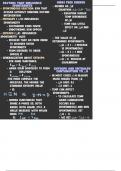
Factors that influence Gibbs free energy
spontaenity - defined as G
- spontaneous reaction: rxn that equation: G H TS
= -
occurs without ongoing outside - equation shows
intervention temp dependence
- enthalpy ( H) influences
-
of g
spontaneity - temp has little
- exothermic rxns favor effect on H and
- endothermic rxn oppose S
- entropy ( s) influences
spontaneity also - the value of g
- process that go from order determines spontaneity:
to disorder favor - G < 0 ( - ) process
spontaneity is spontaneous
- from disorder to order - G > 0 ( + ) non
oppose it spontaneous
- generalization about entropy: - G = 0 process at
- for same substance: equilibrium
s gas > S liquid > s solid
- when solid dissolves to form Entropy and enthalpy
a solution: contribution to G
S solution > s solid -
in most cases, H always
-
-the more complex the much bigger than S
molecule, the higher the - H unit: kj
standard entropy value - S unit: j
- ie: -
temp can affect
EN Vs. spontaneity.
O-N 0
=
- to calculate temp
- among substances that when changeover
share a phase (ie: both occurs b/w
gases, both liquid, etc), s spontaneous and non
value increase with molar spontaneous, set
mass Ne AR G = 0
S
ie: S NO AR - we get: H T S 0 -
=
, - the more the gas particles, - know how s, h, t, and g
the higher the entropy interplay
- entropy increases as temp of - if H negative and h
substance increase positive:
- g negative,
Thermodynamic laws
spontaneous at all
- 1st law thermodynamics: energy
temp
can neither be created nor
- if H negative and s
destroyed
negative:
- 2nd law thermodynamics: for
- G negative at low
spontaneous rxn, entropy of
temp
the universe increases
- if h positive and s
- 3rd law thermodynamics: a
positive:
perfect crystal at 0 k has 0
- G negative at
entropy ( S)
high temp
- at 0 k, molecular motion
- if H positive and H
virtually stops.
negative:
- if substance is a perfect
- G positive, non
crystal, internal
spontaneous at all
arrangement is absolutely
temp
regular. Thus, lowest
possible entropy Entropy, spontaneity,
- standard molar entropy (s ) is
O and 2nd law of
thermodynamics
entropy of 1 mole of pure
substance at: - 2nd law of thermodynamics
- 1 atm tells us occur
- 25c / 298k spontaneously in direction
- standard molar entropies make that increases total entropy
it possible to compare of the universe
entropies of different - sUnl = + —> spontaneous
substances under same temp - s Unl = - —> nonspon
and pressure - s Un = 0 —> at equilibrium
spontaenity - defined as G
- spontaneous reaction: rxn that equation: G H TS
= -
occurs without ongoing outside - equation shows
intervention temp dependence
- enthalpy ( H) influences
-
of g
spontaneity - temp has little
- exothermic rxns favor effect on H and
- endothermic rxn oppose S
- entropy ( s) influences
spontaneity also - the value of g
- process that go from order determines spontaneity:
to disorder favor - G < 0 ( - ) process
spontaneity is spontaneous
- from disorder to order - G > 0 ( + ) non
oppose it spontaneous
- generalization about entropy: - G = 0 process at
- for same substance: equilibrium
s gas > S liquid > s solid
- when solid dissolves to form Entropy and enthalpy
a solution: contribution to G
S solution > s solid -
in most cases, H always
-
-the more complex the much bigger than S
molecule, the higher the - H unit: kj
standard entropy value - S unit: j
- ie: -
temp can affect
EN Vs. spontaneity.
O-N 0
=
- to calculate temp
- among substances that when changeover
share a phase (ie: both occurs b/w
gases, both liquid, etc), s spontaneous and non
value increase with molar spontaneous, set
mass Ne AR G = 0
S
ie: S NO AR - we get: H T S 0 -
=
, - the more the gas particles, - know how s, h, t, and g
the higher the entropy interplay
- entropy increases as temp of - if H negative and h
substance increase positive:
- g negative,
Thermodynamic laws
spontaneous at all
- 1st law thermodynamics: energy
temp
can neither be created nor
- if H negative and s
destroyed
negative:
- 2nd law thermodynamics: for
- G negative at low
spontaneous rxn, entropy of
temp
the universe increases
- if h positive and s
- 3rd law thermodynamics: a
positive:
perfect crystal at 0 k has 0
- G negative at
entropy ( S)
high temp
- at 0 k, molecular motion
- if H positive and H
virtually stops.
negative:
- if substance is a perfect
- G positive, non
crystal, internal
spontaneous at all
arrangement is absolutely
temp
regular. Thus, lowest
possible entropy Entropy, spontaneity,
- standard molar entropy (s ) is
O and 2nd law of
thermodynamics
entropy of 1 mole of pure
substance at: - 2nd law of thermodynamics
- 1 atm tells us occur
- 25c / 298k spontaneously in direction
- standard molar entropies make that increases total entropy
it possible to compare of the universe
entropies of different - sUnl = + —> spontaneous
substances under same temp - s Unl = - —> nonspon
and pressure - s Un = 0 —> at equilibrium