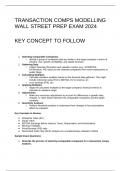
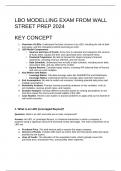
TRANSACTION COMPS MODELLING
WALL STREET PREP EXAM 2024
KEY CONCEPT TO FOLLOW
1. Selecting Comparable Companies:
○ Identify a group of companies that are similar to the target company in terms of
industry, size, growth, profitability, and capital structure.
2. Gathering Data:
○ Collect financial information and valuation metrics (e.g., EV/EBITDA,
EV/Revenue, P/E ratios) for the selected companies from recent transactions or
public filings.
3. Calculating Multiples:
○ Calculate valuation multiples based on the financial data gathered. This might
include enterprise value (EV) to EBITDA, EV to revenue, pri
○ ce to earnings (P/E), etc.
4. Applying Multiples:
○ Apply the calculated multiples to the target company’s financial metrics to
estimate its valuation range.
5. Adjustments:
○ Make any necessary adjustments to account for differences in growth rates,
margins, or other factors between the comparable companies and the target
company.
6. Sensitivity Analysis:
○ Perform sensitivity analysis to understand how changes in key assumptions
affect the valuation.
Key Concepts to Review:
● Enterprise Value (EV)
● Equity Value
● EBITDA (Earnings Before Interest, Taxes, Depreciation, and Amortization)
● Revenue multiples
● Price/Earnings (P/E) ratio
● Discounted Cash Flow (DCF) analysis as a complementary valuation method
Sample Exam Questions:
1. Describe the process of selecting comparable companies for a transaction comps
analysis.
WALL STREET PREP EXAM 2024
KEY CONCEPT TO FOLLOW
1. Selecting Comparable Companies:
○ Identify a group of companies that are similar to the target company in terms of
industry, size, growth, profitability, and capital structure.
2. Gathering Data:
○ Collect financial information and valuation metrics (e.g., EV/EBITDA,
EV/Revenue, P/E ratios) for the selected companies from recent transactions or
public filings.
3. Calculating Multiples:
○ Calculate valuation multiples based on the financial data gathered. This might
include enterprise value (EV) to EBITDA, EV to revenue, pri
○ ce to earnings (P/E), etc.
4. Applying Multiples:
○ Apply the calculated multiples to the target company’s financial metrics to
estimate its valuation range.
5. Adjustments:
○ Make any necessary adjustments to account for differences in growth rates,
margins, or other factors between the comparable companies and the target
company.
6. Sensitivity Analysis:
○ Perform sensitivity analysis to understand how changes in key assumptions
affect the valuation.
Key Concepts to Review:
● Enterprise Value (EV)
● Equity Value
● EBITDA (Earnings Before Interest, Taxes, Depreciation, and Amortization)
● Revenue multiples
● Price/Earnings (P/E) ratio
● Discounted Cash Flow (DCF) analysis as a complementary valuation method
Sample Exam Questions:
1. Describe the process of selecting comparable companies for a transaction comps
analysis.