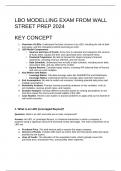
LBO MODELLING EXAM FROM WALL
STREET PREP 2024
KEY CONCEPT
1. Overview of LBOs: Understand the basic structure of an LBO, including the role of debt
and equity, and the motivations behind executing an LBO.
2. LBO Model Components:
○ Sources and Uses of Funds: Know how to calculate and categorize the sources
of funds (debt, equity) and their uses (purchase price, transaction fees).
○ Financial Projections: Be able to forecast the target company's financial
statements, including revenue, EBITDA, and net income.
○ Debt Schedule: Understand how to build a debt schedule, including senior debt,
mezzanine debt, and any other forms of debt.
○ Equity Returns: Calculate equity returns, including IRR (Internal Rate of Return)
and cash-on-cash multiples.
3. Key Metrics and Ratios:
○ Leverage Ratios: Calculate leverage ratios like Debt/EBITDA and Debt/Equity.
○ Coverage Ratios: Understand interest coverage ratios and their importance.
4. Exit Assumptions: Be able to model exit scenarios, including potential sale prices and
multiple assumptions.
5. Sensitivity Analysis: Practice running sensitivity analyses on key variables, such as
exit multiples, revenue growth rates, and margins.
6. Scenario Analysis: Develop different scenarios based on varying assumptions to see
how they impact the returns and overall viability of the LBO.
7. Case Studies: Review case studies or practice problems to apply what you've learned in
real-world scenarios.
1. What is an LBO (Leveraged Buyout)?
Question: What is an LBO and what are its main components?
Answer: An LBO, or Leveraged Buyout, is a financial transaction in which a company is
acquired using a significant amount of borrowed money (leverage). The main components of an
LBO are:
● Purchase Price: The total amount paid to acquire the target company.
● Sources of Funds: Includes debt (such as senior debt and mezzanine debt) and equity
provided by the buyers.
● Uses of Funds: The allocation of the acquisition funds, which typically covers the
purchase price, transaction fees, and possibly other expenses.
STREET PREP 2024
KEY CONCEPT
1. Overview of LBOs: Understand the basic structure of an LBO, including the role of debt
and equity, and the motivations behind executing an LBO.
2. LBO Model Components:
○ Sources and Uses of Funds: Know how to calculate and categorize the sources
of funds (debt, equity) and their uses (purchase price, transaction fees).
○ Financial Projections: Be able to forecast the target company's financial
statements, including revenue, EBITDA, and net income.
○ Debt Schedule: Understand how to build a debt schedule, including senior debt,
mezzanine debt, and any other forms of debt.
○ Equity Returns: Calculate equity returns, including IRR (Internal Rate of Return)
and cash-on-cash multiples.
3. Key Metrics and Ratios:
○ Leverage Ratios: Calculate leverage ratios like Debt/EBITDA and Debt/Equity.
○ Coverage Ratios: Understand interest coverage ratios and their importance.
4. Exit Assumptions: Be able to model exit scenarios, including potential sale prices and
multiple assumptions.
5. Sensitivity Analysis: Practice running sensitivity analyses on key variables, such as
exit multiples, revenue growth rates, and margins.
6. Scenario Analysis: Develop different scenarios based on varying assumptions to see
how they impact the returns and overall viability of the LBO.
7. Case Studies: Review case studies or practice problems to apply what you've learned in
real-world scenarios.
1. What is an LBO (Leveraged Buyout)?
Question: What is an LBO and what are its main components?
Answer: An LBO, or Leveraged Buyout, is a financial transaction in which a company is
acquired using a significant amount of borrowed money (leverage). The main components of an
LBO are:
● Purchase Price: The total amount paid to acquire the target company.
● Sources of Funds: Includes debt (such as senior debt and mezzanine debt) and equity
provided by the buyers.
● Uses of Funds: The allocation of the acquisition funds, which typically covers the
purchase price, transaction fees, and possibly other expenses.