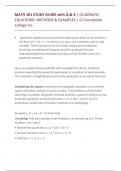
MATH 101 STUDY GUIDE with Q & A | QUADRATIC
EQUATIONS: METHODS & EXAMPLES | G-Foundation
College Inc.
Quadratic equations are polynomial expressions that can be written in
the form ax² + bx + c = 0, where a, b, and c are constants, and x is the
variable. These equations can be solved using several methods:
factoring, completing the square, and the quadratic formula.
Understanding these methods can help quickly find the roots of a
quadratic equation.
Here, we explore these methods with examples for clarity. Factoring
involves rewriting the quadratic expression as a product of two binomials.
This method is straightforward when the quadratic can be easily factored.
Completing the Square transforms the quadratic equation into a perfect
square trinomial, making it easier to solve. This method is useful when
factoring is complex. Quadratic Formula provides a general solution to any
quadratic equation, using the formula x = (-b ± √(b² - 4ac)) / 2a. It’s
particularly useful when the other methods are challenging.
Example 1: x² + 5x + 6 = 0 (Trinomial)
Factoring: Find two numbers that multiply to 6 and add up to 5. These
numbers are 2 and 3.
• Rewrite the quadratic as: (x + 2)(x + 3) = 0
• Set each factor to zero: x + 2 = 0 or x + 3 = 0
• Solutions: x = -2, x = -3
, Completing the Square: Start with x² + 5x + 6 = 0
• Move the constant term to the other side: x² + 5x = -6
• Add (5/2)² = 6.25 to both sides: x² + 5x + 6.25 = 0.25
• Rewrite as a square: (x + 2.5)² = 0.25Take the square root of both sides: x +
2.5 = ±0.5
• Solutions: x = -2, x = -3
Quadratic Formula: Use the formula: x = (-b ± √(b² - 4ac)) / 2a
For x² + 5x + 6 = 0, a = 1, b = 5, c = 6
• Calculate the discriminant: b² - 4ac = 25 – 24 = 1
• Find the roots: x = (-5 ± √1) / 2Solutions: x = (-5 + 1) / 2 = -2, x = (-5 – 1) / 2
= -3
Example 2: x² - 4 = 0 (Difference of Squares)
Factoring: Recognize the quadratic as a difference of squares: (x + 2)(x – 2) =
0
• Set each factor to zero: x + 2 = 0 or x – 2 = 0
• Solutions: x = -2, x = 2
Completing the Square: Start with x² - 4 = 0
• Rewrite as x² = 4
• Take the square root of both sides: x = ±√4
• Solutions: x = -2, x = 2
2
EQUATIONS: METHODS & EXAMPLES | G-Foundation
College Inc.
Quadratic equations are polynomial expressions that can be written in
the form ax² + bx + c = 0, where a, b, and c are constants, and x is the
variable. These equations can be solved using several methods:
factoring, completing the square, and the quadratic formula.
Understanding these methods can help quickly find the roots of a
quadratic equation.
Here, we explore these methods with examples for clarity. Factoring
involves rewriting the quadratic expression as a product of two binomials.
This method is straightforward when the quadratic can be easily factored.
Completing the Square transforms the quadratic equation into a perfect
square trinomial, making it easier to solve. This method is useful when
factoring is complex. Quadratic Formula provides a general solution to any
quadratic equation, using the formula x = (-b ± √(b² - 4ac)) / 2a. It’s
particularly useful when the other methods are challenging.
Example 1: x² + 5x + 6 = 0 (Trinomial)
Factoring: Find two numbers that multiply to 6 and add up to 5. These
numbers are 2 and 3.
• Rewrite the quadratic as: (x + 2)(x + 3) = 0
• Set each factor to zero: x + 2 = 0 or x + 3 = 0
• Solutions: x = -2, x = -3
, Completing the Square: Start with x² + 5x + 6 = 0
• Move the constant term to the other side: x² + 5x = -6
• Add (5/2)² = 6.25 to both sides: x² + 5x + 6.25 = 0.25
• Rewrite as a square: (x + 2.5)² = 0.25Take the square root of both sides: x +
2.5 = ±0.5
• Solutions: x = -2, x = -3
Quadratic Formula: Use the formula: x = (-b ± √(b² - 4ac)) / 2a
For x² + 5x + 6 = 0, a = 1, b = 5, c = 6
• Calculate the discriminant: b² - 4ac = 25 – 24 = 1
• Find the roots: x = (-5 ± √1) / 2Solutions: x = (-5 + 1) / 2 = -2, x = (-5 – 1) / 2
= -3
Example 2: x² - 4 = 0 (Difference of Squares)
Factoring: Recognize the quadratic as a difference of squares: (x + 2)(x – 2) =
0
• Set each factor to zero: x + 2 = 0 or x – 2 = 0
• Solutions: x = -2, x = 2
Completing the Square: Start with x² - 4 = 0
• Rewrite as x² = 4
• Take the square root of both sides: x = ±√4
• Solutions: x = -2, x = 2
2