Conflict & Cooperation
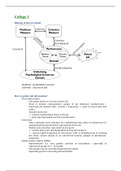
WEEK 1 (Social Dilemmas and Solutions) => process of transformation (social & temporal concerns, cognitive states and
affect)
psychological influences: traits: SVO (pro-socials (joint outcomes), pro-selves
Recognize social dilemmas and describe them + Analyze social dilemmas (own outcomes) and competitors (more than other)), trust (vulnerability based
Three types of interdependence on positive expectations of others), consideration of future consequences (distal)
Cooperative interdependence (your own benefit is in line with others’ benefit) psychological influences: states: (decision) framing, priming (‘smart choice’),
Competitive interdependence (your own benefit is opposed to others’ benefit) heuristics, affect (happiness, guilt, shame, disappointment)
Mixed-motive interdependence (both cooperative and competitive motivations) Effective matrix: interpretation of situation; dependent on personality and
Can cause a social dilemma = incompatibility between (short-term) own interest interaction dynamics (subjective outcomes)
(non-cooperation) and (long-term) common interests of interdependent others => interaction pattern between A & B (choice behavior)
(cooperation). dynamic interaction processes: direct reciprocity (TFT-strategy?), indirect
reciprocity (reputation), communication (domain relevant/irrelevant), support
Prisoner’s Dilemma (2x2) game independent of other’s choice = D more attractive
A/B: C/C = 1/1; C/D = 4/0 ; D/C = 0/4 ; D/D = 3/3 (= D/D-Trap) Appropriateness framework
C-option by both leads to better individual outcomes than D-option by both Assumes that decisions are driven by three basic factors including one’s definition (or
Chicken Dilemma tempted to D, but catastrophic when both parties do so recognition) a situation; one’s identity; and the application of decision rules or
A/B: C/C = 1/1; C/D = 1/2 ; D/C = 2/1 ; D/D = 0/0 heuristics. Situation => Identity + Definition of Situation (+ Identity as moderator on
D-option by both = most risky both sides) => Rule Selection and Use => Decision
Assurance Dilemma highest outcome = C/C, unless other party doesn’t cooperate
A/B: C/C = 4/4; C/D = 1/3 ; D/C = 3/1 ; D/D = 2/2 Evolutionary theories
Kin selection (more likely to help those with whom they share a genetic link)
Social trap (= short term positive outcome for individual results in negative outcome Reciprocal altruism (cooperative behavior influenced by others’ behavior)
for collective), there is a temptation to act, common resource, take-some dilemma Indirect reciprocity (responding to information relevant to reputation: C/D?)
‘good for me to do now, but if everybody does it, we are all worse off’ Costly signaling (engaging in costly activities to signal desirable ‘traits’)
Social fence (= short term negative outcome results in positive outcome for
collective), there is a temptation NOT to act, public goods, give-some dilemma Resource based social exchange model goal membership: attain resources
‘bad for me to do now, but if nobody does it, everyone is worse off’ Cooperation depends on resources and rewards for group membership
Individual Individual Collective Collective Status based identity model (predicts better than resources & identification)
delayed direct delayed direct Self-worth based on group membership (dependent on status of group)
Social trap Smoking Drunk driving Overuse Traffic jam Group status associated with identification and cooperation
water => why people follow group rules + why people work on behalf of their group +
Social fence Studying (Mild) phobia Trash Shoveling why people stay in their groups (cooperative motivation = identity-based)
management snow
Design solutions for cooperation problems in social dilemmas
Know and understand theories associated with social dilemmas (interdependence Solving social dilemmas combine for optimal outcomes
theory, resource based social exchange model, status based identity model) and Structural solutions
compare them with regard to their predictive and descriptive value for cooperation in Reducing interdependence (enlarging capacity, individual reward, privatization)
social dilemmas + Name and describe factors that influence cooperation in social Removing choice (superordinate authority, limits/quota/’closed shop’)
dilemmas Changing outcomes (changing pay-off structure, rewards and punishment)
Interdependence theory Reducing group size (make smaller teams)
SABI: interdependence Structure, interacting partners A and B and Interaction Individual solutions
dynamics together the interdependence interactions Communication (enhance trust, create group identity, free-riding may pay-off)
Given matrix: objective characteristics of interdependence situation + direct self- Trust (especially in homogeneous groups, sanctioning non-co-operators)
interested preferences Social values and responsibility (long term perspective, personal responsibility)
(interdependence) structural influences: reward, punishment (exclusion?), Group identity (cohesion and conformity, trustworthy, collective outcomes)
asymmetry (in resources, benefits and roles), uncertainty, noise (pessimism)
, Conflict & Cooperation
WEEK 2 (Intergroup Dilemmas) Outgroup Outgroup Outgroup No
positive neutral harm cooperation
Cooperation Universal Weak Strong Egoism
Understand the origin and motivation of cooperation in intergroup conflicts parochial parochial
Intergroup conflict: IPD MD 0.5/0.5/0 0.5/0.5/-.25 1/0/0
Outcome deprivation (= source of conflict), e.g. scarcity NSD 0.4/0.4/0.4 0.5/0.5/0 1/0/0
Fear (vs trust, reciprocity, exploitation) NSD IPD 0.4/0.4/0.4 0.5/0.5/-.25 1/0/0
Greed (pro-social to own group) IPUC 0.4/0.4/0.4 0.5/0.5/0 0.5/0.5/-.25 1/0/0
Intergroup competition promotes intragroup cooperation
Pre-emptive strike game (PSG): no incentive to attack (blue/red buttom) => fear/spite
Explain and compare Social Identity Theory, Group Selection Theory and the theory of
Bounded Generalized Reciprocity Explain what parochial cooperation is and which people will be more or less likely to
Parochial cooperation = the tendency to make self-costly contributions to one’s in- show parochial cooperation
group (can, but does not have to, be harmful to the other group) Social Value Orientation: pro-self (competitive, 480/80), pro-self (individualistic,
In-group love > Out-group hate (harming other group vs not-helping other group) 540/280), pro-social (cooperative, 480/480) Nauta: PVO => concern for others => PS
Goal: survival of own group; not getting behind on other groups (through social
categorization/identification and/ore reputation) Universal Weak Strong Egoism
cooperation parochial parochial
Perspectives: Social Value + x (-?) x -
Parochial altruism model / Group selection theory: co-evolution of intragroup Orientation
cooperation and intergroup aggression (Simunovic et al: membership irrelevant) Honesty- + x x (-?) -
Bounded Generalized Reciprocity (BGR): exchange network of cooperation; Humility
cooperation limited to people you can trust due to good reputation (in-group!) Empathetic - (?) + (?) x (-?) x
(membership => reputation => trust => cooperation) > Concern
Social Identity Approach (self categorization): categorization in and identification Social - x + x (+?)
with group; self-worth derived from group success; in-group favoritism vs out-group Dominance
derogation (intergroup bias); Orientation
Goal transformation explanation: people who think of themselves as sharing a
common category membership become relatively more concerned with the Oxytocin turned out to be a catalyst of self-sacrificial behaviour in intergroup
welfare of those in that category; making a collective category membership salient conflicts (since it dampens self-interests behaviour and increases costly displays of
=> less sharply distinguishing between personal and category welfare in-group love, but not out-group hate)
Goal expectation theory: suggested that cooperative expectations may (further)
promote one’s own willingness to cooperate (trust reduces fear, not self-interest) Understand and explain how and why studying experimental games can inform
Buchan et al: global social identity is associated with a desire to maximize (cooperation) behavior in organizations
collective outcomes and motivates individuals to contribute to collective goods Why experimental games?
regardless of whether they expect a return on their investment (social Behavior!
identification has unique effects on cooperative behavior, that are distinct from Highly controlled researching preferences, behavior, outcomes, and consequences
the effects of general attitudes about global issues) Represent reality in a simple and understandable manner
Competition (organizations, clients, market share)
Recognize and describe intergroup experimental games beyond the standard PGD or Public good’s dilemmas (environment)
PDG (e.g. NSD, IPD, IPD- MD, IPUC ) Intergroup dilemmas (refugees)
Nested social dilemma = three levels (individual (private), (sub)group & collective)
Salience of group membership (enhanced by faith, throwing a dice) can increase Why not?
investment in that group (categorization & identification?), Wit & Kerr E1 Interpretation matrix can differ (context important: psychology)
Decreasing salience subgroup enhances contributions to collective E2 as well as Motives are not always easy to interpret (but aren’t clear with introspection either!)
cross-categorization with the opposing subgroup E3 (goal transformation, not trust) Unrealistic simplification of reality (enables drawing causal conclusions, no noise)
WEEK 1 (Social Dilemmas and Solutions) => process of transformation (social & temporal concerns, cognitive states and
affect)
psychological influences: traits: SVO (pro-socials (joint outcomes), pro-selves
Recognize social dilemmas and describe them + Analyze social dilemmas (own outcomes) and competitors (more than other)), trust (vulnerability based
Three types of interdependence on positive expectations of others), consideration of future consequences (distal)
Cooperative interdependence (your own benefit is in line with others’ benefit) psychological influences: states: (decision) framing, priming (‘smart choice’),
Competitive interdependence (your own benefit is opposed to others’ benefit) heuristics, affect (happiness, guilt, shame, disappointment)
Mixed-motive interdependence (both cooperative and competitive motivations) Effective matrix: interpretation of situation; dependent on personality and
Can cause a social dilemma = incompatibility between (short-term) own interest interaction dynamics (subjective outcomes)
(non-cooperation) and (long-term) common interests of interdependent others => interaction pattern between A & B (choice behavior)
(cooperation). dynamic interaction processes: direct reciprocity (TFT-strategy?), indirect
reciprocity (reputation), communication (domain relevant/irrelevant), support
Prisoner’s Dilemma (2x2) game independent of other’s choice = D more attractive
A/B: C/C = 1/1; C/D = 4/0 ; D/C = 0/4 ; D/D = 3/3 (= D/D-Trap) Appropriateness framework
C-option by both leads to better individual outcomes than D-option by both Assumes that decisions are driven by three basic factors including one’s definition (or
Chicken Dilemma tempted to D, but catastrophic when both parties do so recognition) a situation; one’s identity; and the application of decision rules or
A/B: C/C = 1/1; C/D = 1/2 ; D/C = 2/1 ; D/D = 0/0 heuristics. Situation => Identity + Definition of Situation (+ Identity as moderator on
D-option by both = most risky both sides) => Rule Selection and Use => Decision
Assurance Dilemma highest outcome = C/C, unless other party doesn’t cooperate
A/B: C/C = 4/4; C/D = 1/3 ; D/C = 3/1 ; D/D = 2/2 Evolutionary theories
Kin selection (more likely to help those with whom they share a genetic link)
Social trap (= short term positive outcome for individual results in negative outcome Reciprocal altruism (cooperative behavior influenced by others’ behavior)
for collective), there is a temptation to act, common resource, take-some dilemma Indirect reciprocity (responding to information relevant to reputation: C/D?)
‘good for me to do now, but if everybody does it, we are all worse off’ Costly signaling (engaging in costly activities to signal desirable ‘traits’)
Social fence (= short term negative outcome results in positive outcome for
collective), there is a temptation NOT to act, public goods, give-some dilemma Resource based social exchange model goal membership: attain resources
‘bad for me to do now, but if nobody does it, everyone is worse off’ Cooperation depends on resources and rewards for group membership
Individual Individual Collective Collective Status based identity model (predicts better than resources & identification)
delayed direct delayed direct Self-worth based on group membership (dependent on status of group)
Social trap Smoking Drunk driving Overuse Traffic jam Group status associated with identification and cooperation
water => why people follow group rules + why people work on behalf of their group +
Social fence Studying (Mild) phobia Trash Shoveling why people stay in their groups (cooperative motivation = identity-based)
management snow
Design solutions for cooperation problems in social dilemmas
Know and understand theories associated with social dilemmas (interdependence Solving social dilemmas combine for optimal outcomes
theory, resource based social exchange model, status based identity model) and Structural solutions
compare them with regard to their predictive and descriptive value for cooperation in Reducing interdependence (enlarging capacity, individual reward, privatization)
social dilemmas + Name and describe factors that influence cooperation in social Removing choice (superordinate authority, limits/quota/’closed shop’)
dilemmas Changing outcomes (changing pay-off structure, rewards and punishment)
Interdependence theory Reducing group size (make smaller teams)
SABI: interdependence Structure, interacting partners A and B and Interaction Individual solutions
dynamics together the interdependence interactions Communication (enhance trust, create group identity, free-riding may pay-off)
Given matrix: objective characteristics of interdependence situation + direct self- Trust (especially in homogeneous groups, sanctioning non-co-operators)
interested preferences Social values and responsibility (long term perspective, personal responsibility)
(interdependence) structural influences: reward, punishment (exclusion?), Group identity (cohesion and conformity, trustworthy, collective outcomes)
asymmetry (in resources, benefits and roles), uncertainty, noise (pessimism)
, Conflict & Cooperation
WEEK 2 (Intergroup Dilemmas) Outgroup Outgroup Outgroup No
positive neutral harm cooperation
Cooperation Universal Weak Strong Egoism
Understand the origin and motivation of cooperation in intergroup conflicts parochial parochial
Intergroup conflict: IPD MD 0.5/0.5/0 0.5/0.5/-.25 1/0/0
Outcome deprivation (= source of conflict), e.g. scarcity NSD 0.4/0.4/0.4 0.5/0.5/0 1/0/0
Fear (vs trust, reciprocity, exploitation) NSD IPD 0.4/0.4/0.4 0.5/0.5/-.25 1/0/0
Greed (pro-social to own group) IPUC 0.4/0.4/0.4 0.5/0.5/0 0.5/0.5/-.25 1/0/0
Intergroup competition promotes intragroup cooperation
Pre-emptive strike game (PSG): no incentive to attack (blue/red buttom) => fear/spite
Explain and compare Social Identity Theory, Group Selection Theory and the theory of
Bounded Generalized Reciprocity Explain what parochial cooperation is and which people will be more or less likely to
Parochial cooperation = the tendency to make self-costly contributions to one’s in- show parochial cooperation
group (can, but does not have to, be harmful to the other group) Social Value Orientation: pro-self (competitive, 480/80), pro-self (individualistic,
In-group love > Out-group hate (harming other group vs not-helping other group) 540/280), pro-social (cooperative, 480/480) Nauta: PVO => concern for others => PS
Goal: survival of own group; not getting behind on other groups (through social
categorization/identification and/ore reputation) Universal Weak Strong Egoism
cooperation parochial parochial
Perspectives: Social Value + x (-?) x -
Parochial altruism model / Group selection theory: co-evolution of intragroup Orientation
cooperation and intergroup aggression (Simunovic et al: membership irrelevant) Honesty- + x x (-?) -
Bounded Generalized Reciprocity (BGR): exchange network of cooperation; Humility
cooperation limited to people you can trust due to good reputation (in-group!) Empathetic - (?) + (?) x (-?) x
(membership => reputation => trust => cooperation) > Concern
Social Identity Approach (self categorization): categorization in and identification Social - x + x (+?)
with group; self-worth derived from group success; in-group favoritism vs out-group Dominance
derogation (intergroup bias); Orientation
Goal transformation explanation: people who think of themselves as sharing a
common category membership become relatively more concerned with the Oxytocin turned out to be a catalyst of self-sacrificial behaviour in intergroup
welfare of those in that category; making a collective category membership salient conflicts (since it dampens self-interests behaviour and increases costly displays of
=> less sharply distinguishing between personal and category welfare in-group love, but not out-group hate)
Goal expectation theory: suggested that cooperative expectations may (further)
promote one’s own willingness to cooperate (trust reduces fear, not self-interest) Understand and explain how and why studying experimental games can inform
Buchan et al: global social identity is associated with a desire to maximize (cooperation) behavior in organizations
collective outcomes and motivates individuals to contribute to collective goods Why experimental games?
regardless of whether they expect a return on their investment (social Behavior!
identification has unique effects on cooperative behavior, that are distinct from Highly controlled researching preferences, behavior, outcomes, and consequences
the effects of general attitudes about global issues) Represent reality in a simple and understandable manner
Competition (organizations, clients, market share)
Recognize and describe intergroup experimental games beyond the standard PGD or Public good’s dilemmas (environment)
PDG (e.g. NSD, IPD, IPD- MD, IPUC ) Intergroup dilemmas (refugees)
Nested social dilemma = three levels (individual (private), (sub)group & collective)
Salience of group membership (enhanced by faith, throwing a dice) can increase Why not?
investment in that group (categorization & identification?), Wit & Kerr E1 Interpretation matrix can differ (context important: psychology)
Decreasing salience subgroup enhances contributions to collective E2 as well as Motives are not always easy to interpret (but aren’t clear with introspection either!)
cross-categorization with the opposing subgroup E3 (goal transformation, not trust) Unrealistic simplification of reality (enables drawing causal conclusions, no noise)