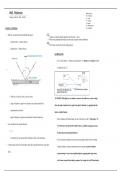
Wk3: Reflection Abbreviations:
b/w = between
Tuesday, October 20, 2020 6:38 PM
w/ = with
V = voltage
I = current
D = displacement
Section 3.1.1: Reflection R = resistance
• Reflector: an object that reflects light that falls upon it. 3.3.3:
• Compass is 6 degrees initially, parallel to the white card. = mirror
• White card is perpendicular initially; laser hits card, and passes beam to photometer.
○ Smooth surface -> specular reflector 3.3.4:
• With 2 loops: increase the amount of light going in.
○ Rough surface -> diffuse reflector
Lab Report Notes
(N, perpendicular to the mirror)
Incident ray
• (3.2.2) Verify θmirror = ½θbench or equivalently θi = θr. θbench (=i) and θmirror (=i+r)
are defined in Fig. 3.7.
•
Point of incidence
○ Reflection of a light ray from a specular surface.
IN THEORY When light rays are shined on a mirror, the incident ray creates an angle
○ Angle of incidence i: angle b/w the incidence ray and the normal line N,
where the angle of incidence (i) is equal to the angle of reflection (r), suggesting that the
perpendicular to the mirror.
θmirror is half of θbench.
○ angle of reflection r: angle b/w the normal line N and the reflected ray.
• Show calculations for the discrepancy for one of the trials, say trial #1. Discrepancy= (T-
• Laws of reflection for specular reflectors:
E)/T*100 Trial 1: (25-24)/25*100= 4.000% There is a 4.000% discrepancy between
○ i = r.
the theoretical and experimental θmirror.
○ The incident ray, the normal, and the reflected ray all lie in the same plane.
• You do not need to estimate the errors, but state and explain which of the two methods
• ^Smooth surface allows for the formation of the objects placed before them, on the other
(compass reading vs. distance measurement) is more accurate. In general, distance
hand…
measurement gives way to more significant figures, suggesting that using a meter
stick is more accurate than reading a compass. For example, in trial #2 θbench using
, • Diffuse reflectors have a reflected beam that is scattered bc of the unevenness of the the meter stick is 29.72degrees with an uncertainty of 0.01; θbench using the compass
surface. -> NO formation of an image. is 30degree with a greater uncertainty of 1.
3.1.2: Refraction • Can you conclude from your results whether the mirror is a perfect specular reflector and
• Refraction: bending of light at the interface of 2 media, as the light ray goes from one why? At a 50degree angle, there is a 4% discrepancy between the theoretical θmirror
medium to another. Ex. Placing a pencil in a glass of water at a bent angle. and the experimental θmirror. Since the discrepancy is below 5%, we can assume
• Index of refraction n = c/v that θmirror is equal to half of θbench (in theory). This suggests that the angle of
○ In any medium other than a vacuum (c=3.00*10^8m/s), light travels slower at the incidence (i) is equal to the angle of reflection (r), where both angles ADD UP to
speed v. θmirror. Since the mirror follows the law of reflection for specular reflectors (i=r),
• If light travels from a rarer to a denser medium (nrare < ndense), then it bends toward the we can conclude that the mirror is a perfect specular reflector.
normal. However, • (3.3.3) Measure how the amount of light reflected by a diffuse reflector varies with the
• If light travels from a denser to a rarer medium (nrare < ndense), then it bends away from the angle of reflection.
• What is the angle θcompass when the white card is parallel to the optical bench? The
normal.
compass is 6 degrees initially when the white card is parallel to the optical bench.
• Calculate the expected θmirror for the expected intensity maximum corresponding to
•
specular reflection. 360 + 6 = 366 - (90-25) = 301degrees. Have to take into account
compass offset of 6 degrees. Reference frame is normal line N 90degrees—where
• Law of refraction: maximum intensity is expected if laser is pointed head-on to the mirror. Angle of
○ The incident ray, the normal, and the reflected ray all lie in the same plane. incidence (i) = expected θmirror = 25degrees
○ The ratio of the angle of incidence i in the 1st medium to the angle of refraction r in • Calculate the discrepancy between the expected angle and the angle given in the data.
the second medium is related to the ratio of the indexes. -> Theoretical θmirror: 301degrees, Experimental θmirror (at maximum intensity):
○ Snell's law of refraction: Ni*sini = nr*sinr 304degrees -> |(301-304)|/301 * 100 = 0.9967%
3.1.3: Total internal reflection • Is the white card an ideal diffuse reflector? Considering there is less than 5%
• Rarer->denser: discrepancy between the theoretical and experimental θmirror at maximum
b/w = between
Tuesday, October 20, 2020 6:38 PM
w/ = with
V = voltage
I = current
D = displacement
Section 3.1.1: Reflection R = resistance
• Reflector: an object that reflects light that falls upon it. 3.3.3:
• Compass is 6 degrees initially, parallel to the white card. = mirror
• White card is perpendicular initially; laser hits card, and passes beam to photometer.
○ Smooth surface -> specular reflector 3.3.4:
• With 2 loops: increase the amount of light going in.
○ Rough surface -> diffuse reflector
Lab Report Notes
(N, perpendicular to the mirror)
Incident ray
• (3.2.2) Verify θmirror = ½θbench or equivalently θi = θr. θbench (=i) and θmirror (=i+r)
are defined in Fig. 3.7.
•
Point of incidence
○ Reflection of a light ray from a specular surface.
IN THEORY When light rays are shined on a mirror, the incident ray creates an angle
○ Angle of incidence i: angle b/w the incidence ray and the normal line N,
where the angle of incidence (i) is equal to the angle of reflection (r), suggesting that the
perpendicular to the mirror.
θmirror is half of θbench.
○ angle of reflection r: angle b/w the normal line N and the reflected ray.
• Show calculations for the discrepancy for one of the trials, say trial #1. Discrepancy= (T-
• Laws of reflection for specular reflectors:
E)/T*100 Trial 1: (25-24)/25*100= 4.000% There is a 4.000% discrepancy between
○ i = r.
the theoretical and experimental θmirror.
○ The incident ray, the normal, and the reflected ray all lie in the same plane.
• You do not need to estimate the errors, but state and explain which of the two methods
• ^Smooth surface allows for the formation of the objects placed before them, on the other
(compass reading vs. distance measurement) is more accurate. In general, distance
hand…
measurement gives way to more significant figures, suggesting that using a meter
stick is more accurate than reading a compass. For example, in trial #2 θbench using
, • Diffuse reflectors have a reflected beam that is scattered bc of the unevenness of the the meter stick is 29.72degrees with an uncertainty of 0.01; θbench using the compass
surface. -> NO formation of an image. is 30degree with a greater uncertainty of 1.
3.1.2: Refraction • Can you conclude from your results whether the mirror is a perfect specular reflector and
• Refraction: bending of light at the interface of 2 media, as the light ray goes from one why? At a 50degree angle, there is a 4% discrepancy between the theoretical θmirror
medium to another. Ex. Placing a pencil in a glass of water at a bent angle. and the experimental θmirror. Since the discrepancy is below 5%, we can assume
• Index of refraction n = c/v that θmirror is equal to half of θbench (in theory). This suggests that the angle of
○ In any medium other than a vacuum (c=3.00*10^8m/s), light travels slower at the incidence (i) is equal to the angle of reflection (r), where both angles ADD UP to
speed v. θmirror. Since the mirror follows the law of reflection for specular reflectors (i=r),
• If light travels from a rarer to a denser medium (nrare < ndense), then it bends toward the we can conclude that the mirror is a perfect specular reflector.
normal. However, • (3.3.3) Measure how the amount of light reflected by a diffuse reflector varies with the
• If light travels from a denser to a rarer medium (nrare < ndense), then it bends away from the angle of reflection.
• What is the angle θcompass when the white card is parallel to the optical bench? The
normal.
compass is 6 degrees initially when the white card is parallel to the optical bench.
• Calculate the expected θmirror for the expected intensity maximum corresponding to
•
specular reflection. 360 + 6 = 366 - (90-25) = 301degrees. Have to take into account
compass offset of 6 degrees. Reference frame is normal line N 90degrees—where
• Law of refraction: maximum intensity is expected if laser is pointed head-on to the mirror. Angle of
○ The incident ray, the normal, and the reflected ray all lie in the same plane. incidence (i) = expected θmirror = 25degrees
○ The ratio of the angle of incidence i in the 1st medium to the angle of refraction r in • Calculate the discrepancy between the expected angle and the angle given in the data.
the second medium is related to the ratio of the indexes. -> Theoretical θmirror: 301degrees, Experimental θmirror (at maximum intensity):
○ Snell's law of refraction: Ni*sini = nr*sinr 304degrees -> |(301-304)|/301 * 100 = 0.9967%
3.1.3: Total internal reflection • Is the white card an ideal diffuse reflector? Considering there is less than 5%
• Rarer->denser: discrepancy between the theoretical and experimental θmirror at maximum