

Unit 10: Fire investigation
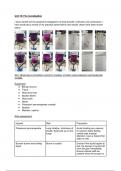
I have carried out the practical investigations of heat transfer, extinction and combustion. I
have produced a record of my practical observations and results, these have been shown
below.
Aim: Observing a convection current in a beaker of water using potassium permanganate
crystals.
Equipment:
● Bunsen burner
● Tripod
● Heat proof mat
● Beaker 600ml
● Glass tube
● Stirrer
● Potassium permanganate crystals
● Spatula
● Matches / splints
Risk assessment:
Hazard Risk Precaution
Potassium permanganate Lung irritation, shortness of Avoid inhaling any vapours,
breath, fluid build up on the if a person starts feeling
lungs unwell seek medical
attention, have a trained first
aider on site.
Bunsen burner and boiling Burns or scalds Ensure if the liquid begins to
liquid boil, the bunsen is turned off
from the gas immediately.
Ensure trained staff are
present when the bunsen is
, in use, ensure students
always use the safety flame.
Glass beaker Smashing glassware Ensure safety goggles are
causing wounds worn to protect the eyes,
ensure if any glass is
smashed it is made aware
immediately.
Method:
● Put room temperature water into a beaker, fill up the beaker ⅔ of the way.
● Remove the potassium permanganate from the container using a spatula. Take ¾
small sized crystals, this is enough to clearly see the current.
● Put the Crystals into the beaker, do not stir.
● Turn on the gas taps, link the bunsen burner tubing to the gas taps and turn the tap.
● Light a match or splint and put this above the bunsen. It should catch alight.
● Ensure the safety flame of the bunsen is on.
● Heat the liquid gently over the bunsen and observe the motion of the dyed water.
● Note the path the dyed water takes from the bottom to the top of the water and back
down again.
After completing the practical, I made some important conclusions. I determined that the
potassium permanganate showed heat transfer in water through a convection. By heating
the beaker, we were able to see the convection currents. The heat was transferred through
the glass beaker by conduction, then the water inside the beaker was heated due to the
bunsen burner. Then the water becomes less dense and rises through the beaker, then it is
replaced by denser and cooler surrounding water. This water is then heated, and the
process reoccurs. To visualise this convection, the purple coloured potassium permanganate
showed the convection in the solution.
Aim: To investigate how heat transfer occurs through radiation
Equipment:
● Plastic beaker 250ml
● Glass beaker 250m
● Thermometers
● 2 sheets of aluminium foil
● Kettle
● Boiling water
Hazard Risk Precaution
Glassware Shatter / smash can cause Ensure safety goggles are
wounds worn to protect the eyes,
ensure if any glass is
smashed it is made aware
immediately.
I have carried out the practical investigations of heat transfer, extinction and combustion. I
have produced a record of my practical observations and results, these have been shown
below.
Aim: Observing a convection current in a beaker of water using potassium permanganate
crystals.
Equipment:
● Bunsen burner
● Tripod
● Heat proof mat
● Beaker 600ml
● Glass tube
● Stirrer
● Potassium permanganate crystals
● Spatula
● Matches / splints
Risk assessment:
Hazard Risk Precaution
Potassium permanganate Lung irritation, shortness of Avoid inhaling any vapours,
breath, fluid build up on the if a person starts feeling
lungs unwell seek medical
attention, have a trained first
aider on site.
Bunsen burner and boiling Burns or scalds Ensure if the liquid begins to
liquid boil, the bunsen is turned off
from the gas immediately.
Ensure trained staff are
present when the bunsen is
, in use, ensure students
always use the safety flame.
Glass beaker Smashing glassware Ensure safety goggles are
causing wounds worn to protect the eyes,
ensure if any glass is
smashed it is made aware
immediately.
Method:
● Put room temperature water into a beaker, fill up the beaker ⅔ of the way.
● Remove the potassium permanganate from the container using a spatula. Take ¾
small sized crystals, this is enough to clearly see the current.
● Put the Crystals into the beaker, do not stir.
● Turn on the gas taps, link the bunsen burner tubing to the gas taps and turn the tap.
● Light a match or splint and put this above the bunsen. It should catch alight.
● Ensure the safety flame of the bunsen is on.
● Heat the liquid gently over the bunsen and observe the motion of the dyed water.
● Note the path the dyed water takes from the bottom to the top of the water and back
down again.
After completing the practical, I made some important conclusions. I determined that the
potassium permanganate showed heat transfer in water through a convection. By heating
the beaker, we were able to see the convection currents. The heat was transferred through
the glass beaker by conduction, then the water inside the beaker was heated due to the
bunsen burner. Then the water becomes less dense and rises through the beaker, then it is
replaced by denser and cooler surrounding water. This water is then heated, and the
process reoccurs. To visualise this convection, the purple coloured potassium permanganate
showed the convection in the solution.
Aim: To investigate how heat transfer occurs through radiation
Equipment:
● Plastic beaker 250ml
● Glass beaker 250m
● Thermometers
● 2 sheets of aluminium foil
● Kettle
● Boiling water
Hazard Risk Precaution
Glassware Shatter / smash can cause Ensure safety goggles are
wounds worn to protect the eyes,
ensure if any glass is
smashed it is made aware
immediately.


