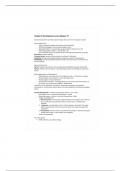
Chapter 8 Development across lifespan
Human development: scientific study of changes that occur from conception to death
Key concepts for DP:
- Process of growth, adaption and decline within individuals
- Affected by biological, social and psychological factors
- Aged-graded factors = w/ particular age group (either adolescents or old)
- Historically graded: related to a time period or era
- Non-normative: factors not expected to be in life stage and experience at any age.
Risk factors: increase with age
Protective factors: resource that contribute to resilience of individual
Equifinality: principle of multiple pathways leaving same outcome of development
Multifinality: early developmental experiences have same nature not same outcome but
lots of outcomes
Nature VS Nurture
Nature: heredity, characteristics of personality, physical/intellectual growth all inherited.
Nurture: influence of environment – parenting styles, physical surroundings and economic
factors
Basic building blocks of development:
- DNA molecules carry instructions for all organism’s traits = ‘instructions’ are genes
- Dominant genes: more influence = more observable traits.
- Recessive gene: recede to dominant
- Chromosomes rod-shape – each egg/sperm have 23 chrome, but chromosomes can
be left out = 22 chrome cause problem in development
Individuals can be affected by microsystem, mesosystem, exosystem, macrosystem,
chronosystem = all interactive systems where can alter development according to ecological
theory.
Prenatal development period of contraception to birth = cell > infant
- Fertilisation occurs = cell has 46 chromosomes = zygote
- Mitosis takes place = division of cells and chromosomes = BABY
- 3 stages of development
1. Germinal period: 2-week period of zygote fertilised, moving down uterus and the
mass of cells forming a ball that attaches to wall of uterus. Umbilical cord
develops
2. Embryonic: once attached to uterus, embryo develops. Period lasts 2-8 weeks.
After 8 weeks embryo 2.5 cm, has nose, lips, teeth, heart-beat. No organ fully
developed
3. Critical period: embryo receives nourishment from placenta = become vulnerable
hazards from mother = major organs can be affected
- Structural development
Pre-natal hazards:
MMR= blindness, deaf, brain damage
, Weed = irritability, nervousness
Caffeine = miscarriage, low birth weight
Alcohol = FAS (facial deformations, intellectual, growth), learning difficulties
FAS permanent birth defects and last lifetime. Need to educate communities, prenatal
screening, improve maternal nutrition, alleviate poverty in rural areas, intervention early can
improve child development.
SA highest prevalence
Foetal period
Large growth from 8 weeks-birth. Size increased x20. Functioning of CNS is vulnerable
throughout foetal period. Development of fat and body end 38 weeks.
- Before 38 weeks = baby pre-term, after = ready.
- Miscarriage most likely 0-3 months
Infancy and childhood developmental
Physical development: birth = respiratory system starts working = lungs fill air and put
oxygen in blood. Blood circulates body = umbilical cord cut.
Body temp regulated, body fat extra = digestive system takes longest to adjust = provide fuel
until nourishment happens on own
Reflexes: involuntary behaviour patterns = until learning more means of interaction = key to
survival
- Paediatrician use reflexes to determine whether nervous system working
Brain development: > 100 billions neurons. Rapid growth occurs when brain triples in
weight = growth of dendrites, axon terminals. Synaptic pruning takes place = connections
and nerve cells cleared away to make room for functioning connections
Prefrontal looking; longer infant looks at stimulus, more it prefers it over others
Habituation: stop paying attention to stimulus that doesn’t change
Cognitive development: 5 y/o = brain 90% of adult weight = starts problem solving and
thinking
Piaget 4 stage theory children form new mental concepts + try understanding new things
in schemes (call apple orange because round)
1. Sensorimotor stage: 0-2 y/o = use motor skills and senses to explore world = reflexes
(involuntary) to motor development where grasp, play objects.
- End of stage = object permanence. = object exist even not in sight = symbolic thought
2. Pre-operational stage: 2-7 y/o = develop language and concepts. Pretend play
understands symbolic thinking = not logical thinker.
- Animism = anything moves is alive.
- Egocentrism = kid can’t see world through adult eyes, everyone must see what child
sees
- Centration = focus on 1 aspect of object instead of whole
- Thinking in pre-operational is irreversible
3. Concrete operations: 7-12 y/o =conversation and reversible thinking and classify
objects. Can logically think/understand but only of concrete concepts
4. Formal operations: 12-adult = abstract thinking involved w/ hypothetical thoughts.
Not successful w/ all adults, those who fail = practical intelligence. Relative thinking =
realize all problems can’t be solved
Psychosocial development personality, relationships and sense of gender develops
Human development: scientific study of changes that occur from conception to death
Key concepts for DP:
- Process of growth, adaption and decline within individuals
- Affected by biological, social and psychological factors
- Aged-graded factors = w/ particular age group (either adolescents or old)
- Historically graded: related to a time period or era
- Non-normative: factors not expected to be in life stage and experience at any age.
Risk factors: increase with age
Protective factors: resource that contribute to resilience of individual
Equifinality: principle of multiple pathways leaving same outcome of development
Multifinality: early developmental experiences have same nature not same outcome but
lots of outcomes
Nature VS Nurture
Nature: heredity, characteristics of personality, physical/intellectual growth all inherited.
Nurture: influence of environment – parenting styles, physical surroundings and economic
factors
Basic building blocks of development:
- DNA molecules carry instructions for all organism’s traits = ‘instructions’ are genes
- Dominant genes: more influence = more observable traits.
- Recessive gene: recede to dominant
- Chromosomes rod-shape – each egg/sperm have 23 chrome, but chromosomes can
be left out = 22 chrome cause problem in development
Individuals can be affected by microsystem, mesosystem, exosystem, macrosystem,
chronosystem = all interactive systems where can alter development according to ecological
theory.
Prenatal development period of contraception to birth = cell > infant
- Fertilisation occurs = cell has 46 chromosomes = zygote
- Mitosis takes place = division of cells and chromosomes = BABY
- 3 stages of development
1. Germinal period: 2-week period of zygote fertilised, moving down uterus and the
mass of cells forming a ball that attaches to wall of uterus. Umbilical cord
develops
2. Embryonic: once attached to uterus, embryo develops. Period lasts 2-8 weeks.
After 8 weeks embryo 2.5 cm, has nose, lips, teeth, heart-beat. No organ fully
developed
3. Critical period: embryo receives nourishment from placenta = become vulnerable
hazards from mother = major organs can be affected
- Structural development
Pre-natal hazards:
MMR= blindness, deaf, brain damage
, Weed = irritability, nervousness
Caffeine = miscarriage, low birth weight
Alcohol = FAS (facial deformations, intellectual, growth), learning difficulties
FAS permanent birth defects and last lifetime. Need to educate communities, prenatal
screening, improve maternal nutrition, alleviate poverty in rural areas, intervention early can
improve child development.
SA highest prevalence
Foetal period
Large growth from 8 weeks-birth. Size increased x20. Functioning of CNS is vulnerable
throughout foetal period. Development of fat and body end 38 weeks.
- Before 38 weeks = baby pre-term, after = ready.
- Miscarriage most likely 0-3 months
Infancy and childhood developmental
Physical development: birth = respiratory system starts working = lungs fill air and put
oxygen in blood. Blood circulates body = umbilical cord cut.
Body temp regulated, body fat extra = digestive system takes longest to adjust = provide fuel
until nourishment happens on own
Reflexes: involuntary behaviour patterns = until learning more means of interaction = key to
survival
- Paediatrician use reflexes to determine whether nervous system working
Brain development: > 100 billions neurons. Rapid growth occurs when brain triples in
weight = growth of dendrites, axon terminals. Synaptic pruning takes place = connections
and nerve cells cleared away to make room for functioning connections
Prefrontal looking; longer infant looks at stimulus, more it prefers it over others
Habituation: stop paying attention to stimulus that doesn’t change
Cognitive development: 5 y/o = brain 90% of adult weight = starts problem solving and
thinking
Piaget 4 stage theory children form new mental concepts + try understanding new things
in schemes (call apple orange because round)
1. Sensorimotor stage: 0-2 y/o = use motor skills and senses to explore world = reflexes
(involuntary) to motor development where grasp, play objects.
- End of stage = object permanence. = object exist even not in sight = symbolic thought
2. Pre-operational stage: 2-7 y/o = develop language and concepts. Pretend play
understands symbolic thinking = not logical thinker.
- Animism = anything moves is alive.
- Egocentrism = kid can’t see world through adult eyes, everyone must see what child
sees
- Centration = focus on 1 aspect of object instead of whole
- Thinking in pre-operational is irreversible
3. Concrete operations: 7-12 y/o =conversation and reversible thinking and classify
objects. Can logically think/understand but only of concrete concepts
4. Formal operations: 12-adult = abstract thinking involved w/ hypothetical thoughts.
Not successful w/ all adults, those who fail = practical intelligence. Relative thinking =
realize all problems can’t be solved
Psychosocial development personality, relationships and sense of gender develops