8/10/24, 3:18 PM
Observational Research
Jeremiah
Terms in this set (35)
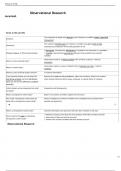
The proportion of people who develop a given disease or condition within a specified
Incidence:
time period
The number of existing cases of a disease or condition at a given point in time
Prevalence:
expressed as a proportion of the total population at risk
1. Descriptive: examining the distributions of predictors and outcomes in a population
Primary Purposes of Observational Studies: 2. Analytic: characterizing associations between these predictor and outcome
variables
observations made on a single occasion with no follow up period - linked to
What is a cross-sectional study?
prevalence
observations made in a group of subjects that is followed over time - linked to
What is a cohort study?
incidence
What are cross-sectional studies used for? to examine associations
Cross-sectional studies are well suited for Because they measure only prevalence, rather than incidence. Need to be cautious
describing variables and their distribution when drawing inferences about causes, prognosis, or natural history of a disease
parts, but why are they difficult to establish
causality?
Cohort studies can be categorized into what Prospective and Retrospective
two types?
What is a prospective cohort study? Begin in the present, and follow subjects into the future
Why would a prospective cohort study be allows investigators to measure variables more completely and accurately than is
better than a retrospective cohort study? possible retrospectively
What is a retrospective cohort study? examines information and specimens that have been collected in the past.
1. identify an existing cohort that has some predictor information already recorded
What would be the steps in collecting a
2. assess loss to follow up that has occurred
retrospective cohort study?
3. measure the outcome variables that have already occurred
Observational Research
1/3
Observational Research
Jeremiah
Terms in this set (35)
The proportion of people who develop a given disease or condition within a specified
Incidence:
time period
The number of existing cases of a disease or condition at a given point in time
Prevalence:
expressed as a proportion of the total population at risk
1. Descriptive: examining the distributions of predictors and outcomes in a population
Primary Purposes of Observational Studies: 2. Analytic: characterizing associations between these predictor and outcome
variables
observations made on a single occasion with no follow up period - linked to
What is a cross-sectional study?
prevalence
observations made in a group of subjects that is followed over time - linked to
What is a cohort study?
incidence
What are cross-sectional studies used for? to examine associations
Cross-sectional studies are well suited for Because they measure only prevalence, rather than incidence. Need to be cautious
describing variables and their distribution when drawing inferences about causes, prognosis, or natural history of a disease
parts, but why are they difficult to establish
causality?
Cohort studies can be categorized into what Prospective and Retrospective
two types?
What is a prospective cohort study? Begin in the present, and follow subjects into the future
Why would a prospective cohort study be allows investigators to measure variables more completely and accurately than is
better than a retrospective cohort study? possible retrospectively
What is a retrospective cohort study? examines information and specimens that have been collected in the past.
1. identify an existing cohort that has some predictor information already recorded
What would be the steps in collecting a
2. assess loss to follow up that has occurred
retrospective cohort study?
3. measure the outcome variables that have already occurred
Observational Research
1/3