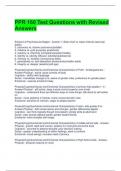
PPR 160 Test Questions with Revised
Answers
Erikson's 8 Psychosocial Stages - Answer-1. Basic trust vs. basic mistrust (security)
(baby)
2. autonomy vs. shame (autonomy)(toddler)
3. initiative vs. guilt (purpose) (preschool)
4. industry vs. inferiority (competence)(elem/middle)
5. identity vs. identity diffusion (identity)(adolesence)
6. intimacy vs. isolation (love)(young adult)
7. generatively vs. self-absorption (productivity)(middle \adult)
8. integrity vs. despair (wisdom)(old age)
Physical/Cognitive/Social and Emotional Characteristics of PreK - Kindergarteners -
Answer-Physical - active, good controls of body
Cognitive - skillful with language
Social - friendships change a lot, aware of gender roles, preference for gender peers
Emotional - express emotions freely
Physical/Cognitive/Social and Emotional Characteristics of primary kids grades 1 -4 -
Answer-Physical - still active, large muscle control superior over small,
Cognitive - understand there are different ways to know things, talk aloud to self earlier
on
Social - more selective in friends, overly concerned with rules
Emotional -sensitive to criticism, eager to please teacher
Physical/Cognitive/Social and Emotional Characteristics of elem. kids grades 5-6 -
Answer-Physical - both sexes leaner and stronger, gender differences appear
Cognitive - can think logically though inconsistent, simple skills at adult level
Social - peer groups replace adults, gender based friends
Emotional -more complex self image,
Physical/Cognitive/Social and Emotional Characteristics of middle school kids - Answer-
Physical - growth rapid and uneven, puberty for most girls and some boys
Cognitive - concrete to abstract thought, poor decision making
Social - greater understanding of others feelings, want to conform
Emotional -mood swings, increase need of privacy
Physical/Cognitive/Social and Emotional Characteristics of High School kids - Answer-
Physical - physical maturity for most
, Cognitive - political thinking and formal thought more abstract and knowledgeable
Social - adults influence long term plans and peers influence immediate status
Emotional -depression common
School District acceptable use policy - Answer-about displaying students work
School district fair use policy - Answer-about copy written material
3 personality structures proposed by Freud - Answer-1. Id - unconscious impulses
2. Ego - regulates acting on id impulses
3. Superego - morally regulates id and ego
Freud's 4 developmental stages - Answer-1. oral - infancy
2. anal - toddler
3. phallic - preschool
4. latency - elementary
5. genital – adolescence
4 stages of Piaget's theory of Cognitive Development - Answer-1. Sensorimotor (0-2)
concrete
2. Preoperational (2-7)
Intuitive, symbolically/thinking still egocenrtric
3. Concrete Operational (7-12)
Logical/ concrete reasoning/decentered thinking
4. Formal Operational (11-adult)
Abstract/symbols for abstract
2 stages of Piaget's theory of moral development - Answer-1. Heteronomous Morality
(young) rules are unchangeable and breaking rules leads to punishment
2. Autonomous Morality (older) rules are created and punishments are not automatic
Kohlberg's 3 levels (6 stages) of moral reasoning - Answer-1. Pre-conventional level
(stages 1/2) - kids make moral decisions to avoid punishment/safety main
consideration.
2. Conventional level (stages 3/4) - kids make moral decisions in consideration of
others/ fairness main consideration.
3. Post-Conventional Level stages 5/6) - kids define their own values in terms of ethical
principles. Good of Society main consideration.
Bilingual education - Answer-for students who speak little or no english and instruction
is provided in native language as well as English
Limited English Proficient (LEP) - Answer-students who have limited mastery of English
language and affects instruction and learning
Answers
Erikson's 8 Psychosocial Stages - Answer-1. Basic trust vs. basic mistrust (security)
(baby)
2. autonomy vs. shame (autonomy)(toddler)
3. initiative vs. guilt (purpose) (preschool)
4. industry vs. inferiority (competence)(elem/middle)
5. identity vs. identity diffusion (identity)(adolesence)
6. intimacy vs. isolation (love)(young adult)
7. generatively vs. self-absorption (productivity)(middle \adult)
8. integrity vs. despair (wisdom)(old age)
Physical/Cognitive/Social and Emotional Characteristics of PreK - Kindergarteners -
Answer-Physical - active, good controls of body
Cognitive - skillful with language
Social - friendships change a lot, aware of gender roles, preference for gender peers
Emotional - express emotions freely
Physical/Cognitive/Social and Emotional Characteristics of primary kids grades 1 -4 -
Answer-Physical - still active, large muscle control superior over small,
Cognitive - understand there are different ways to know things, talk aloud to self earlier
on
Social - more selective in friends, overly concerned with rules
Emotional -sensitive to criticism, eager to please teacher
Physical/Cognitive/Social and Emotional Characteristics of elem. kids grades 5-6 -
Answer-Physical - both sexes leaner and stronger, gender differences appear
Cognitive - can think logically though inconsistent, simple skills at adult level
Social - peer groups replace adults, gender based friends
Emotional -more complex self image,
Physical/Cognitive/Social and Emotional Characteristics of middle school kids - Answer-
Physical - growth rapid and uneven, puberty for most girls and some boys
Cognitive - concrete to abstract thought, poor decision making
Social - greater understanding of others feelings, want to conform
Emotional -mood swings, increase need of privacy
Physical/Cognitive/Social and Emotional Characteristics of High School kids - Answer-
Physical - physical maturity for most
, Cognitive - political thinking and formal thought more abstract and knowledgeable
Social - adults influence long term plans and peers influence immediate status
Emotional -depression common
School District acceptable use policy - Answer-about displaying students work
School district fair use policy - Answer-about copy written material
3 personality structures proposed by Freud - Answer-1. Id - unconscious impulses
2. Ego - regulates acting on id impulses
3. Superego - morally regulates id and ego
Freud's 4 developmental stages - Answer-1. oral - infancy
2. anal - toddler
3. phallic - preschool
4. latency - elementary
5. genital – adolescence
4 stages of Piaget's theory of Cognitive Development - Answer-1. Sensorimotor (0-2)
concrete
2. Preoperational (2-7)
Intuitive, symbolically/thinking still egocenrtric
3. Concrete Operational (7-12)
Logical/ concrete reasoning/decentered thinking
4. Formal Operational (11-adult)
Abstract/symbols for abstract
2 stages of Piaget's theory of moral development - Answer-1. Heteronomous Morality
(young) rules are unchangeable and breaking rules leads to punishment
2. Autonomous Morality (older) rules are created and punishments are not automatic
Kohlberg's 3 levels (6 stages) of moral reasoning - Answer-1. Pre-conventional level
(stages 1/2) - kids make moral decisions to avoid punishment/safety main
consideration.
2. Conventional level (stages 3/4) - kids make moral decisions in consideration of
others/ fairness main consideration.
3. Post-Conventional Level stages 5/6) - kids define their own values in terms of ethical
principles. Good of Society main consideration.
Bilingual education - Answer-for students who speak little or no english and instruction
is provided in native language as well as English
Limited English Proficient (LEP) - Answer-students who have limited mastery of English
language and affects instruction and learning