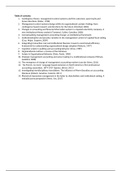
Table of contents:
1. Contingency theory, management control systems and firm outcomes: past results and
future directions (Fisher, 1998)
2. Management control systems design within its organizational context: findings from
contingency-based research and directions for the future (Chenhall, 2003)
3. Changes in accounting and financial information system in a Spanish electricity company: A
new institutional theory analysis (Tsamenyi, Cullen, González; 2006)
4. Conceptualizing management accounting change: an institutional framework
5. Institutionalization and practice variation in the management control of a global/local setting
(Cruz, Major, Scapens, 2009)
6. Integrating transaction cost and institutional theories: toward a constrained-efficiency
framework for understanding organizational design adoption (Roberts, 1997)
7. Cognitive scripts in auditing and accounting behavior (Choo, 1989)
8. Organizational routines: a review of the literature
9. Scripts in Organizational Behavior (Gioia, Poole, 1984)
10. Strategic management accounting and sense-making in a multinational company (Tillman,
Goddard, 2008)
11. The emergence of change of management accounting routines (van der Steen, 2011)
12. ‘No French, no more’: language-based exclusion on North America’s first professional
accounting association, 1879-1927 (Spence, Brivot, 2011)
13. Investigating interdisciplinary translations: The influence of Pierre Bourdieu on accounting
literature (Malsch, Gendron, Grazzini, 2011)
14. Rhetorical impression management in the letter to shareholders and institutional setting: A
metadiscourse perspective (Aerts, Yan, 2017)
,1. Contingency theory, management control systems and firm outcomes: past results and future
directions (Fisher, 1998)
Management control is the control managers exercise over other managers process in which
corporate-level managers ensure mid-level managers carry out organizational objectives/strategies.
- Corporate control; CEO and others
- Operational control; lower echelons for task performance
Contingency theory the design and use of control systems is contingent upon the context of the
organizational setting in which controls operate better match between control system and
contextual contingency variable increased performance.
Contingency theory arose from idea that there is no one way to design operational processes to
maximize efficiency (scientific management theory). The other end (situation-specific approach)
argues factors that influence control systems are unique. Contingency theory right in the middle.
Most important factors of contingency researched;
- Uncertainty; extent that an action by a manager results in an expected outcome. Task
uncertainty is similar to knowledge of the transformation process of Ouchi knowing the
process can specify the actions needing to take.
o Task (repetitive/external factors)
o Environmental (static vs. dynamic, certain vs. uncertain, simple vs. complex & calm
vs. turbulent)
- Technology and interdependence
o Wooodward (1965): small/large batch, process technology and mass production
o Perrow (1967): number of exceptions in the product or service generation process
and nature of search process with exceptions
o Thompson (1967): pooled, sequential and reciprocal interdependencies
- Industry, firm and business unit variables
o Industry: barriers to entry, concentration ratio
o Firm: structure (multi-divisional and functional), size and diversification
o Business: size
- Competitive strategy and mission
o Porter (1980): low-cost, differentiation and focus
o Miles and Snow (1978): defenders, prospectors and analyzers
o Product life cycle: build, hold, harvest and divest
- Observability factors
o Behavior (effort) observability (Thompson/Ouchi/others): measuring actions
o Outcome (output) observability: measuring outcomes of actions
List is not exhaustive, many have not been identified.
Organizational control is any actions or activities taken to influence the probability that people will
behave in ways that lead to attainment of organizational objectives (Flamholtz).
Giglioni and Bedeian; control has two types;
- Direction of subordinates in activities (programming and standard operating procedures, firm
structure (grouping people to achieve goals), firm culture)
- Cybernetic (arguably what formal controls should be anyways); system in which standards of
performance are determined, measuring systems gauge performance, comparisons are made
between standards and actual performance and feedback provides information (financial
budgeting and incentives tied to control systems). Measures used; net income, revenue,
expense targets, headcount, cycle time, on-time delivery and scrap.
,Contingent control system based on premise that correct match between factors and control
package will lead to desired outcomes, system then feeds back into future strategy and operational
decisions consistent.
Cybernetic systems research are mostly focused on budgets and the influence of managers on them,
not on non-financial measures. Budgets are mostly liked to incentives, theoretical goal: feedback and
information (monitoring), reality: budgets for determining compensation.
Contingent control framework; loop with iterative process. Factors in the framework may change due
to the markets or organization; some under the companies control, others not. Example; companies
have choices where to place products on the product life-cycle continuum (strategy) implications
for other factors like the level of environmental uncertainty. Business should use the environmental
uncertainty as starting point for control systems, they don’t influence, but should control them. After
setting goals, the contingency factors are determined and the firm will try to achieve the objectives.
Reasons for a not-yet developed theory of management control;
- Cybernetic control is multidimensional and part of the total system of organizational control
(research looked into a small subset; without addressing relationships between variables)
- Most research look at one contingency actor a time; relationships and causality hard to see
- Lack of databases and techniques for checking relationships; no information readily available
Types of analysis (depending on contingent, control and outcome variables)
- Level 1; one contingent factor correlated with one control mechanism; don’t assess
correlation between contingent factor and control mechanism has any effect on firm
outcome or correlation with other control mechanisms
o Macintosh and Daft (1987); relationship between departmental interdependence
and three elements of control (operating budget, periodic reports and standard
procedures). Pooled interdependence emphasize of departments on standard
operating procedures. Sequentially interdependence emphasize of departments
on budgets and reports. Reciprocally interdependence emphasize of departments
on subjective forms of control (no formal control). Role of control systems reflects a
fit between need for information by interdependence and supply of information by
the control systems.
- Level 2; joint effect of a control mechanism and contingent factor on an outcome variable.
o Simons (1987): control system differences between business units employing
defender or prospector strategies several studies correlation between strategic
business unit strategy and control mechanisms (level 1); defenders based incentive
pay on achievement of budgets, control systems were static. Prospectors had more
, importance for forcast data, goals and monitoring outputs. Match between control
mechanism and SBU strategy higher performance.
- Level 3; joint effect of a contingent factor and multiple control mechanisms on an outcome
variable. Assumes there may be complementary or substitution relationships between the
control variables that may be uncovered by including multiple control mechanisms in the
analysis. Control system substitution implies that use of different control mechanisms can
achieve the same result. Complementary control systems will reinforce on the other hand.
o Waterhouse and Tiessen (1978): technology and environment if firm technology is
well known and the environment is predictable centralized control system is
optimal. Mechanistic control is standard costing and tight budgets, but with high
environmental uncertainty hard to implement because the variables are more
uncertain organic control system.
- Level 4; includes multiple contingent factors in determining the optimal control design.
Multiple contingency factors implemented simultaneously may conflict trade-offs to fit
all contingencies.
o Fisher and Govindarajan (1993); if all factors demanded the same control easy,
presence of conflicts of demands makes it difficult. Hybrid control systems with
controls for each contingency might not be consistent because it focusses on
conflicts. Internal consistency means higher performance (Child, 1975). Ignoring
contingency factors may result in lower BSU performance (Gresov, 1989); some
misfit will always occur. Fisher described potential conflict between requirements of
product life cycle and competitive strategy; build and differentiation are similar
demand is consistent; low-cost and build mission conflicts increase and therefore
the deviations in demand negative impact on SBU performance.
Future research;
- There is no full set of contingency factors yet
- Relationships among contingency variables need to be explored (many no correlation yet)
- Lack of clarity in defining control systems difficulty defining boundaries. Narrow
definitions may limit exploring relationships and trade-offs;
- Poor conceptualization of outcome variables
- Focus on control systems until now incorporate nonfinancial performance measures
1. Contingency theory, management control systems and firm outcomes: past results and
future directions (Fisher, 1998)
2. Management control systems design within its organizational context: findings from
contingency-based research and directions for the future (Chenhall, 2003)
3. Changes in accounting and financial information system in a Spanish electricity company: A
new institutional theory analysis (Tsamenyi, Cullen, González; 2006)
4. Conceptualizing management accounting change: an institutional framework
5. Institutionalization and practice variation in the management control of a global/local setting
(Cruz, Major, Scapens, 2009)
6. Integrating transaction cost and institutional theories: toward a constrained-efficiency
framework for understanding organizational design adoption (Roberts, 1997)
7. Cognitive scripts in auditing and accounting behavior (Choo, 1989)
8. Organizational routines: a review of the literature
9. Scripts in Organizational Behavior (Gioia, Poole, 1984)
10. Strategic management accounting and sense-making in a multinational company (Tillman,
Goddard, 2008)
11. The emergence of change of management accounting routines (van der Steen, 2011)
12. ‘No French, no more’: language-based exclusion on North America’s first professional
accounting association, 1879-1927 (Spence, Brivot, 2011)
13. Investigating interdisciplinary translations: The influence of Pierre Bourdieu on accounting
literature (Malsch, Gendron, Grazzini, 2011)
14. Rhetorical impression management in the letter to shareholders and institutional setting: A
metadiscourse perspective (Aerts, Yan, 2017)
,1. Contingency theory, management control systems and firm outcomes: past results and future
directions (Fisher, 1998)
Management control is the control managers exercise over other managers process in which
corporate-level managers ensure mid-level managers carry out organizational objectives/strategies.
- Corporate control; CEO and others
- Operational control; lower echelons for task performance
Contingency theory the design and use of control systems is contingent upon the context of the
organizational setting in which controls operate better match between control system and
contextual contingency variable increased performance.
Contingency theory arose from idea that there is no one way to design operational processes to
maximize efficiency (scientific management theory). The other end (situation-specific approach)
argues factors that influence control systems are unique. Contingency theory right in the middle.
Most important factors of contingency researched;
- Uncertainty; extent that an action by a manager results in an expected outcome. Task
uncertainty is similar to knowledge of the transformation process of Ouchi knowing the
process can specify the actions needing to take.
o Task (repetitive/external factors)
o Environmental (static vs. dynamic, certain vs. uncertain, simple vs. complex & calm
vs. turbulent)
- Technology and interdependence
o Wooodward (1965): small/large batch, process technology and mass production
o Perrow (1967): number of exceptions in the product or service generation process
and nature of search process with exceptions
o Thompson (1967): pooled, sequential and reciprocal interdependencies
- Industry, firm and business unit variables
o Industry: barriers to entry, concentration ratio
o Firm: structure (multi-divisional and functional), size and diversification
o Business: size
- Competitive strategy and mission
o Porter (1980): low-cost, differentiation and focus
o Miles and Snow (1978): defenders, prospectors and analyzers
o Product life cycle: build, hold, harvest and divest
- Observability factors
o Behavior (effort) observability (Thompson/Ouchi/others): measuring actions
o Outcome (output) observability: measuring outcomes of actions
List is not exhaustive, many have not been identified.
Organizational control is any actions or activities taken to influence the probability that people will
behave in ways that lead to attainment of organizational objectives (Flamholtz).
Giglioni and Bedeian; control has two types;
- Direction of subordinates in activities (programming and standard operating procedures, firm
structure (grouping people to achieve goals), firm culture)
- Cybernetic (arguably what formal controls should be anyways); system in which standards of
performance are determined, measuring systems gauge performance, comparisons are made
between standards and actual performance and feedback provides information (financial
budgeting and incentives tied to control systems). Measures used; net income, revenue,
expense targets, headcount, cycle time, on-time delivery and scrap.
,Contingent control system based on premise that correct match between factors and control
package will lead to desired outcomes, system then feeds back into future strategy and operational
decisions consistent.
Cybernetic systems research are mostly focused on budgets and the influence of managers on them,
not on non-financial measures. Budgets are mostly liked to incentives, theoretical goal: feedback and
information (monitoring), reality: budgets for determining compensation.
Contingent control framework; loop with iterative process. Factors in the framework may change due
to the markets or organization; some under the companies control, others not. Example; companies
have choices where to place products on the product life-cycle continuum (strategy) implications
for other factors like the level of environmental uncertainty. Business should use the environmental
uncertainty as starting point for control systems, they don’t influence, but should control them. After
setting goals, the contingency factors are determined and the firm will try to achieve the objectives.
Reasons for a not-yet developed theory of management control;
- Cybernetic control is multidimensional and part of the total system of organizational control
(research looked into a small subset; without addressing relationships between variables)
- Most research look at one contingency actor a time; relationships and causality hard to see
- Lack of databases and techniques for checking relationships; no information readily available
Types of analysis (depending on contingent, control and outcome variables)
- Level 1; one contingent factor correlated with one control mechanism; don’t assess
correlation between contingent factor and control mechanism has any effect on firm
outcome or correlation with other control mechanisms
o Macintosh and Daft (1987); relationship between departmental interdependence
and three elements of control (operating budget, periodic reports and standard
procedures). Pooled interdependence emphasize of departments on standard
operating procedures. Sequentially interdependence emphasize of departments
on budgets and reports. Reciprocally interdependence emphasize of departments
on subjective forms of control (no formal control). Role of control systems reflects a
fit between need for information by interdependence and supply of information by
the control systems.
- Level 2; joint effect of a control mechanism and contingent factor on an outcome variable.
o Simons (1987): control system differences between business units employing
defender or prospector strategies several studies correlation between strategic
business unit strategy and control mechanisms (level 1); defenders based incentive
pay on achievement of budgets, control systems were static. Prospectors had more
, importance for forcast data, goals and monitoring outputs. Match between control
mechanism and SBU strategy higher performance.
- Level 3; joint effect of a contingent factor and multiple control mechanisms on an outcome
variable. Assumes there may be complementary or substitution relationships between the
control variables that may be uncovered by including multiple control mechanisms in the
analysis. Control system substitution implies that use of different control mechanisms can
achieve the same result. Complementary control systems will reinforce on the other hand.
o Waterhouse and Tiessen (1978): technology and environment if firm technology is
well known and the environment is predictable centralized control system is
optimal. Mechanistic control is standard costing and tight budgets, but with high
environmental uncertainty hard to implement because the variables are more
uncertain organic control system.
- Level 4; includes multiple contingent factors in determining the optimal control design.
Multiple contingency factors implemented simultaneously may conflict trade-offs to fit
all contingencies.
o Fisher and Govindarajan (1993); if all factors demanded the same control easy,
presence of conflicts of demands makes it difficult. Hybrid control systems with
controls for each contingency might not be consistent because it focusses on
conflicts. Internal consistency means higher performance (Child, 1975). Ignoring
contingency factors may result in lower BSU performance (Gresov, 1989); some
misfit will always occur. Fisher described potential conflict between requirements of
product life cycle and competitive strategy; build and differentiation are similar
demand is consistent; low-cost and build mission conflicts increase and therefore
the deviations in demand negative impact on SBU performance.
Future research;
- There is no full set of contingency factors yet
- Relationships among contingency variables need to be explored (many no correlation yet)
- Lack of clarity in defining control systems difficulty defining boundaries. Narrow
definitions may limit exploring relationships and trade-offs;
- Poor conceptualization of outcome variables
- Focus on control systems until now incorporate nonfinancial performance measures