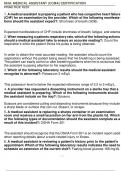
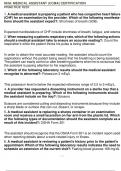
NHA: Medical Assistant (CCMA) Certification Practice Test 2.0 B
Medical Assisting Knowledge and Procedures
1. Electrode Placement for Patients with Below-Knee Amputations
- Site for electrode placement: Abdomen.
2. Faxing a Prescription to a Pharmacy
- Action: Call the pharmacy to confirm receipt of the faxed prescription.
3. Patient Instructions for a 12-Lead EKG
- Important statement: You should refrain from talking during the procedure.
4. Origin of Cardiac Electrical Impulses
- Location: Sinoatrial node.
5. Abnormal Laboratory Results
- Abnormal finding: Potassium 3 mEq/L (normal range is typically 3.5 to 5.0 mEq/L).
6. Format for a Professional Business Letter
- Formatting guideline: Keep flush with the left margin.
7. Dissecting Instrument on a Sterile Tray
- Instrument to include: Scissors.
8. Difference Between Liniment and Medicated Lotion
- Response: Liniments contain a higher portion of oil than medicated lotions.
9. Cleaning an Examination Room After a Biopsy
, - Safety action: Hold sharps by the blunt end to avoid a needlestick injury.
10. Starting Point for ICD-10-CM Code Lookup
- Where to start: The Alphabetic Index.
11. Route of Administration for Tuberculin Skin Test
- Administration route: Intradermal.
12. First Step in Cleaning Instruments After Minor Surgery
- Initial step: Sanitization.
13. Appropriate Electrode Placement for EKG
- Electrode placement description: Tabs downward on the arm.
14. Vital Signs for a 6-Year-Old Child
- Vital sign to report: Heart rate of 140/min is outside of the expected reference range.
15. Laboratory Result Indicating Need for Visit Extension
- Result: Fasting blood glucose 168 mg/dL.
16. Preparing Examination Table for Next Patient
- Action: Roll up the disposable paper on the table tightly and quickly.
17. Purpose of Epinephrine in Local Anesthetic
- Function: To reduce bleeding at the site.
18. Schedule I Drug Regulation
- Characteristic: Have no accepted medical use.
Medical Assisting Knowledge and Procedures
1. Electrode Placement for Patients with Below-Knee Amputations
- Site for electrode placement: Abdomen.
2. Faxing a Prescription to a Pharmacy
- Action: Call the pharmacy to confirm receipt of the faxed prescription.
3. Patient Instructions for a 12-Lead EKG
- Important statement: You should refrain from talking during the procedure.
4. Origin of Cardiac Electrical Impulses
- Location: Sinoatrial node.
5. Abnormal Laboratory Results
- Abnormal finding: Potassium 3 mEq/L (normal range is typically 3.5 to 5.0 mEq/L).
6. Format for a Professional Business Letter
- Formatting guideline: Keep flush with the left margin.
7. Dissecting Instrument on a Sterile Tray
- Instrument to include: Scissors.
8. Difference Between Liniment and Medicated Lotion
- Response: Liniments contain a higher portion of oil than medicated lotions.
9. Cleaning an Examination Room After a Biopsy
, - Safety action: Hold sharps by the blunt end to avoid a needlestick injury.
10. Starting Point for ICD-10-CM Code Lookup
- Where to start: The Alphabetic Index.
11. Route of Administration for Tuberculin Skin Test
- Administration route: Intradermal.
12. First Step in Cleaning Instruments After Minor Surgery
- Initial step: Sanitization.
13. Appropriate Electrode Placement for EKG
- Electrode placement description: Tabs downward on the arm.
14. Vital Signs for a 6-Year-Old Child
- Vital sign to report: Heart rate of 140/min is outside of the expected reference range.
15. Laboratory Result Indicating Need for Visit Extension
- Result: Fasting blood glucose 168 mg/dL.
16. Preparing Examination Table for Next Patient
- Action: Roll up the disposable paper on the table tightly and quickly.
17. Purpose of Epinephrine in Local Anesthetic
- Function: To reduce bleeding at the site.
18. Schedule I Drug Regulation
- Characteristic: Have no accepted medical use.