Advanced Research Methods lectures
Lecture 1: Introduction to qualitative research
There should be a fit between three things in your research:
1. The goal of the research (you want to add something to a literature gap or to something in
practice, so your research question is something important)
2. The characteristics of the data
3. The characteristics of the analytical procedures applied
If your question is about students, you need data about students. You also need to make sure that
you choose the right way (qualitative or quantitative): the characteristics of the analytical procedures
applied. You also have to make choices within for example quantitative research for your kind of
analysis (factor analysis, ANOVA, et cetera). In qualitative you choose your tools based on the beliefs
that are underneath your research question.
Professionals often feel that their identity is also formed by what job they do. Professional identity
consists of three parts: professional ethics and codes of practice, personal values and the law.
4th of October is a workshop in concept mapping. Than we have to prepare by code the transcripts
and categorize these codes. We can use concept mapping to answer the research question.
A code tree is connected to operationalization, we are not going to do that. We are going to work
with a code book. We have to build on an existing theory and explain why things are happing the way
they do.
Your underlying philosophy has practical consequences for your topic, focus of study, what we see as
data, how we collect data and how we write up our research accounts.
Epistemology = study of criteria by which we know what does and does not constitute warranted or
scientific knowledge. So when do we call something true or false? Knowledge about knowledge.
Example: is it green, blue, or turquoise? We have criteria to establish this
Ontology = dealing with the essence of phenomena and the nature of their existence: is it real or
illusory? We believe something is there, if we can see it and if we can point it out, if something is
there, even if we are not.
Example: would we hear a tree falling if nobody is there? Can something exist without us knowing it?
The realists say yes, there is a truth and we can discover it. Relativist or interpretist say no, we
construct something, it exists because we
construct it. Truth doesn’t exist until we talk
about it.
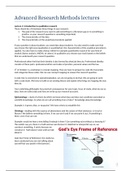
Gods Eye Frame of Reference: the study has
been conducted (you are not talking about
yourself but you speak in third person).
, Deductive reasoning: you begin with the research question, than the theoretical background,
methodology, results and conclusion. You have an idea of what will happen and you exam that
hypothesis. So, a general theory, you check this general idea in a specific situation to see whether the
theory is right again or rejected.
Inductive reasoning: you don’t formulate a hypothesis, but you start with observations and data.
This course is about this inductive reasoning (that is why we don’t need a code tree). You have a
certain fascination, no idea what you might find there, but you are slightly interested in a certain
topic. You just start to do some interviews and observations, draw some conclusions from there and
then you make a model with a hypothesis. You don’t start with reading about the topic, you just get
to work and make your idea concrete after deducting fieldwork. You are not going to generalize
something!! You are not making a general statement, you only talk about the situation that you are
investigating. It is about understanding why. It is normal that you have the feeling that you don’t
know what you are doing, because most people are used to deductive reasoning.
Abductive reasoning: you start with observations and start thinking about ‘what might be the reason
for this observed thing?’. So start with observation and then draw certain assumptions. Then you
have several hypotheses (inductive reasoning stops here). You are going to test whether certain
assumptions and hypotheses are true, whether there is evidence or counterevidence that shows
whether it is true or fault. The testing of the hypotheses is deductive reasoning. The difference is that
the conclusion is not a general truth, but only the truth for that specific situation.
Most of the time we are going to conduct this last one, because we are pushed into deductive
reasoning from early on, but we want to do inductive, so we get a kind of combination of both.
Template analysis is the tool for abductive reasoning.
Positivism: mostly deducted reasoning
Relativism/interpretivist: mostly inductive reasoning
Within relativism there are many philosophies, so inductive reasoning is getting quite big.
There is one philosophy that is in between: qualitative neo positivism philosophy. For your master
thesis, this is not very practical, because you should choose between both.
Positivism says that science should focus only on directly observable phenomena. Theories should be
tested, facts should be neutrally gathered from the observable external world. In research positivism
is more about a big amount of respondents and more quantitative research, to draw general
conclusions. You want to have a quick picture of what is going on right this moment. You want to
know who is in the group and are sitting together.
Qualitative neo-positivism says what is out there is presumed to be independent of the knower and
accessible to the trained researcher, if following correct procedures. They say it is possible to
neutrally apprehend the facts ‘out there’. THIS ONE IS IN BETWEEN POSITIVISM AND RELATIVISM.
Relativism is more about the why and how, you want to know for how long people sit together and
why and what is the process. How do people attend the lecture, instead of just ‘are they there’.
Relativist question is mostly about how, how does something happen? You don’t want to know the
answer on question, but you want to know how they get to an answer. So not: do they like their
manager? But: how to they come to the conclusion that they like their manager or not? If you only
want to know what people think, this is not enough for qualitative research. You want to know how
they come to these opinions in qualitative research, otherwise it isn’t enough for master thesis.
Lecture 1: Introduction to qualitative research
There should be a fit between three things in your research:
1. The goal of the research (you want to add something to a literature gap or to something in
practice, so your research question is something important)
2. The characteristics of the data
3. The characteristics of the analytical procedures applied
If your question is about students, you need data about students. You also need to make sure that
you choose the right way (qualitative or quantitative): the characteristics of the analytical procedures
applied. You also have to make choices within for example quantitative research for your kind of
analysis (factor analysis, ANOVA, et cetera). In qualitative you choose your tools based on the beliefs
that are underneath your research question.
Professionals often feel that their identity is also formed by what job they do. Professional identity
consists of three parts: professional ethics and codes of practice, personal values and the law.
4th of October is a workshop in concept mapping. Than we have to prepare by code the transcripts
and categorize these codes. We can use concept mapping to answer the research question.
A code tree is connected to operationalization, we are not going to do that. We are going to work
with a code book. We have to build on an existing theory and explain why things are happing the way
they do.
Your underlying philosophy has practical consequences for your topic, focus of study, what we see as
data, how we collect data and how we write up our research accounts.
Epistemology = study of criteria by which we know what does and does not constitute warranted or
scientific knowledge. So when do we call something true or false? Knowledge about knowledge.
Example: is it green, blue, or turquoise? We have criteria to establish this
Ontology = dealing with the essence of phenomena and the nature of their existence: is it real or
illusory? We believe something is there, if we can see it and if we can point it out, if something is
there, even if we are not.
Example: would we hear a tree falling if nobody is there? Can something exist without us knowing it?
The realists say yes, there is a truth and we can discover it. Relativist or interpretist say no, we
construct something, it exists because we
construct it. Truth doesn’t exist until we talk
about it.
Gods Eye Frame of Reference: the study has
been conducted (you are not talking about
yourself but you speak in third person).
, Deductive reasoning: you begin with the research question, than the theoretical background,
methodology, results and conclusion. You have an idea of what will happen and you exam that
hypothesis. So, a general theory, you check this general idea in a specific situation to see whether the
theory is right again or rejected.
Inductive reasoning: you don’t formulate a hypothesis, but you start with observations and data.
This course is about this inductive reasoning (that is why we don’t need a code tree). You have a
certain fascination, no idea what you might find there, but you are slightly interested in a certain
topic. You just start to do some interviews and observations, draw some conclusions from there and
then you make a model with a hypothesis. You don’t start with reading about the topic, you just get
to work and make your idea concrete after deducting fieldwork. You are not going to generalize
something!! You are not making a general statement, you only talk about the situation that you are
investigating. It is about understanding why. It is normal that you have the feeling that you don’t
know what you are doing, because most people are used to deductive reasoning.
Abductive reasoning: you start with observations and start thinking about ‘what might be the reason
for this observed thing?’. So start with observation and then draw certain assumptions. Then you
have several hypotheses (inductive reasoning stops here). You are going to test whether certain
assumptions and hypotheses are true, whether there is evidence or counterevidence that shows
whether it is true or fault. The testing of the hypotheses is deductive reasoning. The difference is that
the conclusion is not a general truth, but only the truth for that specific situation.
Most of the time we are going to conduct this last one, because we are pushed into deductive
reasoning from early on, but we want to do inductive, so we get a kind of combination of both.
Template analysis is the tool for abductive reasoning.
Positivism: mostly deducted reasoning
Relativism/interpretivist: mostly inductive reasoning
Within relativism there are many philosophies, so inductive reasoning is getting quite big.
There is one philosophy that is in between: qualitative neo positivism philosophy. For your master
thesis, this is not very practical, because you should choose between both.
Positivism says that science should focus only on directly observable phenomena. Theories should be
tested, facts should be neutrally gathered from the observable external world. In research positivism
is more about a big amount of respondents and more quantitative research, to draw general
conclusions. You want to have a quick picture of what is going on right this moment. You want to
know who is in the group and are sitting together.
Qualitative neo-positivism says what is out there is presumed to be independent of the knower and
accessible to the trained researcher, if following correct procedures. They say it is possible to
neutrally apprehend the facts ‘out there’. THIS ONE IS IN BETWEEN POSITIVISM AND RELATIVISM.
Relativism is more about the why and how, you want to know for how long people sit together and
why and what is the process. How do people attend the lecture, instead of just ‘are they there’.
Relativist question is mostly about how, how does something happen? You don’t want to know the
answer on question, but you want to know how they get to an answer. So not: do they like their
manager? But: how to they come to the conclusion that they like their manager or not? If you only
want to know what people think, this is not enough for qualitative research. You want to know how
they come to these opinions in qualitative research, otherwise it isn’t enough for master thesis.