

100% satisfaction guarantee Immediately available after payment Both online and in PDF No strings attached 4.6 TrustPilot
logo-home
Exam (elaborations)

Bio 210 Cell Structure and Functions Comprehensive Exam Questions And Detailed Answers.

Rating
-
Sold
-
Pages
9
Grade
A+
Uploaded on
09-08-2024
Written in
2024/2025

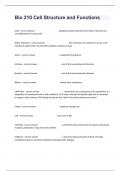
Actin - correct answer a globular protein that links into chains, twist to form microfilaments in muscle cells Active Transport - correct answer the movement of a substance across a cell membrane against the concentration gradient, requires energy Anion - correct answer a negatively charged ion Archaea - correct answer one of the two prokaryotic domains Bacteria - correct answer one of the two prokaryotic domains Bilayer - correct answer double layer membrane CAM Plant - correct answer a plant that uses crassulacean acid metabolism, an adaptation for photosynthesis in arid conditions. CO2 enters stomata during the night and is converted to organic acids, releases CO2 during the day for the Calvin Cycle when stomata are closed Cation - correct answer positively charged ion Cell - correct answer basic unit of life Cell Wall - correct answer a protective layer external to the plasma membrane in plants, prokayotes, fungi and some protists. Cellulose - correct answer a structural polysaccharide of plant cell walls, consisting of glucose monomers joined by beta glycosidic linkages Central Vacuole - correct answer in a mature plant cell, a large membraneous sac with diverse roles in growth, storage, and releasing toxins Centriole - correct answer a structure in the centrosome of an animal cell composed of a cylinder of microtubule triplets; centrosomes have pairs of centrioles Chloroplast - correct answer organelle found in plants and photosynthetic protists that use it to absorb sunlight for photosynthesis Cilia - correct answer short appendage containing microtubules in eukaryotic cells, specialized for locomotion of cell Cis Face - correct answer receiving Cleavage Furrow - correct answer a shallow groove around the cell in the cell surface near the old metaphase plate Concentration Gradient - correct answer a region along which the density of a chemical substance increases or decreases Contractile Vacuole - correct answer a membranous sac that helps move excess water out of certain fresh-water protists Cristae - correct answer an infolding of the inner membrane of the mitochondria, houses electron transport chains and molecules of the enzyme catalyzing the synthesis of ATP Cytoskeleton - correct answer a network of microtubules, microfilaments, involving interactions of myosin and actin filaments, that speeds up the distribution of materials within cells Desmosomes - correct answer a type of intercellular junction in animal cells that functions as a rivet, fastening cells together Diffusion - correct answer the random thermal motion of particles of liquids, gases, or solids. the net movement of a substance from a region of high concentration to an area of lower concentration Dynein - correct answer in cilia and flagella, a large motor protein extending from one microtubule doublet to the adjacent doublet. ATP hydrolysis drives changes in its shape to move cilia and flagella Endocytosis - correct answer cellular uptake of biological molecules and particulate matter via formation of vesicles from the plasma membrane Endomembrane System - correct answer the collection of membranes inside and surrounding a eukaryotic cell, related either through direct physical contact or by the transfer of membranous vesicles Endosymbiosis - correct answer a relationship between two species in which one organism lives inside the cell or cells of another organism Eukaryotic - correct answer a type of cell with membrane enclosed nucleus and membrane enclosed organelles Exocytosis - correct answer the cellular secretion of biological molecules by the fusion of vesicles containing them with the plasma membrane Facilitated Diffusion - correct answer the passage of molecules or ions down their electrochemical gradient across a biological membrane with the assistance of specific transmembrane proteins, requiring no energy expenditure Fagellum - correct answer long cellular appendage used for locomotion of a cell Fluid Mosaic Model - correct answer the currently accepted model of cell membrane structure, which envisions the membrane as a mosaic of protein molecules drifting laterally in a fluid bilayer of phospholipids G Protein - correct answer a GTP-binding protein that relays signals from a plasma membrane signal receptor, known as a G protein coupled receptor, to other signal transduction proteins inside the cell Gap Junctions - correct answer a type of intercellular junction in animal cells, consisting of proteins surrounding a pore that allows the passage of materials between cells Genome - correct answer the genetic material of an organism or virus; the complete complement of an organisms or virus's genes along with its noncoding nucleic acid sequences Glycoprotein - correct answer a protein with one or more convalently attached carbohydrates Golgi Appartatus - correct answer an organelle in eukaryotic cells consisting of stacks of flat membranous sacs that modify, store, and route products of the endoplasmic reticulum and synthesize some product Grana - correct answer stack of membrane bounded thylakoids in the chloroplast; grana function with the light reactions of photosynthesis Hydrophilic - correct answer water loving Hydrophobic - correct answer hates water Hypertonic - correct answer solution that makes the cell lose water and shrink up Hypotonic - correct answer solution that will cause the cell to take up lots of water and to potentially burst Inner Membrane - correct answer inner membrane of a cell Integral Protein - correct answer a transmembrane protein with hydrophobic regions that extend into and often completely span the hydrophobic interior of the membrane and with hydrophobic interior of the membrane Intermediate Filament - correct answer a component of the cytoskeleton that includes filaments of intermediate size between microtubules and microfilaments Lysosome - correct answer a membrane enclosed sac of hydrolytic enzymes found in the cytoplasm of animal cells and some protists Microfilament - correct answer a cable composed of actin proteins in the cytoplasm of almost every eukaryotic cell, making up part of the cytoskeleton and acting alone or with myosin to cause cell contraction; also called an actin filament Microtubules - correct answer a hollow rod composed of tubulin proteins that makes up part of the cytoskeleton in all eukaryotic cells and is found in cilia and flagella Mitochondria - correct answer an organelle in eukaryotic cells that serves as the site of cellular respiration; uses oxygen to break down organic molecules and synthesize ATP, known as the powerhouse of the cell Myosin - correct answer a type of motor protein that associates into filaments that interact with actin filaments to cause cell contraction Nuclear Lamina - correct answer a netlike array of protein filaments that lines the inner surface of the nuclear envelope and helps maintain the shape of the nucleus Nucleoid - correct answer a non-membrane enclosed region in prokaryotic cell where its chromosome is located

Show more Read less
Institution
BIO 210
Course
BIO 210


Whoops! We can’t load your doc right now. Try again or contact support.

Written for

Institution
BIO 210
Course
BIO 210

Document information

Uploaded on
August 9, 2024
Number of pages
9
Written in
2024/2025
Type
Exam (elaborations)
Contains
Questions & answers

Subjects

Content preview

Bio 210 Cell Structure and Functions

Actin - correct answer a globular protein that links into chains, twist to form
microfilaments in muscle cells


Active Transport - correct answer the movement of a substance across a cell
membrane against the concentration gradient, requires energy


Anion - correct answer a negatively charged ion


Archaea - correct answer one of the two prokaryotic domains


Bacteria - correct answer one of the two prokaryotic domains


Bilayer - correct answer double layer membrane


CAM Plant - correct answer a plant that uses crassulacean acid metabolism, an
adaptation for photosynthesis in arid conditions. CO2 enters stomata during the night and is converted
to organic acids, releases CO2 during the day for the Calvin Cycle when stomata are closed


Cation - correct answer positively charged ion


Cell - correct answer basic unit of life


Cell Wall - correct answer a protective layer external to the plasma membrane
in plants, prokayotes, fungi and some protists.


Cellulose - correct answer a structural polysaccharide of plant cell walls,
consisting of glucose monomers joined by beta glycosidic linkages

, Central Vacuole - correct answer in a mature plant cell, a large membraneous
sac with diverse roles in growth, storage, and releasing toxins


Centriole - correct answer a structure in the centrosome of an animal cell
composed of a cylinder of microtubule triplets; centrosomes have pairs of centrioles


Chloroplast - correct answer organelle found in plants and photosynthetic
protists that use it to absorb sunlight for photosynthesis


Cilia - correct answer short appendage containing microtubules in eukaryotic
cells, specialized for locomotion of cell


Cis Face - correct answer receiving


Cleavage Furrow - correct answer a shallow groove around the cell in the cell
surface near the old metaphase plate


Concentration Gradient - correct answer a region along which the density of a
chemical substance increases or decreases


Contractile Vacuole - correct answer a membranous sac that helps move
excess water out of certain fresh-water protists


Cristae - correct answer an infolding of the inner membrane of the
mitochondria, houses electron transport chains and molecules of the enzyme catalyzing the synthesis of
ATP


Cytoskeleton - correct answer a network of microtubules, microfilaments,
involving interactions of myosin and actin filaments, that speeds up the distribution of materials within
cells


Desmosomes - correct answer a type of intercellular junction in animal cells
that functions as a rivet, fastening cells together

Get to know the seller

Seller avatar
Reputation scores are based on the amount of documents a seller has sold for a fee and the reviews they have received for those documents. There are three levels: Bronze, Silver and Gold. The better the reputation, the more your can rely on the quality of the sellers work.
RealGrades Nursing
View profile
Follow You need to be logged in order to follow users or courses
Sold
170
Member since
2 year
Number of followers
52
Documents
11665
Last sold
3 weeks ago

4.0

26 reviews

5
12
4
5
3
7
2
1
1
1

Why students choose Stuvia

Created by fellow students, verified by reviews

Quality you can trust: written by students who passed their tests and reviewed by others who've used these notes.

Didn't get what you expected? Choose another document

No worries! You can instantly pick a different document that better fits what you're looking for.

Pay as you like, start learning right away

No subscription, no commitments. Pay the way you're used to via credit card and download your PDF document instantly.

Student with book image

“Bought, downloaded, and aced it. It really can be that simple.”

Alisha Student

Frequently asked questions
