MUSIC SLCC EXAM QUESTIONS AND
ANSWERS
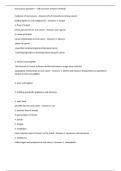
Absoulute Music - Answer-Music that has no external reference to text, story, dance, or
any other artistic influence. It is music for the sake of music and is also referred to as
"pure music".
Antiquity - Answer-The time-period before the Middle Ages (400 A.D.). Due to the lack
of recording and notational capabilities most of the music from this time-period is
unknown.
Baroque - Answer-The term used to describe the musical genres and styles from 1600-
1750. It was a word applied to things that were confused or misshapen. In music it
represents raw elements of volatility and unnaturalness.
Classical - Answer-The term used to describe the musical genres and styles from 1750-
1825. The term "classic" describes something broad and long-lasting which appeals to a
wide range of people
Composers - Answer-A person who writes music.
Insruments - Answer-Devices created to produce musical sound.
Medieval (Middle Ages) - Answer-A term used to describe the time between the Roman
Empire and the Renaissance (400 AD - 1400 AD). Also, referred to as the Medieval era.
Chant was the dominant musical form of the time.
Modernism - Answer-The deliberate separation from past structures with a sense of
innovation and style. This took place during the 20th Century.
Non-Western Music - Answer-Consists of any style or genre of music that is not derived
from Western civilization and therefore, does not follow western practices. Many
composers of Western music incorporate styles from the Middle East, Africa, India, the
Orient, and many indigenous cultures of the Western Hemisphere.
Notation - Answer-A visual system of recording music for future posterity with symbols
that represent sound. Much of the music before the Middle Ages is unknown due to the
lack of notation.
Oral Traditions - Answer-The act of passing down speech or literature from generation
to generation or from community to community by word of mouth. No physical notation
of the text is used. One must memorize the words and then be able to repeat them
exactly.
ANSWERS
Absoulute Music - Answer-Music that has no external reference to text, story, dance, or
any other artistic influence. It is music for the sake of music and is also referred to as
"pure music".
Antiquity - Answer-The time-period before the Middle Ages (400 A.D.). Due to the lack
of recording and notational capabilities most of the music from this time-period is
unknown.
Baroque - Answer-The term used to describe the musical genres and styles from 1600-
1750. It was a word applied to things that were confused or misshapen. In music it
represents raw elements of volatility and unnaturalness.
Classical - Answer-The term used to describe the musical genres and styles from 1750-
1825. The term "classic" describes something broad and long-lasting which appeals to a
wide range of people
Composers - Answer-A person who writes music.
Insruments - Answer-Devices created to produce musical sound.
Medieval (Middle Ages) - Answer-A term used to describe the time between the Roman
Empire and the Renaissance (400 AD - 1400 AD). Also, referred to as the Medieval era.
Chant was the dominant musical form of the time.
Modernism - Answer-The deliberate separation from past structures with a sense of
innovation and style. This took place during the 20th Century.
Non-Western Music - Answer-Consists of any style or genre of music that is not derived
from Western civilization and therefore, does not follow western practices. Many
composers of Western music incorporate styles from the Middle East, Africa, India, the
Orient, and many indigenous cultures of the Western Hemisphere.
Notation - Answer-A visual system of recording music for future posterity with symbols
that represent sound. Much of the music before the Middle Ages is unknown due to the
lack of notation.
Oral Traditions - Answer-The act of passing down speech or literature from generation
to generation or from community to community by word of mouth. No physical notation
of the text is used. One must memorize the words and then be able to repeat them
exactly.