Theme 3
Unstructured vs Structured content
- Structured content consists of numbers in rows and columns that can be manipulated
arithmetically in calculations
- Unstructured content is everything else – Eg: Emails coming into an organisation, customer
feedback surveys
Enterprise Content Management
- The control over capture, storage, access and use of data and information stored outside
relational databases
- Document management – Designed to assist organisations to manage the creation and
flow of documents through the provision of a centralised repository and workflow
- Record management – The field of management responsible for the efficient and
systematic control of the creation, receipt, maintenance, use and disposition of records
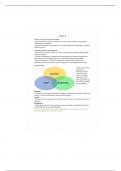
Scope of ECM
- Where is information
stored? How is
information stored?
Enterprise - What information
Where/How
needs to be stored?
- Who has access to
information? When do
they have access? Why
Content Management
What Who/When/Why are they allowed?
Enterprise
- Describes all the functions of distribution, application, publication, acquisition, capture and
access in a uniform and pervasive nature without boundaries
Content
- Describes all the rich components, information, data, records, rules, structures, topics and
templates
Management
- Brings together facets of communication, processes, workflows, collaboration, interaction
and exchange with an excess of stakeholders
Click Up – Lecturers have certain control, adding slides, announcements etc. Students can
only download that and upload their own work
, ECM Components
Document Management
- Documents must be managed as they are used throughout the organisation
- Controls the lifecycle of documents in your organization—how they are created, reviewed,
and published, and how they are ultimately disposed of or retained
Records Management
- Process by which an organization determines what types of information are records, how
to manage them through their retention periods, and how to ultimately destroy or archive
them
Workflow/Business Process Management
- Content development should be managed through a workflow that ensures content is
created on schedule and receives proper approvals
- Workflow components can include the creation, processing, routing, rules, administration,
security
- BPM way of looking at and then controlling the processes that are present in an
organization
Collaboration
- Having collaboration capabilities helps groups or teams of knowledge workers improve
productivity when working with records
- Wikis, policy derivation, forums, support, project management
Imaging
- Paper documents must be able to be digitally scanned and captured in electronic format
Digital Asset Management
- Process that focuses on the storage, tracking and use of rich media documents like video,
logos, photographs
Portal
- Portal technology that maintains profiles of users can help them find unstructured data
Web Content Management
- Used to present information already existing and managed in the ECM repository
Digital Rights Management
- Systematic approach to copyright protection for digital media.
- Purpose is to prevent unauthorized redistribution of digital media and restrict the ways
consumers can copy content they've purchased
Knowledge Management
- Process of creating, sharing, using and managing the knowledge and information of an
organisation
- It refers to a multidisciplinary approach to achieving organisational objectives by making
the best use of knowledge
Unstructured vs Structured content
- Structured content consists of numbers in rows and columns that can be manipulated
arithmetically in calculations
- Unstructured content is everything else – Eg: Emails coming into an organisation, customer
feedback surveys
Enterprise Content Management
- The control over capture, storage, access and use of data and information stored outside
relational databases
- Document management – Designed to assist organisations to manage the creation and
flow of documents through the provision of a centralised repository and workflow
- Record management – The field of management responsible for the efficient and
systematic control of the creation, receipt, maintenance, use and disposition of records
Scope of ECM
- Where is information
stored? How is
information stored?
Enterprise - What information
Where/How
needs to be stored?
- Who has access to
information? When do
they have access? Why
Content Management
What Who/When/Why are they allowed?
Enterprise
- Describes all the functions of distribution, application, publication, acquisition, capture and
access in a uniform and pervasive nature without boundaries
Content
- Describes all the rich components, information, data, records, rules, structures, topics and
templates
Management
- Brings together facets of communication, processes, workflows, collaboration, interaction
and exchange with an excess of stakeholders
Click Up – Lecturers have certain control, adding slides, announcements etc. Students can
only download that and upload their own work
, ECM Components
Document Management
- Documents must be managed as they are used throughout the organisation
- Controls the lifecycle of documents in your organization—how they are created, reviewed,
and published, and how they are ultimately disposed of or retained
Records Management
- Process by which an organization determines what types of information are records, how
to manage them through their retention periods, and how to ultimately destroy or archive
them
Workflow/Business Process Management
- Content development should be managed through a workflow that ensures content is
created on schedule and receives proper approvals
- Workflow components can include the creation, processing, routing, rules, administration,
security
- BPM way of looking at and then controlling the processes that are present in an
organization
Collaboration
- Having collaboration capabilities helps groups or teams of knowledge workers improve
productivity when working with records
- Wikis, policy derivation, forums, support, project management
Imaging
- Paper documents must be able to be digitally scanned and captured in electronic format
Digital Asset Management
- Process that focuses on the storage, tracking and use of rich media documents like video,
logos, photographs
Portal
- Portal technology that maintains profiles of users can help them find unstructured data
Web Content Management
- Used to present information already existing and managed in the ECM repository
Digital Rights Management
- Systematic approach to copyright protection for digital media.
- Purpose is to prevent unauthorized redistribution of digital media and restrict the ways
consumers can copy content they've purchased
Knowledge Management
- Process of creating, sharing, using and managing the knowledge and information of an
organisation
- It refers to a multidisciplinary approach to achieving organisational objectives by making
the best use of knowledge