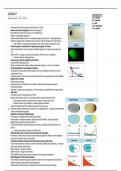
Lecture 2 Abbreviation Key:
Wednesday, August 7, 2019 10:03 AM b/c = because
b/w = between
w/ = with
expt = experiment
• Human genome has been sequenced: 25,000 genes in 3.25bp. ex. = example
• Bicoid is an anterior morphogen (anterior-inducing agent).
• Bicoid mRNA is localized in the anterior of an unfertilized egg.
• mRNA is translated after fertilization. ->
• Resulting proteins diffuse and form a concentration gradient along A/P axis. -> Morphogen gradient
• Experiment suggests that no matter the location, presence of Bicoid will give rise to head structure.
○ Only if injection is during syncytial blastoderm phase (bicoid protein can access the nuclei).
• Posterior pattern is controlled by nine posterior group genes. Ex. Nanos
• Same concept as Bicoid, forming a protein concentration gradient w/ its high point at posterior end.
Yet…
• Nanos is NOT a morphogen. It just binds to Hunchback mRNA to prevent its translation.
○ Prevents hunchback phenotype in flies.
• Caudal is also critical for establishing the A/P axis.
• Caudal mRNA is distributed evenly.
• Bicoid (concentrated in the anterior) inhibits caudal protein synthesis -> forms a P to A gradient.
• A/P Ends Specified by Torso Receptor Activation
• Torso (gene?) encodes tyrosine kinase receptor that is evenly distributed everywhere, but is only
activated on A/P ends…
• The ligand needed to activate torso are only present at A/P ends. Ligand released only after fertilization.
• Zygotic Gene Activation
• Hierarchy of gene activity.
• Zygotic genes are what "elaborate on information" provided by maternal genes during early
developmental stages.
• Regulation of unique sets of zygotic genes -> First broad genes are established, then smaller domains.
• Gap Genes
• 1st zygotic genes to be expressed along A/P axis.
• Mutations of these genes result in a loss of large sections of pattern along the A/P axis.
○ Gene expression domain corresponds more or less to the regions that are lost.
○ Mutations result in LoF phenotypes -> multiple segments are deleted.
• Encode transcription factors that regulate the expression of other genes.
• Expression precedes cellularization, but proteins are not highly diffusible. -> Gap genes encode proteins
that have limited diffusion gradients.
• Regulation of Hunchback (Hb) Expression
• Hb expression is regulated both maternally and zygotically…
• Nanos inhibits hb translation posteriorly. (Despite maternal hb mRNA is uniformly distributed)
• Bicoid activates zygotic hb expression anteriorly. ->
• CONCLUSION: Maternal hb being inhibited in the posterior, and Zygotic hb being activated in the
anterior.
○ Creates an hb gradient w/ high point on anterior side.
• INCing the Bicoid copy # results in shift of domain of Hb expression.
• Hb threshold: minimum amount of Bicoid protein needed to express Hb. Bicoid moves Hb expression
from anterior to posterior ends to form gradient.
• Hunchback activates and represses the Kruppel gene (inverse relationship).
• In Bicoid mutant (absence of bicoid), Hb protein concentration gradient drops significantly. -> Kruppel is
able to reach activation threshold only!
• When Hb is high -> Kruppel is restricted.
• When Hb is low -> Kruppel is not restricted.
• CONCLUSION: Bicoid protein presence inversely controls Kruppel gene expression!
• Mutual Regulation of Gap Gene Expression.
• Cross inhibition b/w adjacent gap genes happens to keep them in their respective domains/serves to
maintain mutually exclusive domains of gene expression.
• Anterior stripe of Giant expression is regulated through repression by Knirps and Krüppel.
Wednesday, August 7, 2019 10:03 AM b/c = because
b/w = between
w/ = with
expt = experiment
• Human genome has been sequenced: 25,000 genes in 3.25bp. ex. = example
• Bicoid is an anterior morphogen (anterior-inducing agent).
• Bicoid mRNA is localized in the anterior of an unfertilized egg.
• mRNA is translated after fertilization. ->
• Resulting proteins diffuse and form a concentration gradient along A/P axis. -> Morphogen gradient
• Experiment suggests that no matter the location, presence of Bicoid will give rise to head structure.
○ Only if injection is during syncytial blastoderm phase (bicoid protein can access the nuclei).
• Posterior pattern is controlled by nine posterior group genes. Ex. Nanos
• Same concept as Bicoid, forming a protein concentration gradient w/ its high point at posterior end.
Yet…
• Nanos is NOT a morphogen. It just binds to Hunchback mRNA to prevent its translation.
○ Prevents hunchback phenotype in flies.
• Caudal is also critical for establishing the A/P axis.
• Caudal mRNA is distributed evenly.
• Bicoid (concentrated in the anterior) inhibits caudal protein synthesis -> forms a P to A gradient.
• A/P Ends Specified by Torso Receptor Activation
• Torso (gene?) encodes tyrosine kinase receptor that is evenly distributed everywhere, but is only
activated on A/P ends…
• The ligand needed to activate torso are only present at A/P ends. Ligand released only after fertilization.
• Zygotic Gene Activation
• Hierarchy of gene activity.
• Zygotic genes are what "elaborate on information" provided by maternal genes during early
developmental stages.
• Regulation of unique sets of zygotic genes -> First broad genes are established, then smaller domains.
• Gap Genes
• 1st zygotic genes to be expressed along A/P axis.
• Mutations of these genes result in a loss of large sections of pattern along the A/P axis.
○ Gene expression domain corresponds more or less to the regions that are lost.
○ Mutations result in LoF phenotypes -> multiple segments are deleted.
• Encode transcription factors that regulate the expression of other genes.
• Expression precedes cellularization, but proteins are not highly diffusible. -> Gap genes encode proteins
that have limited diffusion gradients.
• Regulation of Hunchback (Hb) Expression
• Hb expression is regulated both maternally and zygotically…
• Nanos inhibits hb translation posteriorly. (Despite maternal hb mRNA is uniformly distributed)
• Bicoid activates zygotic hb expression anteriorly. ->
• CONCLUSION: Maternal hb being inhibited in the posterior, and Zygotic hb being activated in the
anterior.
○ Creates an hb gradient w/ high point on anterior side.
• INCing the Bicoid copy # results in shift of domain of Hb expression.
• Hb threshold: minimum amount of Bicoid protein needed to express Hb. Bicoid moves Hb expression
from anterior to posterior ends to form gradient.
• Hunchback activates and represses the Kruppel gene (inverse relationship).
• In Bicoid mutant (absence of bicoid), Hb protein concentration gradient drops significantly. -> Kruppel is
able to reach activation threshold only!
• When Hb is high -> Kruppel is restricted.
• When Hb is low -> Kruppel is not restricted.
• CONCLUSION: Bicoid protein presence inversely controls Kruppel gene expression!
• Mutual Regulation of Gap Gene Expression.
• Cross inhibition b/w adjacent gap genes happens to keep them in their respective domains/serves to
maintain mutually exclusive domains of gene expression.
• Anterior stripe of Giant expression is regulated through repression by Knirps and Krüppel.