Lecture 1 Abbreviation Key:
Friday, August 2, 2019 10:37 PM
b/c = because
b/w = between
w/ = with
expt = experiment
• Epigenesis: organisms develop via a sequence of steps where cells differentiate and organs form, during
ex. = example
different stages. New structures arising progressively -> need to acknowledge temporal and spatial
arrangement/location.
• Determinant development/Mosaic Theory: argues that 1-cell zygote contains specific determinants that
are distributed unequally b/w daughter cells (asymmetric cell division). Wilhelm Roux experiment
○ Determinants are spatially located.
○ Roux expt: stated separate function of cells had already been determined b/c specific determinants
went into certain cells during cell division-> Mosaic model.
• Regulative development: an embryo can regulate aspects of development even when some cells are lost.
Hans Driesch experiment
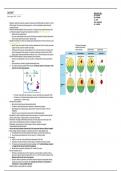
○ Mosaic Theory cannot explain Driesch's expt where separated cells still form the same (yet smaller) Environment encourages
organism that also arose from controlled 2-cell stage. specified cell to take on
○ If the Mosaic Theory was true, inducing apoptosis to one of the cells during the 2-cell stage would another cell fate. Determination Specification
effect the development of the organism, b/c a portion of determinants would be lost. But it didn't…
○ Driesch's work refuted both preformation and Mosaic Theory. Cell-to-cell interactions are important.
• NOW WE KNOW Development is all about regulation of gene expression.
○ Genome is normally identical in every cell, yet cells in an embryo differ b/c they express different
genes.
○ Gene expression is controlled by upstream developmental genes.
○ How is gene expression regulated? With enhancers? Enhancers interact w/ the promoter, which
allow them to control gene expression.
▪ Promoter: located before the coding gene -> give you where the gene is expressed in DNA.
▪ Enhancers: are at multiple locations upstream promoter. Can hold information on associated
genetic disease. -> Interest of study
• Development is progressive:
○ Early embryonic cells have great developmental potential.
○ The ability to switch fates (pluripotency) decreases as development progresses.
○ Start expressing only necessary genes; genes become "narrower and narrower" in their cell
lineage/fate.
○ Cells go thru a series of steps before acquiring their final differentiated states…
• Specification: the ability to differentiate autonomously when placed in a neutral environment (petri dish,
test tube, saline solution). Cell fate depends on environment. Reversible.
• Determination: the ability to differentiate autonomously even when placed into another region of the
embryo. Aka the cell differentiates according to it's original fate. Irreversible.
• Differentiation: process where one cell type changes to another, allowing morphological
changes/displaying specific phenotypes.
• How can cells acquire different characteristics? What mechanism determines different lineages?
1. Mosaic strategy: cytoplasmic localization + asymmetric cell division = distinct daughter cells
a. The properties of these cells will be defined by their lineage, not by their environmental cues.
b. One cell would acquire determinants, the other would not. -> Different cell fates
2. Via induction
a. Induction: occurs when a cell signal influences development of other cells.
b. Competency: the ability to respond to inductive signals. Competent cells respond to signals.
c. The response can be stage-specific (temporally regulated). How? Commitment/being competent
is a stage itself that can be controlled in development.
d. New structures are induced by cell signaling. Ex. Formation of eye cups.
• Inductive interactions can be:
○ Permissive: A cell makes only one kind of response to an inducing signal, and makes it when a
given level of signal is reached: a single outcome, all or none. All info is present in responder cells.
Responder cells hold the control. One response.
○ Instructive: different concentrations elicit different responses/cell types (dose-dependent effects).
Inducing cells provide info to responder cells. Inducing cells hold control. Concentration of
inducing cells -> various possible responses.
• Multiple cell types can be generated by a morphogen.
Friday, August 2, 2019 10:37 PM
b/c = because
b/w = between
w/ = with
expt = experiment
• Epigenesis: organisms develop via a sequence of steps where cells differentiate and organs form, during
ex. = example
different stages. New structures arising progressively -> need to acknowledge temporal and spatial
arrangement/location.
• Determinant development/Mosaic Theory: argues that 1-cell zygote contains specific determinants that
are distributed unequally b/w daughter cells (asymmetric cell division). Wilhelm Roux experiment
○ Determinants are spatially located.
○ Roux expt: stated separate function of cells had already been determined b/c specific determinants
went into certain cells during cell division-> Mosaic model.
• Regulative development: an embryo can regulate aspects of development even when some cells are lost.
Hans Driesch experiment
○ Mosaic Theory cannot explain Driesch's expt where separated cells still form the same (yet smaller) Environment encourages
organism that also arose from controlled 2-cell stage. specified cell to take on
○ If the Mosaic Theory was true, inducing apoptosis to one of the cells during the 2-cell stage would another cell fate. Determination Specification
effect the development of the organism, b/c a portion of determinants would be lost. But it didn't…
○ Driesch's work refuted both preformation and Mosaic Theory. Cell-to-cell interactions are important.
• NOW WE KNOW Development is all about regulation of gene expression.
○ Genome is normally identical in every cell, yet cells in an embryo differ b/c they express different
genes.
○ Gene expression is controlled by upstream developmental genes.
○ How is gene expression regulated? With enhancers? Enhancers interact w/ the promoter, which
allow them to control gene expression.
▪ Promoter: located before the coding gene -> give you where the gene is expressed in DNA.
▪ Enhancers: are at multiple locations upstream promoter. Can hold information on associated
genetic disease. -> Interest of study
• Development is progressive:
○ Early embryonic cells have great developmental potential.
○ The ability to switch fates (pluripotency) decreases as development progresses.
○ Start expressing only necessary genes; genes become "narrower and narrower" in their cell
lineage/fate.
○ Cells go thru a series of steps before acquiring their final differentiated states…
• Specification: the ability to differentiate autonomously when placed in a neutral environment (petri dish,
test tube, saline solution). Cell fate depends on environment. Reversible.
• Determination: the ability to differentiate autonomously even when placed into another region of the
embryo. Aka the cell differentiates according to it's original fate. Irreversible.
• Differentiation: process where one cell type changes to another, allowing morphological
changes/displaying specific phenotypes.
• How can cells acquire different characteristics? What mechanism determines different lineages?
1. Mosaic strategy: cytoplasmic localization + asymmetric cell division = distinct daughter cells
a. The properties of these cells will be defined by their lineage, not by their environmental cues.
b. One cell would acquire determinants, the other would not. -> Different cell fates
2. Via induction
a. Induction: occurs when a cell signal influences development of other cells.
b. Competency: the ability to respond to inductive signals. Competent cells respond to signals.
c. The response can be stage-specific (temporally regulated). How? Commitment/being competent
is a stage itself that can be controlled in development.
d. New structures are induced by cell signaling. Ex. Formation of eye cups.
• Inductive interactions can be:
○ Permissive: A cell makes only one kind of response to an inducing signal, and makes it when a
given level of signal is reached: a single outcome, all or none. All info is present in responder cells.
Responder cells hold the control. One response.
○ Instructive: different concentrations elicit different responses/cell types (dose-dependent effects).
Inducing cells provide info to responder cells. Inducing cells hold control. Concentration of
inducing cells -> various possible responses.
• Multiple cell types can be generated by a morphogen.