100% satisfaction guarantee Immediately available after payment Both online and in PDF No strings attached 4.2 TrustPilot
logo-home
Exam (elaborations)

Nurs 2873 Lab quiz Terms in this set (105) 1. A patient with a right upper extremity CVC reports pain, swelling, and tenderness of the extremity. No fluids are infusing through the catheter. The nurse knows that these signs and symptoms may indicate wh

Rating
-
Sold
-
Pages
9
Grade
A+
Uploaded on
06-08-2024
Written in
2024/2025

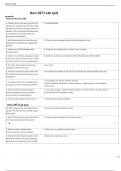
Nurs 2873 Lab quiz Terms in this set (105) 1. A patient with a right upper extremity CVC reports pain, swelling, and tenderness of the extremity. No fluids are infusing through the catheter. The nurse knows that these signs and symptoms may indicate which CVC- associated complication? Thrombophlebitis 2. Which action should the nurse take when changing a CVC dressing on a diaphoretic patient? D. Place an occlusive gauze dressing over the catheter exit site. 3. Proper care of CVCs includes which nursing action? B. Replacing the dressing when it is damp, loose, or soiled 4. A patient has redness, drainage, and pain at the CVC exit site as well as a fever. Which nursing intervention is the most appropriate? B. Notify the practitioner and discuss further interventions to confirm CLABSI. 5. How often should a gauze dressing be changed on a CVC exit site? every 2 days 6. A nurse is educating a patient with a new CVC. Which teaching point should the nurse emphasize? do not disrupt the dressing on the CVCD. The patient's exit site has erythema with pain. 7. In a patient with a PICC, phlebitis should be suspected if which condition is present? D. The patient's exit site has erythema with pain. *Signs of phlebitis, include pain , erythema, edema, ,streak formation, and a palpable venous cord 8. Which procedure should be used to cleanse the catheter exit site of a patient who is allergic to chlorhexidine? C. Use swabs to apply a povidone-iodine solution in a circular motion, moving outward from the exit site in concentric circles. 9. A CVC exit site dressing is moist, but it is C. Change the dressing immediately. Nurs 2873 Lab quiz 10. When removing the old dressing from a patient's CVC site, the nurse should include which step? remove the catheter stabilization device 1. Which action would the nurse perform first when preparing to apply sterile gloves? C. Assess the glove packaging for wetness or tears. 2. When are sterile nonlatex gloves recommended for a sterile procedure? A. When there is a possible sensitivity issue 3. What is the most important step the nurse can take to minimize the risk of tearing a sterile glove when applying it to the hands? selecting the proper glove size 4. After applying sterile gloves, the patient states she is uncomfortable and would like to move to her left side. What is the best way for the nurse to keep the gloves sterile while waiting for nursing assistive personnel (NAP) to position the patient for a sterile dressing change? A. Interlocking the fingers and keeping the hands above waist level 5. Which protocol does not vary among institutions? C. Use of sterile gloves for sterile procedures 1. Which statement might the nurse make to nursing assistive personnel (NAP) when caring for a patient with a dressed central venous access device (CVAD) site? C. "Let me know immediately if the patient's dressing becomes damp." 2. Which action would the nurse take to minimize the patient's risk for infection when changing the dressing on a CVAD? A. Use sterile technique throughout the process. 3. How can the nurse minimize the risk of dislodging the catheter when removing a dressing? B. Remove the transparent dressing or tape and gauze in the direction of catheter insertion. 4. What will the nurse do after removing the soiled dressing from a patient's CVAD device? D. Remove the catheter stabilization device, if present. 5. What is the most important way in which the nurse can reduce the risk for infection in a patient with a CVAD that has a gauze dressing? A. Change the dressing every 48 hours. 1. When drawing blood from a patient's peripherally inserted central catheter (PICC), what can the nurse do to minimize pressure on the device during flushing? C. Use a 10-mL syringe for the flush. 2. When drawing blood from a peripherally inserted central catheter (PICC) in which all ports are patent, it is recommended that the nurse select which lumen? the largest Nurs 2873 Lab quiz 3. Which action can the nurse take to ensure a quality blood sample when drawing blood from a patient's peripherally inserted central catheter (PICC) site? D. Discard the first 6 to 9 mL of blood drawn. 4. After drawing blood from a patient's peripherally inserted central catheter (PICC), what would the nurse do to ensure that the device resumes proper functioning? D. Flush the catheter with preservative-free 0.9% sodium chloride, per agency policy. 5. After drawing blood from a peripherally inserted central catheter (PICC), which action would minimize the patient's risk for infection when reconnecting prescribed intravenous fluids? C. Disinfecting the IV needleless connector and the end of the IV tubing 1. Which action would the nurse perform to best ensure effective insertion of a venous access device into a patient's arm? A. Anchor the vein by placing a thumb 1 to 2 inches below the site. 2. How might the nurse prepare a patient to anticipate some discomfort when inserting a venous access device? A. Instruct the patient to expect a sharp, quick stick. 3. Which of the following technique(s) is/are best for minimizing a patient's risk for injury when inserting a venous access device? A. Inserting the needle with the bevel up B. Using a vein on the dorsal surface of the arm C. Holding the skin taut directly below the site 4. The nurse is inserting an over-the-needle catheter into a newly admitted patient. What will the nurse do after confirming blood return? C. Lower the catheter until it is flush with the skin. 5. Which instruction might the nurse give to nursing assistive personnel (NAP) regarding the care of a patient with an intravenous access device? C. "Let me know when you notice that the IV bag contains less than 100 milliliters." 1. Which instruction might the nurse give to nursing assistive personnel (NAP) regarding the care of a patient with an intravenous (IV) site dressing? D. "Be sure to notify me if the patient reports that the IV site is painful or swollen." 2. How will the nurse minimize the risk for infection when changing a patient's IV catheter site dressing? A. Use aseptic technique throughout the process. 3. The nurse is concerned that a confused patient's erratic movements may compromise the intravenous (IV) insertion site. Which action can the nurse take to protect the patient and the site from injury? A. Apply an IV site-protection device over the site, such as House UltraDressing. 4. Which action would the nurse take if an intravenous (IV) insertion site appeared red, warm, and swollen? B. Discontinue the infusion. 5. How can the nurse ensure that a patient's IV tubing will not tug on the infusion catheter after a transparent dressing is applied to an infusion site on the arm? C. Secure the tubing in two different locations on the arm. 1. What would the nurse do to assess a patient's risk for embolus when removing a venous access device? B. Visualize the tip of the IV device. 2. Which instruction might the nurse give to nursing assistive personnel (NAP) when caring for a patient whose IV access device is to be removed? C. "Let me know if you notice any bleeding on the site dressing." 3. What might the nurse do to improve a patient's cooperation during the removal of an IV access device? A. Describe the entire procedure to the patient. 4. Which action will best minimize the patient's risk for vein injury when removing an IV access device from a patient's arm? A. Keep the hub parallel to the skin. 5. What will the nurse do to prevent possible complications after removing an IV access device in a patient on anticoagulant therapy? D. Apply firm pressure to the site with sterile gauze for 10 minutes. 1. Which technique is most accurate in identifying an appropriate vein site for IV catheter insertion into the arm? D. Apply a tourniquet to the selected arm 4 to 6 inches above the proposed site. 2. When preparing to insert a venous access device, how can the nurse encourage patient compliance with the procedure? A. Assess the patient's understanding of the placement of the device. 3. Which action minimizes the patient's risk for injury when inserting a venous access device into the arm? C. Checking for a radial pulse once the tourniquet has been applied 4. The nurse is preparing to insert a venous access device into a newly admitted 75- year-old patient. Which vein is not an inappropriate choice for IV insertion in this patient? C. Superficial dorsal vein 5. The nurse is using chlorhexidine to prepare the site before inserting a venous access device into the median cubital vein of a 60-year-old patient. Which action is correct? D. Cleanse the area by first swabbing horizontally, then vertically with the applicator for about 30 seconds. 1. After changing the intravenous (IV) tubing on a patient's primary infusion, the nurse notes air bubbles in the tubing. How would the nurse remove them? D. Close the clamp, stretch the tubing downward, and flick the tubing. 2. Which action can the nurse take to minimize the patient's risk for infection when applying new tubing to a primary IV infusion? D. Using aseptic technique and changing the tubing at the same time a new primary fluid bag is hung are both appropriate to minimize the patient's risk for infection 3. While changing a patient's hospital gown, the extension set on the IV infusion becomes disconnected and ends up on the bed linens. What would the nurse do? D. Change the extension set tubing. 4. What would the nurse do to ensure the correct administration of gravity drip intravenous (IV) fluid after changing the tubing on a patient's primary infusion? C. Recheck the drip rate by counting the drops for 1 full minute. 5. Which instruction would the nurse give to nursing assistive personnel (NAP) when caring for a patient who is receiving IV fluids? C. "Let me know when the IV bag is almost empty." 1. Which instruction reflects the nurse's correct understanding of the role of nursing assistive personnel (NAP) in caring for a patient receiving an intravenous (IV) antibiotic medication by piggyback? B. "Let me know immediately if the patient complains of pain at the IV site." 2. When administering an IV piggyback medication to infuse by gravity, how can the nurse ensure that the medication will flow properly? B. Hang the piggyback medication higher than the primary fluid. 3. What is the best way to protect a patient from an IV site injury when giving an antibiotic medication by piggyback? B. Assess the IV site before initiating the IV piggyback medication. 4. What is the best way to prevent infection and conserve resources when terminating an IV piggyback medication infusion in a patient who also has a primary fluid infusion? B. Leave both the piggyback tubing and the bag attached to the primary line Y-site port until the next scheduled dose. 5. Which nursing intervention is most important in ensuring safe infusion of a medication delivered by IV piggyback through a saline lock? D. Flush the saline lock with sodium chloride solution before initiating the infusion. 1. Which response might the nurse give to nursing assistive personnel (NAP) who reports that the alarm is sounding on a patient's electronic infusion device (EID)? C. "I'll check the IV site and pump." 2. How would the infusion of the IV fluids be affected if the tubing were unintentionally dislodged from the chamber of the control mechanism of the EID? D. The flow of fluid would stop. 3. A patient is prescribed 1000 mL of intravenous (IV) normal saline to run over 8 hours. The initial fluid is hung at 0800. How many milliliters of fluid will have infused by 1200? C. 500 mL 4. The nurse calculates that the patient is to receive 125 mL of intravenous (IV) normal saline per hour. After programming the infusion pump to deliver at that rate, how would the nurse ensure accurate fluid administration? A. First verify that the fluid is dripping, and then check the level of fluid remaining in the container every hour. 5. Which information is not necessary for the nurse to include when documenting the use of an EID for an intravenous infusion? C. Patient's pulse and heart rate 1. When preparing to administer a new medication, what would the nurse do first to ensure the patient's safety? A. Perform hand hygiene. 2. What is the most important step the nurse can take to ensure that the patient is getting the correct medication? C. Compare the medication label with the MAR three times. 3. Which statement or question best illustrates the nurse's understanding of the role of nursing assistive personnel (NAP) in medication administration? B. "Let me know if she complains of any nausea." 4. As the nurse is administering medication to a patient, the patient states, "I've never seen that pill before." What is the nurse's most appropriate response? C. Tell the patient that you will review the physician's order to clarify any discrepancies. 5. What is the nurse's best response after noticing that the route of administration has been omitted from a medication order? B. Immediately notify the prescriber to request that the order be completed. 1. When preparing an injection from an ampule, what will the nurse do if liquid is trapped in the neck of the ampule? C. Use quick, light finger taps on the top of the ampule to move the liquid. 2. What is the greatest safety concern when withdrawing medication from an ampule? C. Withdrawing glass particles into the syringe 3. How does the nurse minimize the risk of patient infection when preparing medication from an ampule? D. Preserving the sterility of the needle while preparing the medication 4. Which action minimizes the risk of introducing glass particles into the syringe when drawing medication from an ampule? C. Using a filter needle or straw to draw the medication from the ampule Nurs 2873 Lab quiz 1. A nurse is preparing to withdraw medication from an open multi-dose vial. After confirming that the vial contains the appropriate medication and checking the expiration date, what would the nurse do next? C. Wipe the rubber seal of the vial with an alcohol swab. 2. What would the nurse do to remove air trapped in a syringe before withdrawing the syringe from the vial? A. Position the tip of the needle in the vial's airspace, and tap the barrel of the syringe. 3. How can the nurse prevent negative pressure from building up in the vial when preparing an injection? A. Inject a volume of air into the vial equivalent to the volume of medication to be withdrawn. 4. How can the nurse ensure that medication from a single-dose vial is used appropriately? D. Discard the vial and any remaining medication in the vial directly after use. 5. What will the nurse do after opening a multi-dose vial and withdrawing a dose of medication from it? D. Label the vial with the date it was opened and your initials. 1. Which action would the nurse take to diminish tissue irritation when administering a subcutaneous injection to a patient of average size? B. Make sure the volume of the medication is less than 2 mL. 2. Which needle would be most appropriate for the nurse to use when giving a subcutaneous injection to a patient of average height and weight? C. 25-gauge, ⅜-inch 3. What can the nurse do to minimize the discomfort of a subcutaneous injection? C. Cover the injection site with gauze pad after withdrawing the needle. 4. When preparing to administer heparin or insulin subcutaneously, which site is preferred? A. Abdomen 5. What can the nurse do to ensure proper site selection for subcutaneous insulin injection? D. Systematically rotate sites within the same anatomical location or area. 1. Which action by the nurse ensures patient safety when administering an intramuscular injection? B. Rotating injection sites 2. When preparing an intramuscular injection, C. Clean the injection site with an alcohol swab. Nurs 2873 Lab quiz 3. What can the nurse do to minimize the patient's risk for injury when delivering an intramuscular injection? C. Pull back on the plunger after inserting the needle. 4. Which site is most commonly used for intramuscular injections? Ventrogluteal 5. Which action by the nurse helps to ensure that the medication is delivered into the muscle when administering an intramuscular injection? D. Aspirating for blood return before injecting the medication 1. How can the nurse best ensure the patient's safety when preparing insulin for administration? A. Obtain the patient's current blood glucose level. 2. How would the nurse prepare insulin to ensure its efficacy? C. Roll the vial of insulin suspension between the palms prior to drawing up the medication. 3. When will a patient's blood glucose levels be most affected by a short-acting insulin injection, such as Humulin-R? A. In 2 to 3 hours 4. Which of the following statements is accurate regarding insulin administration? C. Vials of insulin must be inspected before each use for changes in appearance. 5. To prevent hypoglycemia and enhance efficacy, it is appropriate to give rapid-acting insulin how many minutes before the next meal? A. 5 to 15 minutes 1. The nurse is preparing to mix short- and intermediate-acting insulins to administer to a patient. Which action best preserves the insulin's effectiveness? B. Refraining from injecting the intermediate-acting insulin into the short-acting vial 2. The patient is to receive both Lantus® (insulin glargine) and regular insulin. To ensure the proper action of the insulins, what would the nurse do when preparing these two types of insulin for administration? B. Prepare the insulins in two syringes for separate injections. 3. When preparing an injection that contains both short- and intermediate-acting insulins, what is the first step the nurse would take to ensure the effectiveness of the injection? A. Insert air into the intermediate-acting insulin. 4. When preparing an injection of mixed insulin that includes 12 units of NPH and 5 units of regular insulin, how does the nurse initially confirm the proper dosage in the syringe? A. By noting when 5 units of clear insulin is visible in the syringe 5. Which action would the nurse take when mixing intermediate- and long-acting insulins together in one syringe? C. Prepare two injections. Nurs 2873 Lab quiz 1. Which statement might a nurse make to nursing assistive personnel (NAP) when caring for a patient prescribed an intravenous (IV) bolus of analgesic medication? B. "Let me know immediately if the patient complains of pain at the insertion site." 2. Which patient safety issue is specific to administration of medication by IV bolus? A. Determining that the medication is compatible with the IV solution 3. What is the most important action the nurse can take to protect the patient when administering a narcotic analgesic by IV bolus? A. Injecting the medication at the prescribed rate 4. How can the nurse best minimize the patient's risk for infection when administering an IV bolus of an analgesic? C. Follow aseptic technique during the entire process. 5. If the nurse does not see blood return when aspirating the saline lock in preparation for an IV bolus medication, what is the next step? D. Assess the site for swelling or coolness while flushing the saline lock with normal saline.

Show more Read less
Institution
CGFO - Certified Government Finance Officer
Course
CGFO - Certified Government Finance Officer


Whoops! We can’t load your doc right now. Try again or contact support.

Written for

Institution
CGFO - Certified Government Finance Officer
Course
CGFO - Certified Government Finance Officer

Document information

Uploaded on
August 6, 2024
Number of pages
9
Written in
2024/2025
Type
Exam (elaborations)
Contains
Questions & answers

Subjects

Content preview

8/6/24, 8:04 AM


Nurs 2873 Lab quiz
Jeremiah
Terms in this set (105)

1. A patient with a right upper extremity CVC Thrombophlebitis
reports pain, swelling, and tenderness of the
extremity. No fluids are infusing through the
catheter. The nurse knows that these signs
and symptoms may indicate which CVC-
associated complication?

2. Which action should the nurse take when D. Place an occlusive gauze dressing over the catheter exit site.
changing a CVC dressing on a diaphoretic
patient?

3. Proper care of CVCs includes which B. Replacing the dressing when it is damp, loose, or soiled
nursing action?

4. A patient has redness, drainage, and pain B. Notify the practitioner and discuss further interventions to confirm CLABSI.
at the CVC exit site as well as a fever. Which
nursing intervention is the most appropriate?

5. How often should a gauze dressing be every 2 days
changed on a CVC exit site?

6. A nurse is educating a patient with a new do not disrupt the dressing on the CVCD. The patient's exit site has erythema with pain.
CVC. Which teaching point should the nurse
emphasize?

D. The patient's exit site has erythema with pain.
7. In a patient with a PICC, phlebitis should
*Signs of phlebitis, include pain , erythema, edema, ,streak formation, and a palpable
be suspected if which condition is present?
venous cord

8. Which procedure should be used to C. Use swabs to apply a povidone-iodine solution in a circular motion, moving outward
cleanse the catheter exit site of a patient from the exit site in concentric circles.
who is allergic to chlorhexidine?

9. A CVC exit site dressing is moist, but it is C. Change the dressing immediately.


Nurs 2873 Lab quiz
10. When removing the old dressing from a remove the catheter stabilization device
patient's CVC site, the nurse should include
which step?

1. Which action would the nurse perform first C. Assess the glove packaging for wetness or tears.
when preparing to apply sterile gloves?


2. When are sterile nonlatex gloves A. When there is a possible sensitivity issue
recommended for a sterile procedure?

3. What is the most important step the nurse selecting the proper glove size
can take to minimize the risk of tearing a
sterile glove when applying it to the hands?


1/9

, 8/6/24, 8:04 AM
4. After applying sterile gloves, the patient A. Interlocking the fingers and keeping the hands above waist level
states she is uncomfortable and would like
to move to her left side. What is the best way
for the nurse to keep the gloves sterile while
waiting for nursing assistive personnel (NAP)
to position the patient for a sterile dressing
change?


5. Which protocol does not vary among C. Use of sterile gloves for sterile procedures
institutions?

1. Which statement might the nurse make to C. "Let me know immediately if the patient's dressing becomes damp."
nursing assistive personnel (NAP) when
caring for a patient with a dressed central
venous access device (CVAD) site?

2. Which action would the nurse take to A. Use sterile technique throughout the process.
minimize the patient's risk for infection when
changing the dressing on a CVAD?

3. How can the nurse minimize the risk of B. Remove the transparent dressing or tape and gauze in the direction of catheter
dislodging the catheter when removing a insertion.
dressing?

4. What will the nurse do after removing the D. Remove the catheter stabilization device, if present.
soiled dressing from a patient's CVAD
device?

5. What is the most important way in which A. Change the dressing every 48 hours.
the nurse can reduce the risk for infection in
a patient with a CVAD that has a gauze
dressing?

1. When drawing blood from a patient's C. Use a 10-mL syringe for the flush.
peripherally inserted central catheter (PICC),
what can the nurse do to minimize pressure
on the device during flushing?

2. When drawing blood from a peripherally the largest
inserted central catheter (PICC) in which all
ports are patent, it is recommended that the
nurse select which lumen?


Nurs 2873 Lab quiz


2/9

Get to know the seller

Seller avatar
Reputation scores are based on the amount of documents a seller has sold for a fee and the reviews they have received for those documents. There are three levels: Bronze, Silver and Gold. The better the reputation, the more your can rely on the quality of the sellers work.
Denyss Teachme2-tutor
View profile
Follow You need to be logged in order to follow users or courses
Sold
24
Member since
1 year
Number of followers
3
Documents
6307
Last sold
4 days ago
Classic Writers

I am a professional writer/tutor. I help students with online class management, exams, essays, assignments and dissertations. Improve your grades by buying my study guides, notes and exams or test banks that are 100% graded

5.0

2 reviews

5
2
4
0
3
0
2
0
1
0

Recently viewed by you

Why students choose Stuvia

Created by fellow students, verified by reviews

Quality you can trust: written by students who passed their tests and reviewed by others who've used these notes.

Didn't get what you expected? Choose another document

No worries! You can instantly pick a different document that better fits what you're looking for.

Pay as you like, start learning right away

No subscription, no commitments. Pay the way you're used to via credit card and download your PDF document instantly.

Student with book image

“Bought, downloaded, and aced it. It really can be that simple.”

Alisha Student

Frequently asked questions