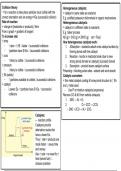
Collision theory: Homogeneous catalysts:
= for a reaction to take place particles must collide with the = catalyst in same state as reactants
correct orientation and an energy>/=Ea (successful collision) E.g. acidified potassium dichromate in organic mechanisms
Rate of reaction: Heterogeneous catalysts:
= change in [reactants or products] / time = catalyst in a different state to reactants
From a graph = gradient of tangent E.g. haber process
To increase rate: N2 (g) + 3H2 (g) ⇌ 2NH3 (g) cat = Fe(s)
↑ temp How heterogeneous catalysts work:
- ↑ rate = ↑ KE ∴faster ∴↑successful collisions 1. ADsorption - reactants adsorb onto catalyst surface by
- ↑particles have E>Ea ∴↑successful collisions forming bonds with the catalyst
↑ conc 2. Reaction - bonds in reactants break (due to new
- ↑ likely to collide ∴↑successful collisions strong bonds formed w/ catalyst) & product formed
↑ pressure 3. Desorption - product leaves catalyst surface
- ↑ likely to collide ∴↑successful collisions Poisoning = blocking active sites - adsorb and wont desorb
↑ SA (solids) Catalytic converters
- ↑ particles available to collide∴↑successful collisions = thin metal catalyst coating & honeycomb structure to ↑ SA
+ catalyst and ↓ metal used
- Lowers Ea ∴↑particles have E>Ea ∴↑successful - Use Pt ot rhodium catalysts (expensive)
collisions Remove CO & NO from vehicle exhausts:
1. 2NO → N2 + O2
2. O2 + 2CO → 2CO2
∴ 2NO + 2CO → N2 + 2CO2
Catalysts:
← reaction profile
Catalysts provide
alternative routes that
have a lower Ea.
They ↑ rate = products are
made faster ∴ saves time
and money
Also ↑ rate = no need for ↑
heat (saves fuel) ∴
reduces pollution
= for a reaction to take place particles must collide with the = catalyst in same state as reactants
correct orientation and an energy>/=Ea (successful collision) E.g. acidified potassium dichromate in organic mechanisms
Rate of reaction: Heterogeneous catalysts:
= change in [reactants or products] / time = catalyst in a different state to reactants
From a graph = gradient of tangent E.g. haber process
To increase rate: N2 (g) + 3H2 (g) ⇌ 2NH3 (g) cat = Fe(s)
↑ temp How heterogeneous catalysts work:
- ↑ rate = ↑ KE ∴faster ∴↑successful collisions 1. ADsorption - reactants adsorb onto catalyst surface by
- ↑particles have E>Ea ∴↑successful collisions forming bonds with the catalyst
↑ conc 2. Reaction - bonds in reactants break (due to new
- ↑ likely to collide ∴↑successful collisions strong bonds formed w/ catalyst) & product formed
↑ pressure 3. Desorption - product leaves catalyst surface
- ↑ likely to collide ∴↑successful collisions Poisoning = blocking active sites - adsorb and wont desorb
↑ SA (solids) Catalytic converters
- ↑ particles available to collide∴↑successful collisions = thin metal catalyst coating & honeycomb structure to ↑ SA
+ catalyst and ↓ metal used
- Lowers Ea ∴↑particles have E>Ea ∴↑successful - Use Pt ot rhodium catalysts (expensive)
collisions Remove CO & NO from vehicle exhausts:
1. 2NO → N2 + O2
2. O2 + 2CO → 2CO2
∴ 2NO + 2CO → N2 + 2CO2
Catalysts:
← reaction profile
Catalysts provide
alternative routes that
have a lower Ea.
They ↑ rate = products are
made faster ∴ saves time
and money
Also ↑ rate = no need for ↑
heat (saves fuel) ∴
reduces pollution